Haplogroup here
– 5 min read


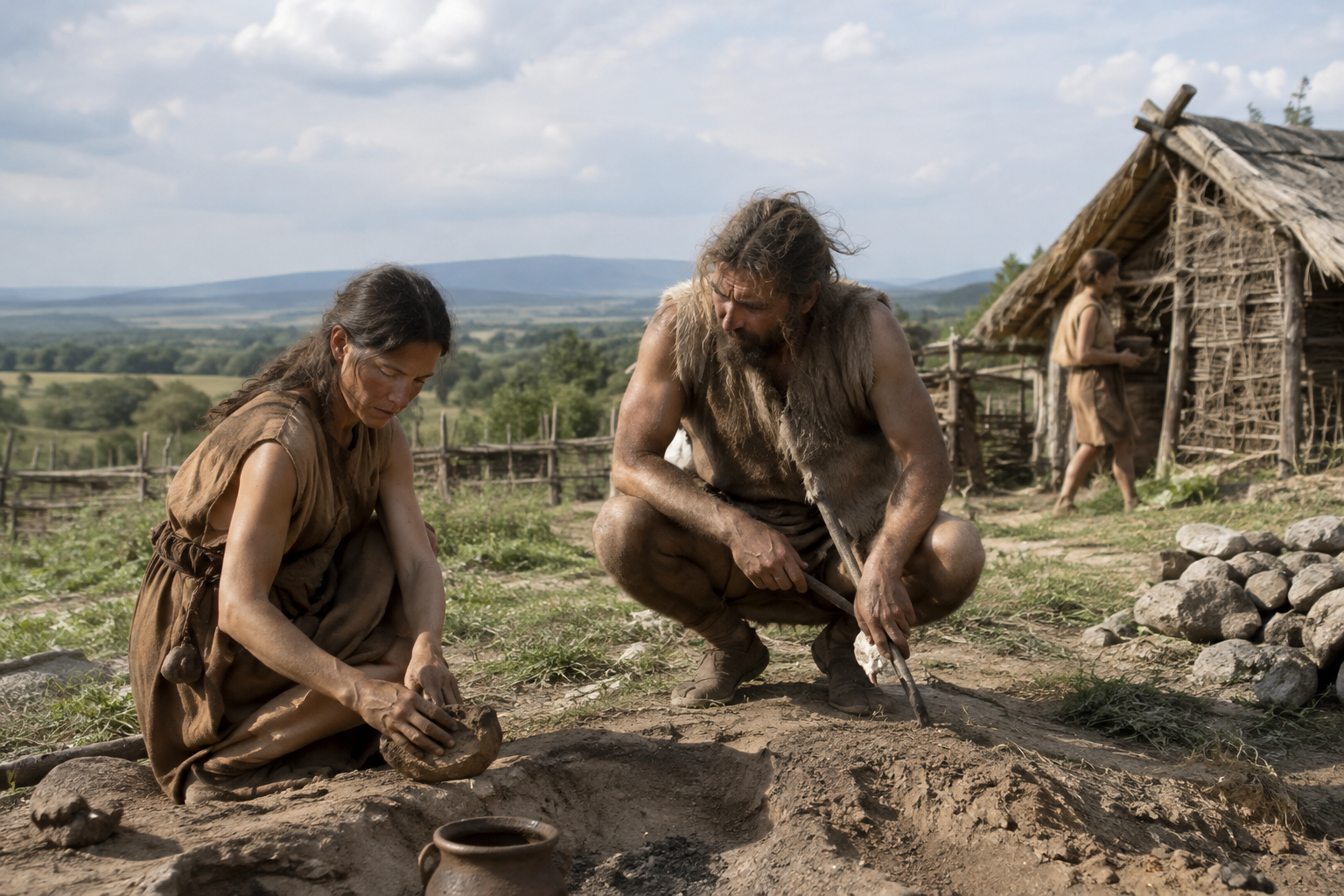
At Unterhautzenthal in Lower Austria, two men buried around 1900 BC carry the clue that makes haplogroup here worth pausing over. They are known in the ancient DNA record as UZH040 and UZH042, both assigned to Bronze Age Austria, both from the same site, and both pointing to the same paternal branch under discussion here. Even with such spare labels, the pattern is telling: this is not a lone, exotic outlier, but a repeated male line turning up in one Early Bronze Age community north of the Danube.
That matters because Y-DNA follows one very narrow thread, the direct paternal line from father to son. It does not describe a person's whole ancestry, still less an entire people. But when the same branch appears more than once at one archaeological site, it gives us a firmer footing for asking how male kinship, local continuity, and community structure worked in Bronze Age Central Europe.
Unterhautzenthal sits in a landscape that was anything but peripheral in the early second millennium BC. Lower Austria lay within a corridor linking the Carpathian Basin, the Alpine forelands, and the middle Danube. By 1900 BC, communities here were part of a world of farming, stock-raising, exchange, and burial traditions that connected villages across a surprisingly wide zone.
Within that setting, UZH040 and UZH042 are useful precisely because they are modest pieces of evidence. We are not dealing with a named king or a richly narrated grave. We are dealing with two ancient men from the same Bronze Age site whose paternal lines both fall into haplogroup here. The value of that is archaeological rather than romantic: repeated occurrence at one place suggests this lineage was embedded in the ordinary social fabric of the settlement or cemetery.
The broader genetic picture from Bronze Age Austria has increasingly shown that cemeteries can preserve local family structure as well as wider regional connections. That makes sites like Unterhautzenthal particularly helpful for anyone trying to understand how a paternal lineage could be both local and mobile at once: rooted in a community, yet part of larger networks of marriage and exchange.
It is tempting to turn two matching Y-lines into a tidy story about a ruling clan, a patriarch, or a single household. Archaeology is rarely so obliging. The presence of UZH040 and UZH042 in the same site does not by itself prove that they were close relatives, buried together, or socially dominant. Ancient cemeteries often contain men who shared a paternal line at different degrees of relatedness, from brothers and cousins to much more distant male kin.
Still, the duplication is meaningful. A single sample can always be dismissed as chance; two from the same place begin to suggest local persistence. In practical terms, haplogroup here was present in the male population of this Bronze Age Austrian community, and present more than once. For people researching the lineage today, that places it securely in Central Europe by the early Bronze Age, at least in the context represented by Unterhautzenthal.
This is exactly the sort of evidence ancient DNA has made newly visible. Earlier archaeology could map pottery styles, burial customs, and exchange routes, but paternal lineages had to remain largely invisible. Now even a small cluster of male burials can hint at how descent and place were linked.
By 1900 BC, Central Europe had already lived through enormous change. The Neolithic had brought farming, and later millennia saw fresh movements of people and the spread of new cultural practices from the steppe and from neighboring European regions. The early Bronze Age in Austria belongs to the aftermath of those transformations, when local communities were no longer simply receiving change from outside but developing long-standing regional identities of their own.
That is where a lineage such as here becomes historically interesting. Rather than imagining one dramatic migration attached to one haplogroup, it is often better to picture generations of men living in settled farming societies, marrying across local and regional networks, and leaving behind cemeteries that capture only fragments of that history. In this case, the fragment comes from two men at Unterhautzenthal whose shared paternal branch suggests continuity inside a real community rather than a passing intrusion.
Research on ancient kinship and mobility in nearby parts of Lower Austria has been especially useful in showing how burial grounds could combine local family continuity with wider marriage links. That broader context helps make sense of why repeated Y-lineages matter without forcing them into a simplistic tale of invasion or ethnic replacement.
One reason Austrian Bronze Age cemeteries have drawn such close attention in recent research is that they do more than preserve ancestry. They also preserve evidence for health, mortality, and the biological pressures that shaped prehistoric life. A study connected with early Bronze Age Austrian graves, including the wider cultural setting of such burials, can be found here. Without stretching its conclusions beyond the evidence, it reminds us that these burial grounds belong to a period when communities were also facing infectious disease as part of everyday historical reality.
That wider context is important for reading UZH040 and UZH042 properly. Ancient men in a cemetery are not just data points for migration maps. They belonged to communities that farmed, married, buried their dead, and coped with risk. The same graves that preserve a paternal lineage may also belong to a society dealing with demographic shocks, long-distance contacts, and the ordinary fragility of Bronze Age life.
There are articles where the most exciting thing is a spectacular object or a famous dynasty. This is not one of them. The strength of the evidence here lies in repetition at a specific place: UZH040 and UZH042, both from Bronze Age Unterhautzenthal, both around 1900 BC, both associated with haplogroup here. In archaeological terms, that is a small but solid cluster.
Clusters matter because they anchor a lineage in time and place. They show that the branch was not merely somewhere in prehistoric Europe in a vague sense, but present in one documented community in Bronze Age Austria. For descendants exploring the same haplogroup today, that does not create a direct pedigree to these two men. What it does provide is something more disciplined and, in many ways, more interesting: a real glimpse of the kind of world in which this paternal line was living nearly four thousand years ago.
Central Europe mobility and burials
The most distinctive thing we can responsibly say about haplogroup here from the evidence at hand is that it appears more than once in an Early Bronze Age community at Unterhautzenthal in Austria. That repeated presence makes it a historically grounded lineage in Central Europe by around 1900 BC, not just a modern test result floating free of context. For someone tracing a paternal line today, that is the real value of ancient DNA: not a fantasy of certain descent from famous people, but a documented connection to the everyday human landscapes where your direct male line once existed.






Comments