Haplogroup H3b
– 5 min read


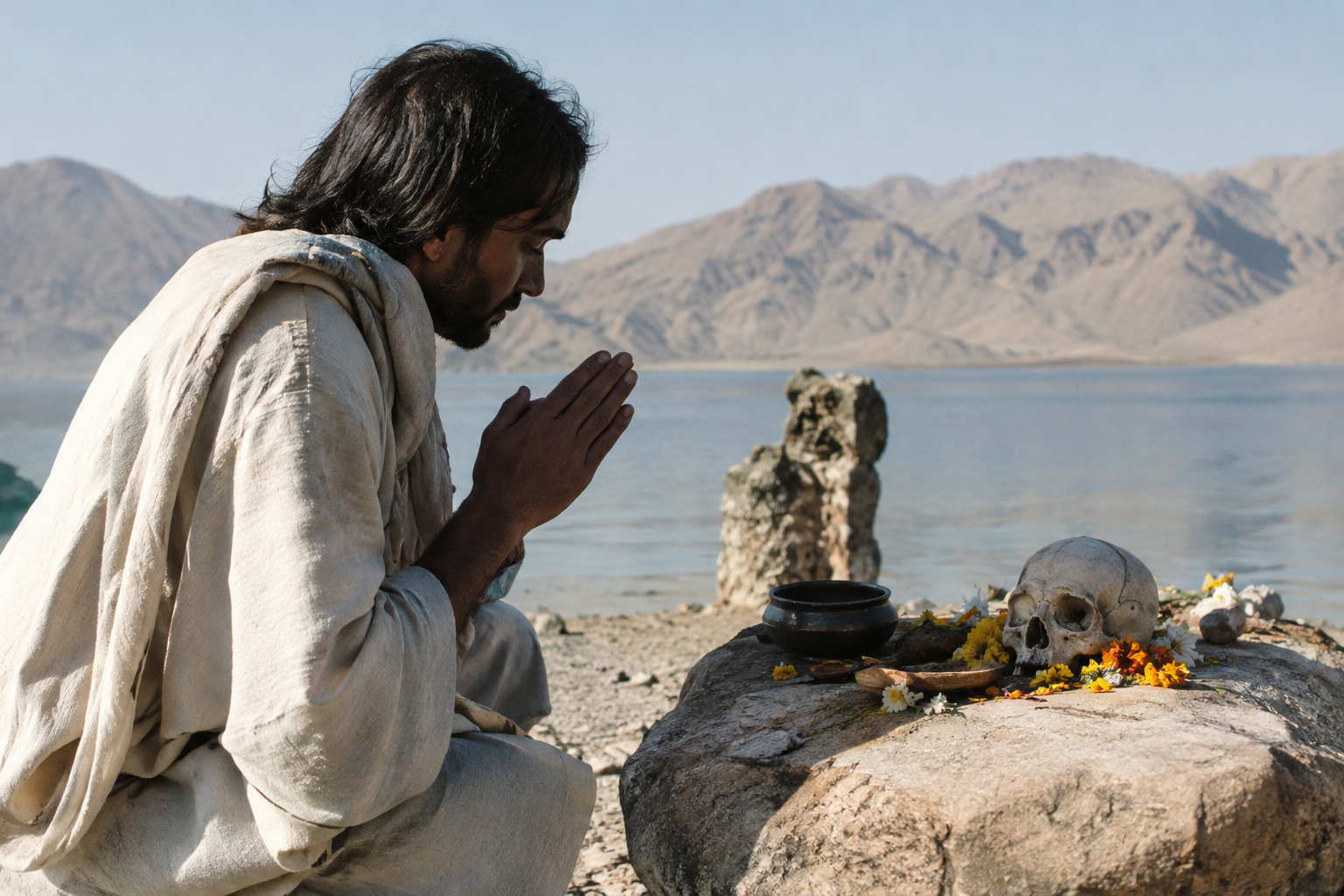
One of the more arresting clues for the haplogroup H3b comes from an individual labelled I3402, described as a "Skeleton Lake Sindhi Worshipper" and dated to around AD 830. Even without romantic embroidery, that is already enough to stop us in our tracks. A man carrying a paternal line associated with H3b appears in the early medieval world of the northwestern Indian subcontinent, in a setting tied to worship and ritual rather than kingship or conquest.
That matters because Y-DNA is a very particular kind of evidence. It tracks one direct paternal line only: father to son to son across generations. It does not sum up a person's whole ancestry, language, religion, or social identity. But when a branch like H3b turns up in an excavated ancient individual, it gives us something rare and concrete: a documented point on the map where that paternal line was undeniably present in the past.
The sample I3402 is the centerpiece here because it gives H3b an archaeological foothold. The date, around AD 830, places this individual in the early medieval period, when Sindh stood at a crossroads of South Asian, Iranian, and Indian Ocean connections. By that time, the region had already seen centuries of movement in traders, pilgrims, soldiers, and farming communities, and it was also shaped by shifting political powers after the early Islamic conquest of Sindh in the 8th century.
The description "Sindhi Worshipper" is intriguing precisely because it suggests a ritual or religious context, but we must be careful not to turn that into a novel. It does not automatically tell us which religious tradition he followed, what sort of burial he received, or how he understood his own identity. What it does tell us is simpler and better: a man in early medieval Sindh carried a paternal line reported here as H3b, and that places the lineage within a real human community rather than in an abstract haplogroup tree.
A broader ancient DNA study of South and Central Asian populations has helped show just how layered this region's past was, with ancestry streams meeting over very long periods rather than arriving in one neat wave. That wider context is important for thinking about H3b as part of the historical population background of the subcontinent rather than as a marker of one single episode or ethnic label. See the research here: https://www.ncbi.nlm.nih.gov/pmc/articles/PMC6702210/.
H3b belongs to the wider Y-chromosome haplogroup H, a deep paternal lineage with strong roots in South Asia. That much is broadly established. But one of the common traps in popular DNA storytelling is to take what is true of a very large parent haplogroup and paste it onto a much narrower branch. We should resist that.
For this article, the evidence is modest and specific. We have an early medieval individual, I3402, associated with H3b. That allows us to say H3b was present in Sindh by around the 9th century AD. It does not allow us to declare a precise place of origin for H3b itself, or to assign all modern bearers of H3b to one people, caste, language group, or historical migration.
Still, there is something historically useful in even this modest evidence. Haplogroup H branches are often under-discussed in grand Eurasian narratives, which tend to be dominated by later steppe expansions or imperial lineages. A sample like I3402 is a reminder that South Asian paternal diversity has its own depth and continuity, and that local lineages remained part of the story even in periods of intense contact and political change.
Early medieval Sindh was not some sealed-off corner of the world. It sat on routes linking the Indus basin to Gujarat, the Arabian Sea, southern Iran, and farther inland toward Afghanistan. Long before and long after AD 830, this was a region where merchants, migrants, monks, and rulers moved through landscapes already densely inhabited by local communities.
That is exactly why a paternal lineage such as H3b is interesting here. Its appearance in I3402 does not scream "outsider" or "elite founder." Quite the opposite: it may fit a picture in which older South Asian male lines persisted within changing religious and political worlds. The archaeology of the subcontinent repeatedly shows cultural transformation without simple population replacement, and genetics often points the same way.
If you are interested in how ancient DNA is starting to illuminate Iranian and adjoining regional histories as well, this related article offers a nearby comparative perspective:
There is a tendency to think one sample is too little to say anything useful. In one sense, that is right: one man cannot stand for all of Sindh, still less for all carriers of H3b. But in archaeology, a securely identified individual can be enormously valuable, because he fixes a lineage in time and place. Before that, we may only have modern distributions and statistical inference. After that, we have a dated human presence.
Sample I3402 therefore acts rather like a pin in the historical map. It shows that by the early medieval period, H3b was part of the paternal landscape of Sindh. Future ancient DNA work may yet reveal the branch in earlier contexts - perhaps in Iron Age, Late Antique, or even Bronze Age layers of the northwestern subcontinent. For now, though, responsible storytelling means staying close to what is actually documented.
This is also where archaeology improves genealogy. Modern testers often want a single sweeping answer: "What people were my ancestors?" Ancient DNA usually gives a more interesting one. It shows communities forming and reforming over centuries, with continuity in some lines, movement in others, and social identities that do not map neatly onto one chromosome.
When people see a haplogroup result, they understandably want a grand migration story attached to it. Sometimes the evidence allows that. Sometimes it does not. With H3b, the safest historical reading is that we are looking at a branch within a deeply South Asian paternal framework, documented in at least one early medieval individual from Sindh.
That is not a small finding. The Indus region has been a hinge between worlds for millennia, yet its local populations were never just passive recipients of outside influence. A lineage such as H3b may represent exactly that kind of long local persistence: fathers and sons living through the rise and fall of states, through new religions, new trade patterns, and new ruling powers, while the paternal line itself continued quietly onward.
For readers interested in how DNA studies are expanding our understanding of the subcontinent across much longer time depths, this overview is a useful companion:
What makes H3b distinctive here is not a parade of royal pedigrees or a dramatic conquest tale. It is the quieter solidity of one documented ancient man, I3402, in early medieval Sindh. For someone researching this paternal line today, that is a meaningful clue: H3b belongs in the historical fabric of South Asia, and at least one bearer is archaeologically visible in the Indus world around AD 830. That is exactly the sort of small, durable fact from which better family history can grow.




Comments