Haplogroup H2a1a

– 5 min read


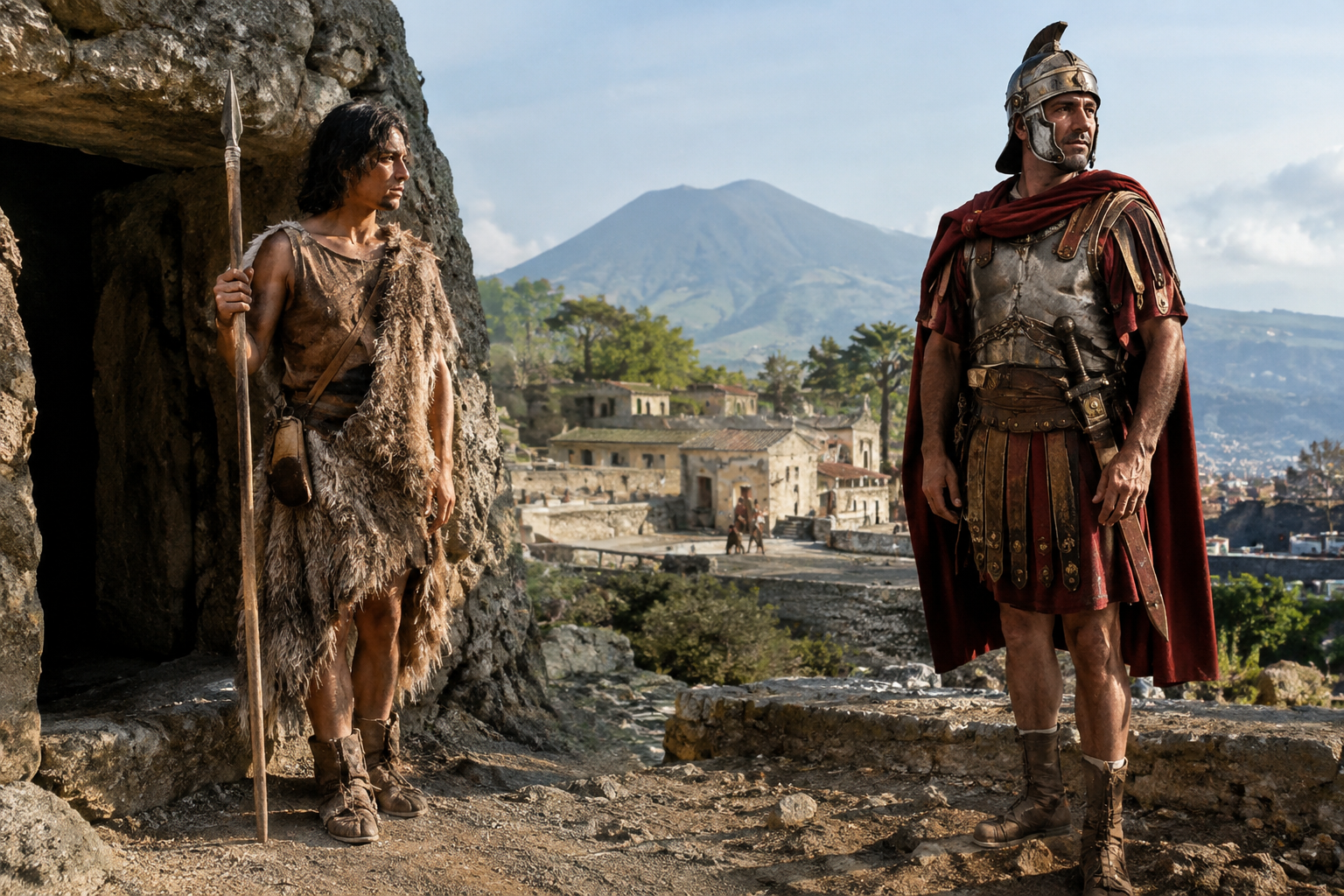
In the chalklands of northern France, the burial complex known as Mon-Aime hypogee II preserves a small but important clue to one of Europe's older paternal lineages. One of the men buried there, sample 2H07, is dated to around 3235 BC. He is associated with H2a1a, a branch of Y-DNA that appears in the archaeological record of early farming Europe and is now far rarer than the lineages that later came to dominate much of the continent.
That is what makes H2a1a so interesting. It does not announce itself through imperial dynasties or famous battlefields. Instead, it turns up in the quieter places archaeologists know well: collective tombs, village cemeteries, and the layered landscapes of early agriculture. Y-DNA follows one direct paternal line only, not a person's whole ancestry, but it can still reveal something precise: which male lines endured, which faded, and which survived by slipping through great historical changes almost unnoticed.
Mon-Aime belongs to the long tradition of collective burial in Neolithic and Chalcolithic France. These hypogea, cut into the ground and reused over time, were not casual graves. They were durable places of memory, where communities returned to bury their dead and, in a sense, to define themselves through shared ancestry and shared land.
Within that setting, 2H07 matters because H2 lineages are strongly associated with the spread and establishment of early farmers in Europe. The precise branch here is H2a1a, but the wider significance lies in the parent lineage as well: H2 has repeatedly appeared in Neolithic contexts, especially in western and central Europe, making it part of the paternal story of the first agricultural societies after farming expanded out of the Near East and through the Mediterranean and Danubian worlds.
A study of ancient populations in Neolithic France has helped sharpen that picture, showing how burial monuments, regional communities, and ancestry patterns can be studied together rather than as separate stories. For readers interested in that broader setting, MyTrueAncestry has also explored Neolithic France and Cerny-related ancestry in more detail.
It would be wrong to turn a single man from Mon-Aime into a mascot for all Neolithic France. Still, his presence is a useful reminder that the male landscape of that period was different from later Europe. Many paternal lines visible in early farming communities did not remain equally common after the demographic upheavals of the 3rd millennium BC. H2a1a belongs to that earlier layer.
When geneticists discuss H2 in ancient Europe, they are usually dealing with a lineage that appears far more often in the Neolithic than it does today. That alone makes it historically revealing. Modern frequencies can mislead us into imagining the past as a simple prelude to the present, but ancient DNA keeps showing that some once-visible male lines later contracted dramatically.
For H2a1a, caution is important. We should not automatically assign to this narrow branch every migration or distribution pattern proposed for the broader H2 family. But the available pattern is still suggestive: H2a1a sits within a paternal lineage repeatedly linked to early European farming populations, especially before the large-scale arrival and expansion of later Bronze Age-associated Y-chromosome branches in many regions.
In practical terms, that means a modern tester with H2a1a may be looking at a paternal line with very deep roots in the agricultural world of prehistoric Europe. Not a tribe, not a language, not a complete identity - but a surviving thread from that older male landscape.
The second supplied sample is striking for a different reason. R118, dated to around 500 AD, comes from Roman Mix San Ercolano. Even without embellishing the burial context beyond what is securely given, the chronological contrast is enough to make the point. Between 2H07 in later Neolithic France and R118 in Late Antique Italy stretches nearly four millennia of European history.
That is precisely why R118 is valuable. H2a1a is not appearing only in an early farming tomb and then vanishing from view. It is still present in a Roman-period or post-Roman world shaped by empire, mobility, local continuity, and regional reshuffling. By about AD 500, Italy was no longer simply "Roman" in the old imperial sense. It was a landscape of continuity and disruption at once, where old local families, newcomers, soldiers, laborers, and rural communities all formed part of the human picture.
Research on ancient Italy has increasingly shown that Roman and post-Roman populations cannot be reduced to one neat type. Regional burial sites often reveal a mixture of continuity and change rather than clean replacement. That makes a sample like R118 useful not because it proves one grand migration, but because it shows that this paternal line could still be carried into the Late Antique Mediterranean world.
If we place these two samples side by side, the most interesting feature of H2a1a is not abundance but persistence. At Mon-Aime, the lineage belongs to a world of communal burial and established farming societies in prehistoric France. At San Ercolano, it appears in a completely different social and political landscape: the long aftermath of Roman rule.
That does not mean there was a straight, documented genealogical line from one site to the other. Archaeology and genetics rarely give us that kind of tidy story across thousands of years. What they do show is that a paternal branch associated with Europe's early farmers did not simply disappear when later demographic events transformed the continent. In some places and families, it endured.
This is one of the most useful correctives offered by ancient DNA. European history was not a single replacement event followed by uniformity. Different lineages expanded, contracted, lingered locally, or reappeared in later cemeteries in ways that only burial-by-burial evidence can reveal. A major ancient DNA study on prehistoric populations across Europe, published in Science, helped establish just how dramatic some of those long-term population shifts were, especially across the later Neolithic and Bronze Age. Against that background, the survival of an H2a1a line into Late Antiquity becomes more, not less, interesting.
It is tempting to turn two points on a map into a migration arrow. France in the 4th millennium BC; Italy around AD 500; surely there must be a neat route between them. But the real lesson is subtler. These finds show H2a1a in western Europe and later southern Europe, across very different archaeological settings, without giving us license to invent a single family saga crossing the ages.
What they do support is a broader historical reading. H2a1a belongs to a paternal background that was present in the Neolithic west, and at least some branches of that background remained part of Europe's population structure long after the first farmers' world had been transformed. That matters especially for people whose modern results seem rare or disconnected from today's dominant Y-DNA patterns. Rare does not mean recent, and unusual does not mean rootless.
The French context also fits well with a wider body of work on Neolithic burial communities and population change in the Paris Basin and neighboring regions. Even where exact subclade resolution varies from sample to sample, the repeated appearance of H2-related lines in early farming settings remains one of the clearer paternal patterns in European archaeogenetics.
H2a1a is a small branch with a large historical backdrop. Its current rarity makes ancient examples especially valuable, and the two samples here point to something distinctive: a paternal lineage visible in Europe's farming past and still present in a very different world thousands of years later. If this is your Y-DNA haplogroup, the strongest supported insight is not a promise of one famous ancestor, but a connection to one of the older male strata of European history - one that can be seen in Neolithic France and again in Late Antique Italy.






Comments