Haplogroup H1a1

– 4 min read


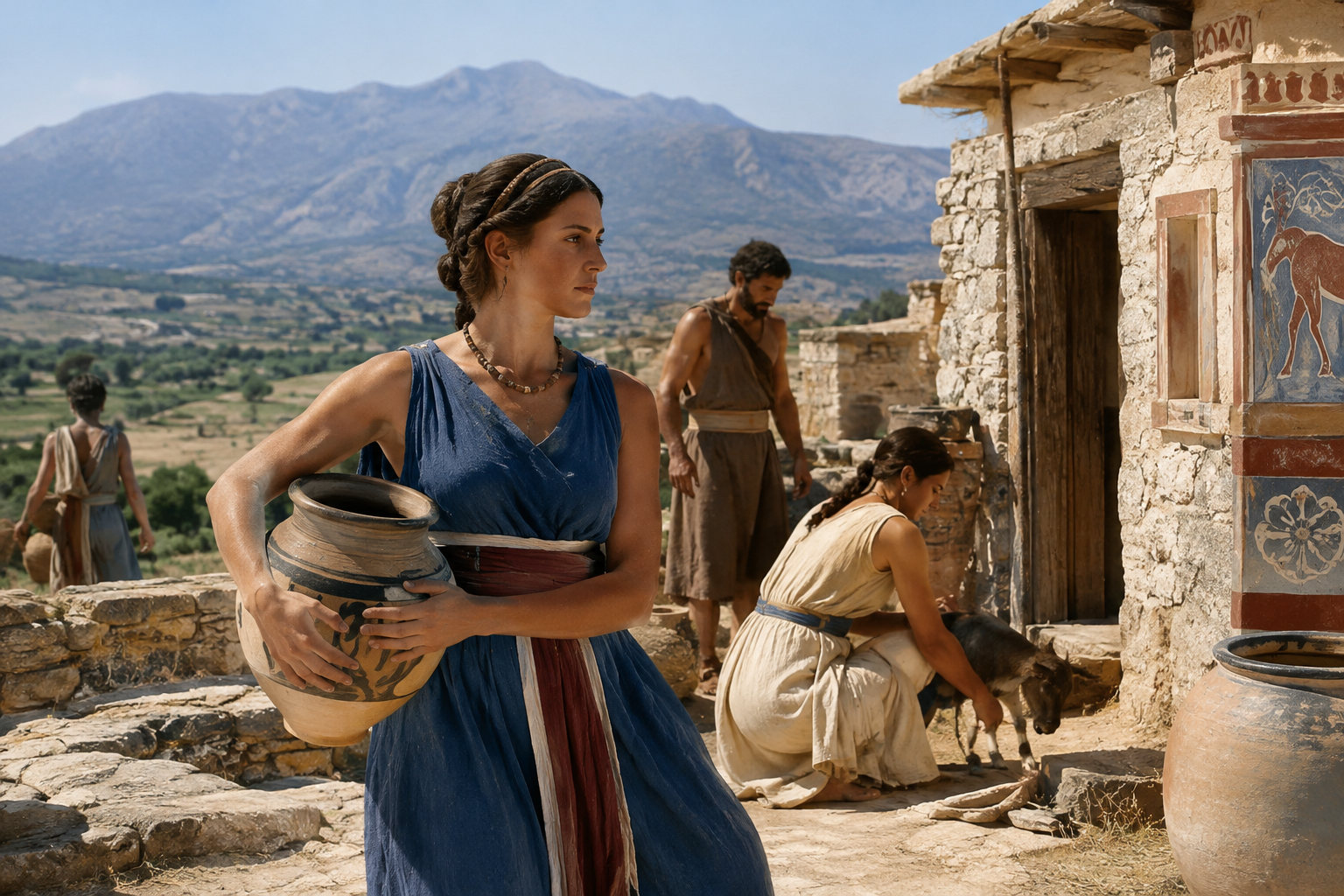
At Krousonas on Crete, one Late Bronze Age male identified as KRO008 offers a small but intriguing glimpse into the paternal history behind haplogroup H1a1. He lived around 1240 BC, in the last centuries of the Minoan world, when Crete was still tied into the wider Aegean but had already passed through enormous political and cultural change. That matters because H1a1 is not one of the Y-DNA branches most people expect to meet in Bronze Age Greece.
The interest here lies precisely in that surprise. A Y-chromosome haplogroup traces one direct paternal line only, not a person's whole ancestry, but even a single securely placed ancient man can sharpen the picture. In the case of KRO008, the question is not whether one lineage can explain Minoan society. It plainly cannot. The question is what it means to find a branch associated with H1a1 in a Late Bronze Age Cretan context at all.
Krousonas lies inland on Crete, away from the better-known palace sites that dominate popular imagination. By about 1240 BC, the island was living in the long aftermath of the Neopalatial and Postpalatial periods, and the old story of "the Minoans" had already become more complicated than the frescoes of Knossos suggest. Communities persisted, adapted, and buried their dead within local traditions that were part of a changing eastern Mediterranean world.
KRO008 belongs to that later horizon. With only one named ancient sample here, we should be careful: this is evidence for one paternal line in one man from one site, not for the entire island. But archaeology often advances through exactly such stubbornly specific finds. A lineage like H1a1 appearing in Late Bronze Age Crete reminds us that the island's population was never genetically monolithic.
An ancient DNA study of prehistoric Aegean populations, including material relevant to Bronze Age Crete, has helped show how much local continuity and outside connection coexisted in the region. The broader research frame can be followed in this scientific study, which places Aegean populations into a larger genetic discussion rather than treating them as isolated museum pieces.
H1a1 is a branch within the wider Y-DNA haplogroup H, a lineage with deep roots outside the standard north-European paternal story that often dominates consumer genealogy. That does not mean every ancient carrier followed the same route into the Mediterranean, nor does it allow us to assign a neat ethnic label to KRO008. Ancient populations did not march about wearing their haplogroups on their tunics.
What we can say is narrower and more useful. The presence of H1a1 in a Late Bronze Age man from Crete shows that paternal diversity in the Aegean included lineages that are easy to overlook if one relies only on famous elite sites or on modern national categories. Bronze Age islands were not sealed containers. They were places of contact, marriage, movement, and local survival over long stretches of time.
That is also why the exact level of assignment matters. Here the article's focus is H1a1 as reported for this ancient individual; we should not inflate that into claims about every branch of haplogroup H, still less into a grand theory of Minoan origins. One sample anchors a possibility. It does not settle an entire migration debate.
Late Bronze Age Crete is often narrated as an epilogue, as though the real excitement ended with the great palaces. In fact, the later period may be even more revealing for population history. After the height of palatial power, local communities had to negotiate changing networks across the Aegean, the eastern Mediterranean, and mainland Greece. This is exactly the sort of world in which an unexpected paternal lineage can appear without fanfare.
For historians, that is a useful corrective. We are tempted to make ancient islands too tidy: Minoan equals one people, one culture, one biological story. But the archaeology of Crete has long shown regional variation, shifting burial customs, and uneven political control. Genetics now adds another layer, not by replacing archaeology, but by showing that the men buried in these landscapes did not all belong to one narrow paternal profile.
If you want a wider view of how early farming, kinship, and population mixture shaped this region before and during later Aegean history, the broader background is well paired with MyTrueAncestry's piece on the Neolithic roots of the area.
It is perfectly fair to ask whether one sample is enough to build a story around. In one sense, no: KRO008 cannot stand in for all Cretans, all Minoans, or all bearers of H1a1. But in another sense, yes: archaeology is full of cases where a single burial forces us to stop repeating oversimplified narratives.
KRO008 does that because he sits at the intersection of three important histories. First, he belongs to Crete, one of the best-known archaeological islands in the world. Second, he belongs to the Late Bronze Age, a period of upheaval and reorganization. Third, he carries a paternal branch that broadens the range of lineages documented in the ancient Aegean. Those three facts together make him more than a stray datapoint.
They also fit a pattern seen across many ancient DNA studies: local populations often contain more paternal variety than later historical myths would lead us to expect. That does not diminish the distinctiveness of Minoan Crete. If anything, it makes the island more historically real - populated by actual communities shaped by both inheritance and contact.
Ancient Greek Genetic Connections
The eastern Mediterranean in the second millennium BC was densely connected. Ships, goods, technologies, and people moved between islands and coasts with a frequency that can be hard to appreciate if we imagine the ancient world as a patchwork of isolated cultures. Crete sat inside that maritime system. So while H1a1 may feel unusual in a Greek Bronze Age context, unusual does not mean implausible. It means the evidence is nudging us to keep the map open.
That broader point has parallels elsewhere in MyTrueAncestry's coverage of Mediterranean population history, especially where archaeology and genetics together reveal continuity mixed with outside influence rather than simple replacement.
For members exploring H1a1, KRO008 from Krousonas offers a grounded ancient reference point: a man living on Crete around 1240 BC, in the complicated later life of the Bronze Age Aegean. The strongest lesson is not that H1a1 was "the Minoan lineage", because the evidence does not say that. It is that this paternal branch was present in an Aegean community at a historically important moment, and that your direct male line may belong to a deeper and more geographically varied past than modern labels suggest.
Comments