Haplogroup G2b2

– 5 min read


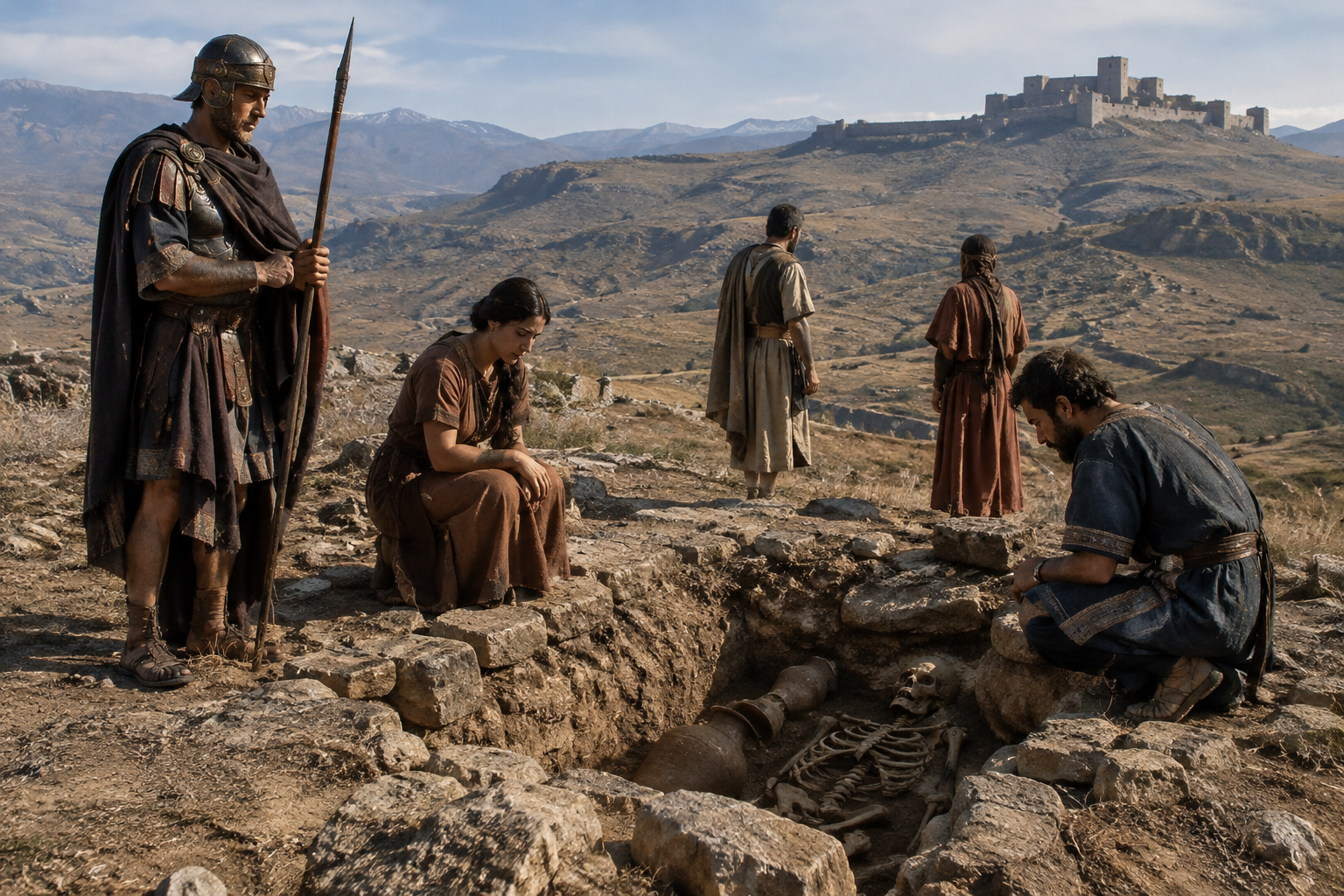
At Teishebaini in Armenia, ancient DNA has now put a paternal label on men who lived at the edge of a hard-driven Iron Age kingdom. Two individuals from the necropolis there, dated around 1030 BC and 985 BC and identified as I3938 and I3944, are associated here with Y-DNA haplogroup G2b2. A third man from the same wider site, I3892, belongs to the Urartian world at about 850 BC. That is a striking cluster, because it places this paternal line not in a vague map of "ancient Eurasia", but in one specific landscape: the Armenian highlands during the centuries when fortified centers, shifting frontiers, and new states were transforming the South Caucasus.
That matters because Y-DNA follows one direct paternal line only, not a person's whole ancestry. Even so, when the same branch appears more than once at the same site and then turns up again much later in a different historical setting, it gives us something much better than a slogan. It gives us a trail of men, places, and periods in which G2b2 can be discussed as part of real archaeology.
Teishebaini, often linked with Karmir Blur near modern Yerevan, is best known as a major Urartian fortress, but the sample list here is useful precisely because it spans more than one moment. I3938 and I3944 come from the Early Iron Age necropolis of Teishebaini, with dates before the classical florescence of the Urartian kingdom. Then I3892 appears in the Urartian Kingdom horizon itself, around 850 BC. The simplest reading is not that one paternal line "built Urartu", but that G2b2 was present in this region across a period of political consolidation.
The archaeological importance of that continuity is considerable. The South Caucasus was no backwater in the Early Iron Age. It sat between Anatolia, northern Mesopotamia, the Iranian plateau, and the steppe zones to the north. Men carrying the same paternal branch could therefore belong to populations shaped by local continuity, regional interaction, or both. A broad ancient DNA synthesis on the South Caucasus and neighboring regions, published in Science, has helped frame just how dynamic this wider zone was over millennia.
One should be careful, though, not to over-polish the picture. These three men are not a dynasty, and the site does not magically become genetically uniform because one haplogroup recurs there. What the pattern does suggest is that G2b2 had a place in the male population of the Armenian highlands during the transition from local Early Iron Age communities into the orbit of an organized territorial kingdom.
G2b2 is a sub-branch within the larger haplogroup G, a lineage with deep roots in West Eurasia and a long association with ancient populations of the Near East and Caucasus. But the wider history of haplogroup G should not simply be pasted onto this narrower branch. With the evidence here, the responsible point is more modest: G2b2 is documented in ancient men from Armenia in the Early Iron Age and Urartian periods, showing that this paternal branch was part of the human landscape of the South Caucasus.
That is especially useful for modern testers because G2b2 is not one of the most frequently discussed western Eurasian Y lineages in popular history. When a rarer branch appears in repeated ancient contexts, the temptation is to make it stand for a tribe, language, or kingdom. Better not. A paternal lineage can pass through people who spoke different languages, served different rulers, and married into quite different communities. The value lies in the documented placements, not in grandiose claims.
The other especially interesting appearance in this small dossier is much later and much farther west: sample I41151, from a Gothic grave at Aquae Calidae in Bulgaria, dated to about AD 350. Now we are in the Roman-era Balkans, in a world of frontier politics, mobile warbands, imperial negotiation, and mixed communities. The label "Gothic grave" is historically meaningful, but it should not be mistaken for a genetic essence. By Late Antiquity, Gothic-associated groups were already heterogeneous, and ancient DNA has repeatedly shown that such communities could include men from quite varied paternal backgrounds.
That is precisely why a G2b2-associated male in this context is so revealing. He is not evidence that "the Goths were G2b2", nor proof of a direct migration from Teishebaini to Aquae Calidae. He does, however, show that this paternal branch could appear within a Gothic-period burial setting in the Balkans centuries after its attested presence in the South Caucasus. That fits the broader historical reality of the Black Sea and Danubian worlds: they were contact zones, not sealed ethnic boxes.
A recent study of Late Antique Bulgaria and Gothic-associated burials, available as a bioRxiv preprint, speaks directly to that mixed and mobile setting. Even without pressing beyond the evidence, the Aquae Calidae sample is enough to remind us that a Y-line can surface in very different historical environments.
Gothic Communities in Bulgaria
Aquae Calidae itself was no obscure hamlet. Known for its thermal springs and long occupation history, it belonged to a region where Roman administration, local Balkan populations, and incoming groups all intersected. By the fourth century AD, this was exactly the sort of place where cultural identity could be visible in burial practice while biological ancestry remained complicated.
That makes I41151 valuable beyond the haplogroup label alone. The sample helps anchor G2b2 in a setting shaped by empire and migration-period interaction, rather than only in the earlier Caucasian evidence. If your paternal line is G2b2, this is the kind of result worth noticing: not because it hands you a neat ethnic badge, but because it places your branch in the messy human realities of Late Antiquity.
For all the attraction of a Gothic-period burial, the real weight of the evidence here still lies in Armenia. Three individuals tied to Teishebaini and its Urartian setting make that site the strongest documented cluster for G2b2 in this article. Clusters matter because they reduce the chance that we are looking at a one-off appearance. They show a paternal branch recurring in one region across successive historical phases.
In practical terms, that gives G2b2 a more credible ancient anchor in the South Caucasus than in the Balkans, where we currently have a single later occurrence in the material provided here. It does not prove origin in a strict sense, but it does make the Armenian highlands an important early theater in the known history of this branch.
On the evidence we have, G2b2 is a paternal line attested in Early Iron Age and Urartian Armenia, and later in a Gothic-associated Roman-era grave in Bulgaria. That is a compact but vivid record: a branch present in the South Caucasus during state formation, then visible again in the diverse societies of the Late Antique Balkans. For someone researching this haplogroup today, the best-supported insight is not a claim to one tribe or kingdom, but a connection to historical zones where Caucasian, Near Eastern, Black Sea, and Balkan worlds met each other face to face.






Comments