Haplogroup G2a2b2b1a

– 4 min read


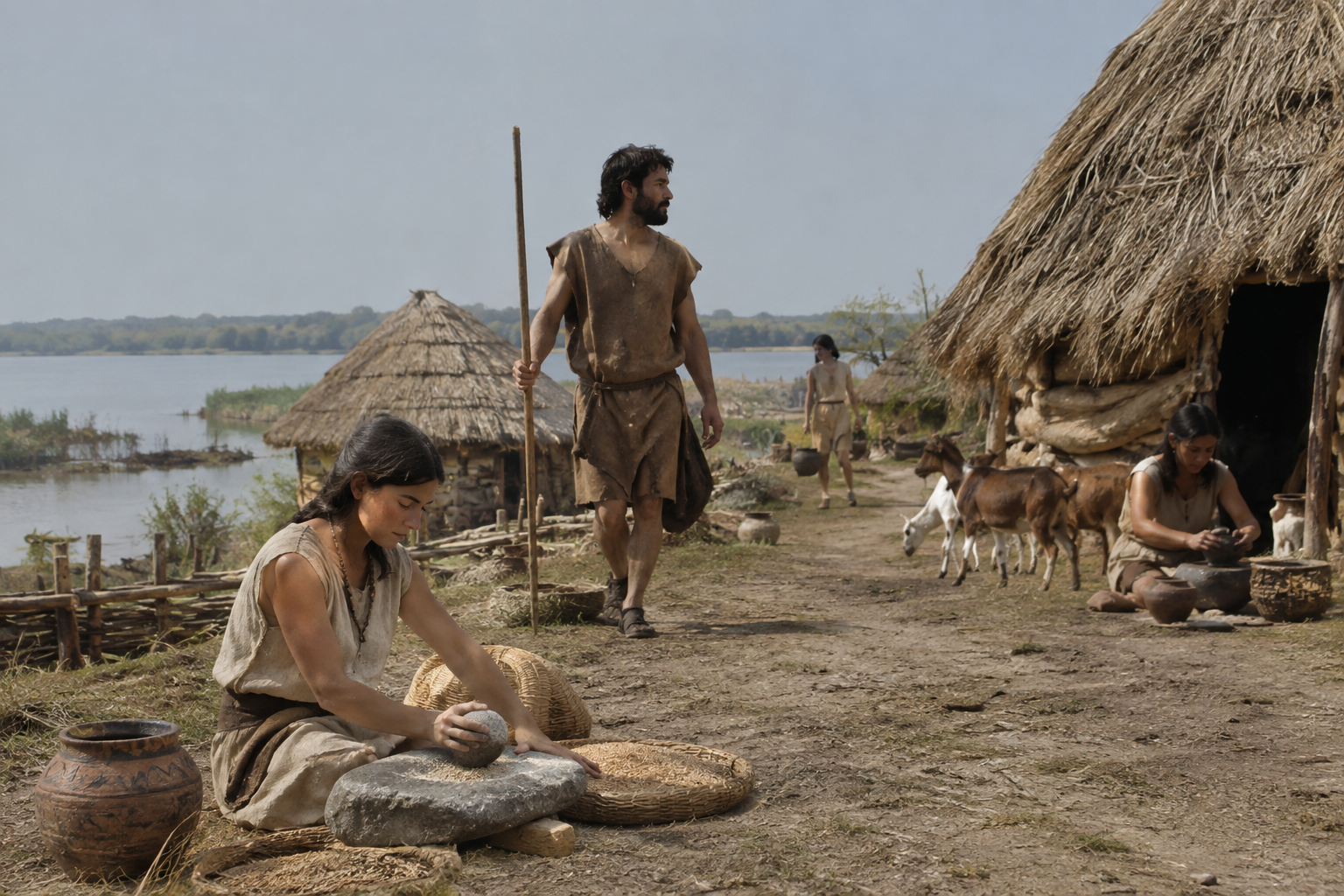
At Lánycsók-Gata-Csátola in southern Hungary, one Early Neolithic man, sample I1880, offers a particularly sharp glimpse into the paternal history of haplogroup G2a2b2b1a. He is dated to around 5650 BC and belongs to the world archaeologists call Starcevo: one of the earliest farming horizons to spread through the Balkans and into the Carpathian Basin.
That matters because G2a lineages turn up again and again among Europe's first farmers. In other words, this is not a stray medieval curiosity or a late local founder effect. With I1880, we are looking at a paternal branch tied to the earliest agricultural communities in this part of Europe, at the moment when farming villages, domesticated animals, and new ways of life were becoming established north of the Balkans.
The site name is a mouthful, but the setting is historically important. Southern Hungary sat in a crucial corridor between southeastern Europe and the wider plains and river routes of Central Europe. When Starcevo communities appeared here in the 6th millennium BC, they were part of the broader Neolithic expansion that carried farming, pottery, and settled village life out of Anatolia and through the Balkans.
Sample I1880 belongs in that movement. The specific Y-DNA label attached here is G2a2b2b1a, a downstream branch within the wider G2a family. It is worth being precise: Y-DNA traces one direct paternal line only, not a person's whole ancestry, language, or identity. But in Neolithic Europe, that one line can still be historically revealing, because G2a branches are so closely associated with early farming populations.
An ancient DNA study of Neolithic populations in this broad region has been central to how scholars reconstructed this shift, and the research lead linked with this sample reflects that scientific context: genetic research connected to ancient individuals from the Carpathian Basin and neighboring regions. Even without forcing more than the evidence allows, I1880 sits firmly inside that first-farmer story.
If this haplogroup looks unfamiliar beside later European Y-DNA lineages, that is because the Neolithic paternal landscape was different from the one many people know from Bronze Age and modern population summaries. Across much of early farming Europe, G2a and its branches appear with striking regularity in male burials. That pattern has made G2a one of the signature Y-chromosome families of Europe's first agricultural settlers.
For G2a2b2b1a specifically, caution is essential. We should not simply project the entire history of all G2a men onto this narrower branch, nor should we claim a single homeland or migration route for it beyond the evidence. What the Hungarian sample does show, however, is that this branch was already present among established Early Neolithic communities in the Carpathian Basin by about 5650 BC.
That is a powerful chronological anchor. It places this paternal line not in the age of Celts, Romans, or medieval dynasties, but in the much earlier world of Europe's agricultural pioneers.
Starcevo is one of those archaeological labels that can sound dry until you pause over what it means. It marks communities living in southeastern and central Europe during the first great spread of farming. These were people building the earliest village-based food-producing societies in regions where, not long before, hunter-gatherer lifeways had dominated.
That context is important for interpreting I1880. He should not be casually folded into later ethnic or linguistic stories just because his remains were found in modern Hungary. In 5650 BC there were no Hungarians, no Indo-European-speaking steppe empires in the later sense, and no written names for the populations involved. The real historical interest lies in something deeper: the formation of Europe's first farming societies and the paternal lines present within them.
Mesolithic to Neolithic Transition
Seen that way, G2a2b2b1a is part of an older European chapter than many readers might expect. It belongs to the age when ancestry was being reshaped not by armies or kingdoms, but by the slow establishment of farms, households, herds, and cultivated land.
The Carpathian Basin was never a sealed box. In prehistory it functioned as a meeting ground and transit zone, open to influences moving from the Balkans, the Danube routes, and later the steppe and Central Europe. For the Early Neolithic, that made southern Hungary an especially revealing place to find lineages like G2a2b2b1a.
The presence of I1880 at Lánycsók-Gata-Csátola suggests continuity with the larger stream of first-farmer expansion into inland Europe. This is exactly why ancient DNA has transformed the field: it lets archaeologists test whether cultural change involved local adoption, incoming populations, or a mixture of both. In the case of the earliest farmers of southeastern and central Europe, the genetic evidence broadly supports substantial movement of people as well as ideas.
That broader pattern has become clearer across many regions, including studies highlighted in MyTrueAncestry's coverage of Neolithic European farmers. I1880 is one man, not a civilization in miniature, but he belongs to a wider and repeatedly documented paternal landscape.
For a modern tester carrying G2a2b2b1a, the most responsible historical takeaway is not a romantic leap to one named tribe or noble line. It is something both older and, in a sense, more consequential: your direct paternal line may connect to the male lineages present among Europe's first settled farming communities.
That does not mean every bearer of the haplogroup descends specifically from I1880, or that all branches followed the same route through prehistory. Later millennia brought enormous change, including population turnover, admixture, and the rise of new dominant Y-DNA lineages in many parts of Europe. But the ancient appearance of this branch in Starcevo Hungary gives it a solid place in the Neolithic story.
Ancient DNA in the Carpathian Basin
The most distinctive thing about G2a2b2b1a, on the evidence here, is its presence in an Early Neolithic man from southern Hungary at around 5650 BC. That places the lineage squarely in the archaeological world of the first farmers who helped transform Europe. If your paternal line belongs to this branch, the clearest historical signal is not a later dynasty or a famous battle, but an older inheritance: the village-based frontier of the Neolithic, when farming life was still new in the heart of the continent.


Comments