Haplogroup G2a2b2a1a1b1a1a2b1a1
– 5 min read


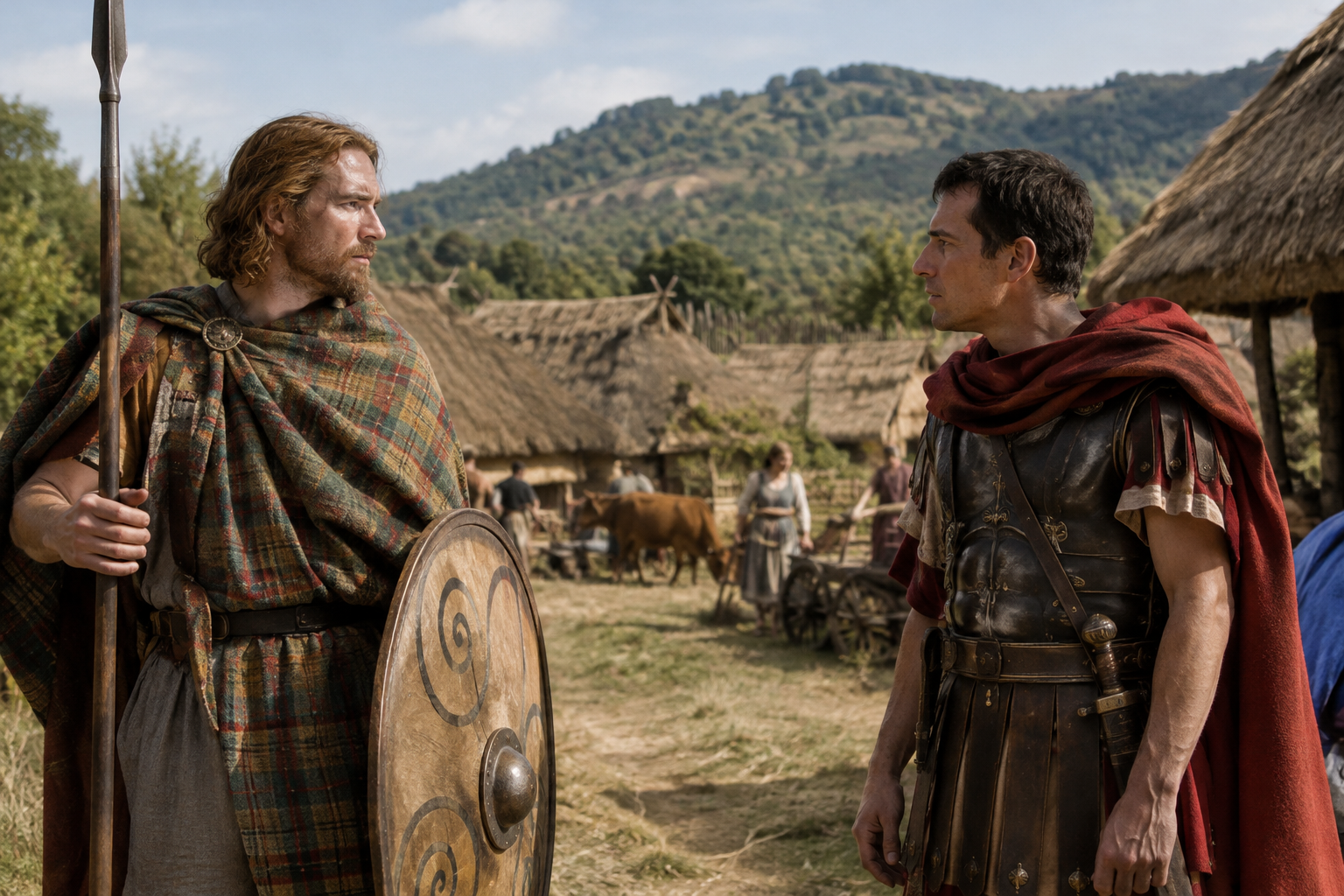
At Les Moidons in eastern France, one ancient male sample offers a very precise little glimpse into the paternal past: CGG023690, dated here to around 600 BC and associated with the Iron Age world of the Sequani region in Gaul. That matters because the Y-DNA line linked to him is the highly specific branch G2a2b2a1a1b1a1a2b1a1, a lineage whose modern testers will usually see only as a string of letters and numbers, but which here appears in a recognisably Celtic landscape of pre-Roman France.
A second appearance comes from Bessan in southern France, at Monderière, where sample BES1249 is dated here to about 100 BC, in the late pre-Roman or early Roman-era horizon. Two finds do not make a dynasty, a tribe, or a whole population. But they do place this paternal branch in ancient France in two different settings, one in Iron Age eastern Gaul and another in Mediterranean southern Gaul, just as the old political world of independent communities was being drawn into Rome's orbit.
Y-DNA tracks a direct paternal line: father to son to son, across many generations. That makes it unusually good for asking whether one narrow male lineage can be spotted in different places and periods, but it does not describe a person's whole ancestry, language, status, or identity. A man carrying G2a2b2a1a1b1a1a2b1a1 might have belonged culturally to a Celtic-speaking community, lived under Roman rule, or married into families of very different genetic backgrounds; the Y chromosome records only one thread in that much larger fabric.
The branch name here is also far narrower than the better-known parent haplogroup G2a. G2a as a whole has a deep history in western Eurasia and is especially familiar to archaeologists because it appears often in early farming populations. That broad background is useful, but it should not be lazily projected onto this exact terminal branch. What the present evidence actually shows is more limited and more interesting: this particular paternal line is attested in later prehistoric and near-Roman France.
Les Moidons lies in the Jura, within the broad region associated in later historical geography with the Sequani. Sample CGG023690, dated here to around 600 BC, belongs to a period before Caesar, before Roman provincial order, and before the surviving written sources become much use for this particular landscape. That is exactly why ancient DNA is so helpful: it gives us evidence from the people themselves, not merely from later observers.
For this sample, the important point is not a dramatic burial story - none is securely provided here - but the combination of date, place, and paternal assignment. An Iron Age man in eastern Gaul associated with this branch shows that G2a2b2a1a1b1a1a2b1a1 was present among communities living in a region that would later be folded into the historical map of Celtic Gaul. This does not mean the lineage was "typically Sequani" or uniquely Celtic. It does mean that by the 1st millennium BC, this branch was part of the male-line diversity of inland France.
A broader ancient DNA study of Celtic-related populations in France is likely tied to recent research on ancient individuals from Gaul. Even without overstating any single paper's conclusions, that kind of work is precisely what is changing the old picture: Iron Age France was not a cartoon of neat tribes with neat bloodlines, but a human landscape of local continuity, contact, and movement.
The second sample, BES1249 from Monderière at Bessan, is dated here to about 100 BC. Bessan sits in a very different part of France from Les Moidons: the Mediterranean south, where indigenous communities, colonial contacts, trade routes, and Roman expansion all overlapped. By this date, southern Gaul was already deeply entangled with the Roman world, even if local identities remained strong.
That is what makes the pairing with CGG023690 so suggestive. The same narrow paternal branch appears not only in inland eastern Gaul around 600 BC, but also several centuries later in the south. We should be careful: this does not prove a direct family connection between the two men, nor a single migration event. But it does show that the lineage was not confined to one tiny pocket. It was present in more than one French region during a period of major historical change.
The Bessan context also reminds us that Y-DNA lineages do not obey our tidy historical labels. A lineage found in a "Celtic" setting can appear again in a Roman-era environment without changing its name or needing a grand tale of replacement. Often the more sober explanation is the better one: male lines persist while political systems, material culture, and self-identification shift around them.
For many readers, haplogroup G immediately evokes Europe's early farmers, because G2a branches are common in Neolithic ancient DNA. That background is real, but what is striking in later periods is survival. By the Iron Age and Roman period, western European male populations included a range of lineages, and some branches that had been prominent in earlier prehistory became less common or more regionally patchy. A later find of a narrow G-derived branch can therefore be historically revealing, not because it is exotic, but because it shows persistence.
In France, persistence matters enormously. The country we now call France sits at the meeting point of Mediterranean routes, Atlantic connections, Rhine corridors, and Alpine approaches. A paternal line turning up in both Jura and Mediterranean Languedoc is a reminder that ancient France was never a sealed ethnic box. It was a zone of accumulation, local survival, and repeated mixing over centuries.
The available evidence here is still modest, and one should resist the temptation to turn two samples into a sweeping origin myth. Yet modest evidence is often how real history begins. Instead of asking whether this branch was "really Celtic" or "really Roman", it is better to ask where and when it can be documented. In this case, the answer is already useful: eastern Gaul in the Iron Age and southern France on the eve of full Roman dominance.
Ancient sample labels can look impersonal, but they anchor the discussion in real archaeological contexts. CGG023690 was not a theory; he was an individual buried in Iron Age France. BES1249 likewise belonged to a man who lived in a southern Gallic world undergoing political and cultural transformation. Their Y chromosomes preserve one direct paternal trail through those different settings.
Research published on ancient populations from Roman and pre-Roman France has increasingly shown that mobility and continuity can exist together. A paper linked to southern French and Roman-period genetic work, available here, fits that broader conversation, even if any one sample still has to be handled with care. Ancient DNA is most valuable when it keeps us close to the evidence and discourages the old habit of reducing entire regions to a single people.
If your paternal line falls under G2a2b2a1a1b1a1a2b1a1, the most distinctive point from the present evidence is not a claim to a famous dynasty or a single ancient tribe. It is that this very specific branch has already been spotted in ancient France in at least two historically meaningful settings: one in Iron Age Gaul, another in a southern community living close to the Roman threshold. That is a small but solid kind of depth. It places your direct male line within the long, complicated human history of Gaul, where older paternal lineages could persist across major cultural change.


Comments