Haplogroup G2a2b2a1a1b1a1a2a1b1a
– 5 min read


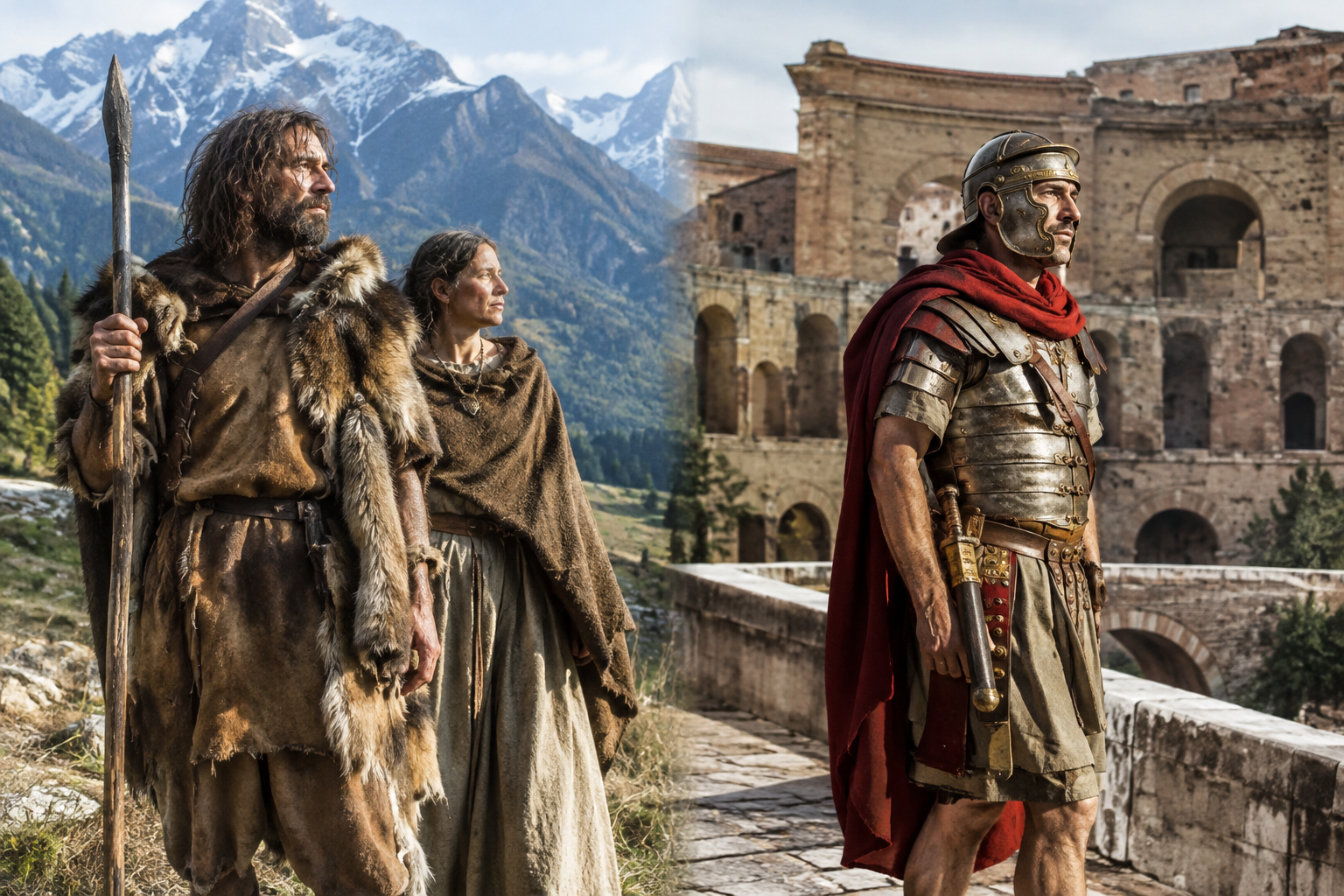
At Stenico Calfer in the Giudicarie area of Trento, one ancient male dated to around 1541 BC, sample STE04, offers a particularly sharp glimpse of haplogroup G2a2b2a1a1b1a1a2a1b1a. That string of letters and numbers is very specific, but the setting is easy to picture in historical terms: the Bronze Age Alps, where communities lived in a landscape of valleys, passes, uplands, and local networks that connected northern Italy to wider European worlds.
What makes STE04 interesting is not that he can stand for all Bronze Age Alpine men; he cannot. It is that this paternal line appears in a place where continuity and movement were both part of life. Y-DNA tracks one direct male line only, not a person's whole ancestry, but even one such line can show how old paternal branches endured inside changing societies.
The wider haplogroup G has a deep history in Europe and western Eurasia, and it is often discussed in connection with early farming populations. But that broad background should not be lazily pasted onto a very narrow terminal branch like G2a2b2a1a1b1a1a2a1b1a. What the evidence here really gives us is something more modest and more valuable: a documented appearance of this paternal line, or a reported association with it, in ancient Italy across very different periods.
In the Alps, that matters because the Bronze Age was not an isolated age of mountain villages cut off from history. Alpine zones were active corridors. Metals, techniques, livestock strategies, and people moved through them. A genetic study of ancient individuals from the region around the Tyrolean Iceman has helped underline just how informative Alpine burials can be for long-term population history, even when each grave only captures one life at one moment in time: https://www.nature.com/articles/s41467-025-61601-8.
So STE04 is best understood not as a lonely curiosity, but as evidence that a paternal lineage associated with this branch was present in Bronze Age Alpine Italy. The important point is survival in context: a male line embedded in a mountain region that was both local and connected.
Trentino in the second millennium BC sat within a complicated world of upland settlement, exchange, and adaptation. Archaeology across the Alpine arc has repeatedly shown that mountain communities were not merely peripheral hangers-on to lowland civilizations. They managed herds, controlled routes, and participated in systems of resource movement that could stretch surprisingly far.
That is why a Y-chromosome result from Stenico Calfer matters. A paternal lineage like G2a2b2a1a1b1a1a2a1b1a in this setting hints at local male continuity within societies already shaped by centuries of interaction. It does not mean every man in the valley belonged to that branch, nor that this one lineage "defined" the Bronze Age Alps. It does mean that beneath the broad archaeological labels, there were real family lines persisting through the everyday business of mountain life.
There is also a useful contrast here with more dramatic migration stories. The Alpine Bronze Age certainly belonged to wider continental changes, but a sample like STE04 reminds us that history was not made only by sweeping replacements. Sometimes the evidence points instead to the endurance of older paternal strands within new social worlds.
The second supplied ancient individual could hardly come from a more different historical stage. Sample R108, dated to around 500 AD and described as Gallo-Roman Mix Crypta Balbi, comes from Rome in Late Antiquity. Now we are no longer in a Bronze Age valley but in one of the great urban centers of the Mediterranean, at a time when the Western Roman Empire had fractured politically but the city still pulled in people, identities, and lineages from many directions.
Crypta Balbi has become one of those invaluable Roman sites where archaeology and biomolecular evidence can talk to one another. Late Antique Rome was not a sealed inheritance from the Republican past; it was a city shaped by imperial mobility, migration, military service, slavery, trade, and resettlement. A reported Gallo-Roman mixed context for R108 fits that broader historical picture of Rome as a place where provincial and metropolitan histories met.
Research on ancient Rome has already shown how dramatically the city's population changed across time, especially under empire, when ancestry linked to the eastern Mediterranean and other regions became increasingly visible. One major ancient DNA study that transformed discussion of Rome's population history is here: https://science.sciencemag.org/content/366/6466/708.
For this haplogroup article, R108 is important because he places the same highly specific paternal branch, or an association reported with it, in a Roman-world context nearly two millennia later than STE04. That does not prove a direct line from one man to the other. But it does show that this paternal branch belonged to historical populations that were not frozen in one place or one cultural identity.
It is tempting to force ancient DNA into a neat arrow: first Alpine, then Roman, therefore a single migration story. Real evidence is messier. STE04 and R108 are separated by time, social world, and archaeological setting. One belongs to Bronze Age Alpine Italy; the other to Late Antique urban Rome with a mixed Gallo-Roman description. That is not a dynasty. It is a pattern of presence.
Still, it is a meaningful pattern. Both samples sit in Italy, but in sharply different Italies: one in a mountainous Bronze Age landscape, the other in a cosmopolitan post-imperial city. For a paternal lineage associated with G2a2b2a1a1b1a1a2a1b1a, that spread suggests durability across changing political orders and regional identities.
There is a broader lesson here about Roman and pre-Roman population history. Italy was never genetically simple. Long before Rome ruled the Mediterranean, the peninsula contained communities with different local histories. Under Roman rule, those differences did not vanish; they were layered with new arrivals, new connections, and new mixtures. A branch that appears in both Bronze Age Trentino and Late Antique Rome sits comfortably inside that long, uneven history.
One of the easiest mistakes in popular ancestry writing is to turn haplogroups into ethnic badges. The evidence here pushes the other way. The same paternal branch can appear in a Bronze Age Alpine individual and in a much later person living in Rome's mixed social world. That is precisely why Y-DNA is historically interesting: it preserves one line of descent through societies that may have changed language, culture, political allegiance, and ancestry profile many times over.
In Italy especially, this is a familiar theme. Prehistoric farmers, Bronze Age communities, Iron Age peoples, Roman citizens, migrants, soldiers, and post-Roman populations all contributed to the human landscape. If your own paternal line falls within G2a2b2a1a1b1a1a2a1b1a, these ancient matches point less to a single "tribe" than to a lineage capable of lasting through very different historical chapters.
With only two ancient individuals, caution is essential. Yet the pairing is unusually revealing. G2a2b2a1a1b1a1a2a1b1a appears here in evidence tied first to Bronze Age Alpine Italy and then to Late Antique Rome, linking a mountain world of local continuity with an urban world of mixture and movement. For someone researching this paternal line today, that is the most responsible takeaway: not a grand claim of identity, but a glimpse of a male lineage that was present in Italy across very different ages and social landscapes.






Comments