Haplogroup G2a2b2a1a1b1a1a2a1b1
– 5 min read


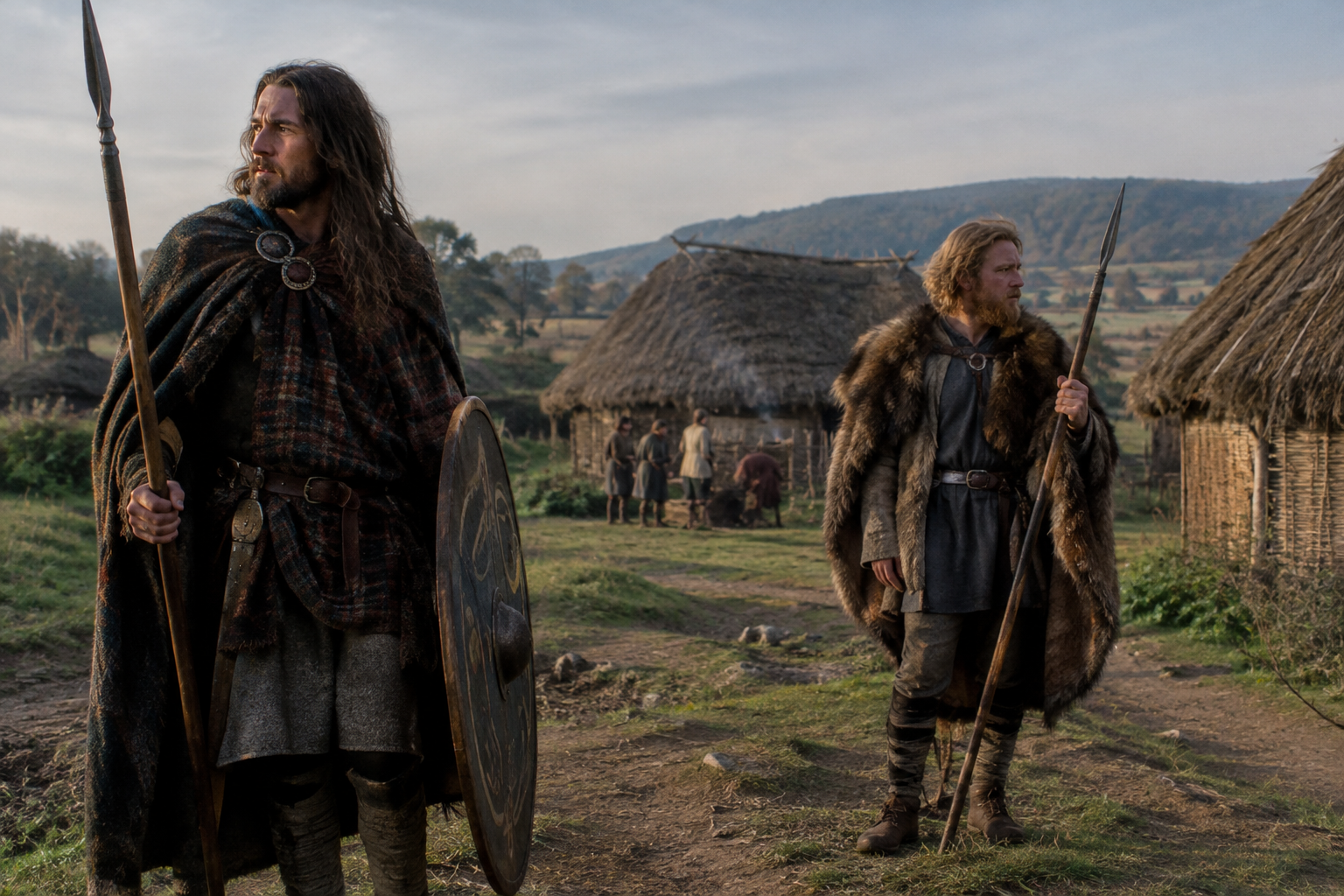
At Les Moidons in Iron Age France, one ancient male dated to around 455 BC, identified as CGG023703, offers a precise little clue from the paternal line: the very specific Y-DNA branch G2a2b2a1a1b1a1a2a1b1. That is a formidable label, but the historical point is simpler. It places one direct male line inside a Celtic world in eastern Gaul at a time when communities were already deeply rooted in local landscapes yet also connected to the wider networks of Iron Age Europe.
A second man, CGG022451 from Bucy-le-Long in France and dated to around 360 BC, appears in a different Gallic setting but within the same broad era. Two men do not define all of Gaul, of course, yet they do make something immediately interesting visible: this branch was present in Iron Age France in more than one place, and in contexts associated with Celtic-speaking populations of the later first millennium BC.
Y-DNA follows one line only: father to son, back through time. That means G2a2b2a1a1b1a1a2a1b1 is not a shorthand for a whole people, a language, or a complete ancestry profile. It is better understood as one thread in a much larger human fabric.
Even so, the thread matters. The wider haplogroup G has deep roots in the ancient history of western Eurasia and appears often in discussions of early farming populations in Europe. But one must be careful here: the presence of a very narrow downstream branch in Iron Age Gaul does not mean we can simply lift the entire story of haplogroup G and paste it onto these two individuals. What we can say, with proper caution, is that a paternal line from that broader family persisted into Celtic France and was still being passed on centuries after the Neolithic world that first made haplogroup G famous in European archaeogenetics.
That longer background makes these French Iron Age examples especially appealing. They hint at continuity, survival, and reshaping rather than simple replacement. A paternal lineage with much older roots could still be living within communities we would describe archaeologically as Celtic.
CGG023703 comes from Les Moidons, in the Jura region of eastern France, a landscape that sat within the cultural orbit of Iron Age Gaul but also close to routes linking the interior of France to the Alps and central Europe. Around the 5th century BC, this was not a remote backwater. It was part of a changing world of fortified sites, regional identities, exchange systems, and evolving burial customs.
Because the sample details here are spare, it would be irresponsible to embroider the burial with invented objects or rituals. But even without that, the result is useful. It shows that this highly specific paternal branch was present among men living in a Celtic cultural setting in eastern Gaul during the middle Iron Age.
That matters because eastern Gaul is one of the places where archaeologists can see both local continuity and long-distance interaction at once. If a branch like G2a2b2a1a1b1a1a2a1b1 appears here, it reminds us that Iron Age populations were not made of a single newly arrived male lineage. They were mixtures of older and newer ancestries, folded into local societies over many generations.
An ancient DNA study on these populations is linked through this research preprint, which is associated with the individuals discussed here. Even without overstating details that are not fully given in the sample summary, the study context reinforces the value of these burials for tracing paternal diversity in Iron Age France.
The second individual, CGG022451 from Bucy-le-Long and dated to around 360 BC, adds something slightly different. Bucy-le-Long lies in northern France, well away from the Jura. So the importance of this sample is not merely that the haplogroup existed once in Gaul, but that it appears again in another region of Iron Age France.
That sort of repetition is often more informative than a single isolated find. Not because it proves a dynasty or close kinship; it does not. But because it suggests that this paternal branch formed part of the real demographic background of at least some Gallic communities across a wider zone.
In historical terms, the 4th century BC was a period when the societies of Gaul were anything but static. Trade, craft production, elite display, conflict, and movement all linked communities to one another and to neighboring regions. A lineage such as G2a2b2a1a1b1a1a2a1b1 could therefore have been maintained locally for generations, spread through ordinary family history, or both. The two samples do not let us choose neatly between those possibilities, but together they do show distribution rather than singularity.
It is tempting to imagine "the Gauls" as though they were a single biological bloc, neatly matching the labels in Greek and Roman texts. Ancient DNA keeps upsetting that tidy picture. Archaeological cultures, political identities, language groups, and paternal lines do not map onto one another one-for-one.
These two French cases sit very comfortably within that more complicated reality. A man in Iron Age Gaul could belong to a Celtic cultural world and yet carry a Y-line with a much deeper and older history than the Iron Age itself. That is not an exception to history; it is history. Populations are built from accretion, marriage, migration, survival, and local adaptation over long periods.
For this reason, the presence of G2a2b2a1a1b1a1a2a1b1 in Gaul is interesting not because it makes the Celtic world somehow less Celtic, but because it shows what Celtic societies actually were: historically layered populations, not biological monoliths. Anyone following a direct paternal line in the present should keep that point firmly in mind.
The broader pattern fits well with other work on Iron Age mobility and social diversity in Celtic Europe. Comparable questions about movement, local continuity, and burial communities appear in MyTrueAncestry's discussion of Late Iron Age mobility and burial practices in Celtic Switzerland.
There is also a methodological lesson here. Many ancient Y-DNA discussions stop at a broad haplogroup label, but your assigned branch is far narrower. That narrowness is valuable because it points to a much more specific paternal lineage than simply saying "haplogroup G". At the same time, it increases the need for caution: the more specific the branch, the less we should casually generalize from wider parent groups unless we have direct evidence.
With CGG023703 and CGG022451, the value lies in securely placing this branch, or an assignment associated with it, in Iron Age France. What we should not do is invent a fully mapped migration route, or claim that every later bearer of this lineage descends from Gaulish elites, or turn two samples into a tribal signature. Ancient DNA is powerful precisely because it lets us avoid those old romantic shortcuts.
The strongest supported insight is quite focused: G2a2b2a1a1b1a1a2a1b1 is attested here in Iron Age France through at least two ancient males, one from Les Moidons around 455 BC and another from Bucy-le-Long around 360 BC. That places this paternal line within the human reality of Celtic Gaul, not as a mythic emblem of an entire people, but as a documented male lineage living there.
For a modern tester, that is already substantial. It suggests that one branch of your direct paternal ancestry may connect, somewhere along its long path, to the varied and historically layered communities of Iron Age France. Not every ancestor, not every identity, and not a guaranteed tribal label - but one real paternal thread, carried by real men in Gaul more than two thousand years ago.






Comments