Haplogroup G2a2b2a1a1b1
– 6 min read


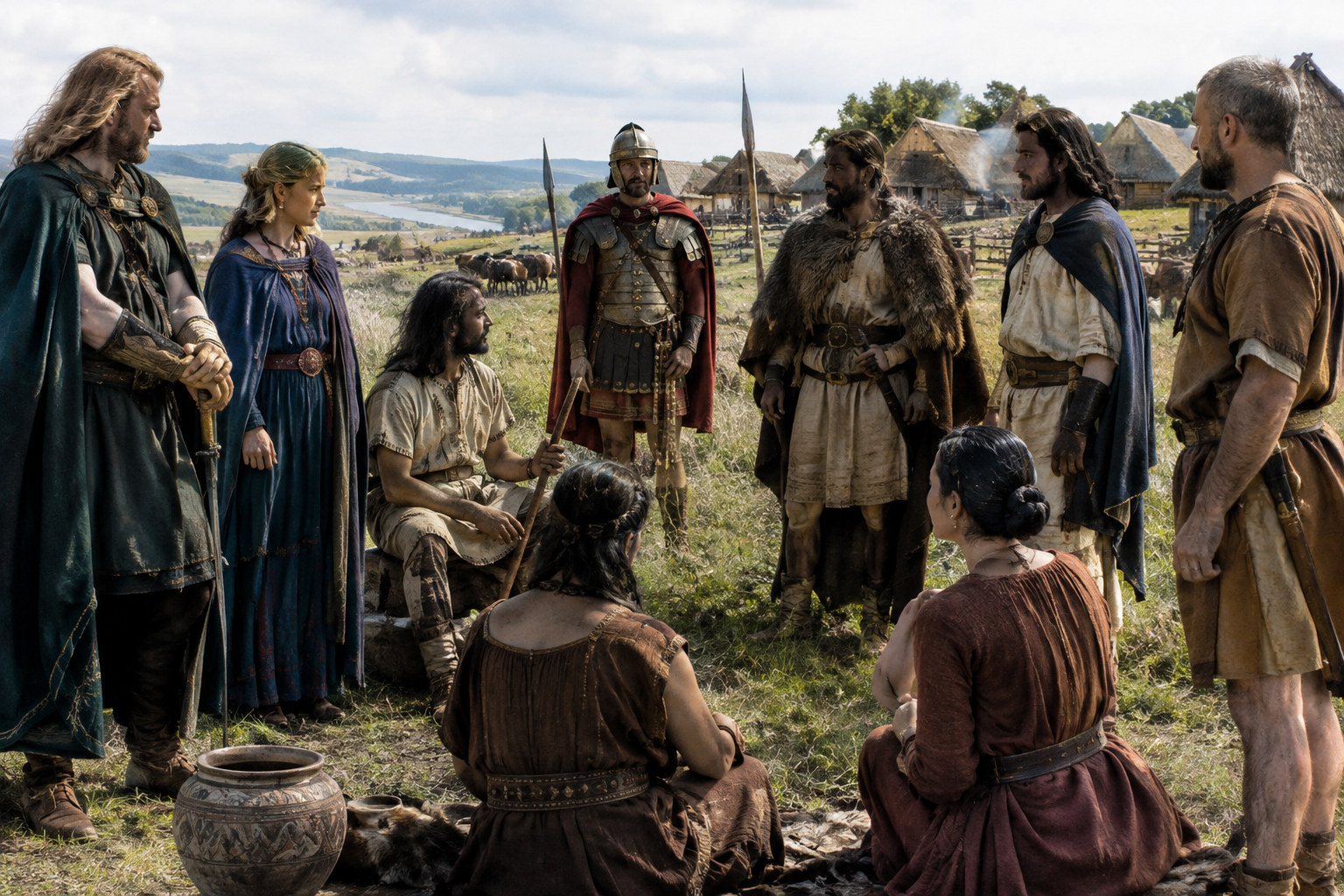
Some Y-chromosome lineages announce themselves with imperial drama. Haplogroup G2a2b2a1a1b1 is more elusive, and in some ways more interesting for that very reason. It appears not as the banner of a single famous conquest, but in a chain of ancient men spread across Copper Age Alpine communities, Bronze Age northern Italy, Iron Age Celtic worlds, Etruscan Italy, Roman Pannonia, and early medieval Germany. That is exactly the sort of pattern ancient DNA is so good at revealing: not a neat legend, but a long, human story of persistence, movement, and reinvention.
As always with Y-DNA, a warning is built into the method. A haplogroup traces one direct paternal line only: father to father to father across time. It does not describe a person's full ancestry, culture, language, or identity. Still, that single line can be historically powerful. In the case of G2a2b2a1a1b1, the evidence points toward a paternal heritage with deep roots in prehistoric Europe, especially in regions tied to early farming and later Alpine, Celtic, and Mediterranean societies. What makes this branch so compelling is that it keeps turning up in places where archaeology already tells us people were mixing, trading, marrying, and shifting political loyalties.
Haplogroup G belongs to a wider Y-chromosome family often associated in broad terms with early farming expansions into Europe. But one must be careful here: the full history of haplogroup G is much larger than the specific branch G2a2b2a1a1b1. We should not simply pour the whole Neolithic into this narrower subclade. What the evidence does suggest is that this lineage fits comfortably within a long European story in which paternal lines connected to early agricultural populations remained present, especially in southern and central Europe, even as later cultural worlds emerged around them.
That matters because popular history often imagines prehistory as a sequence of total replacements: farmers arrive, then Bronze Age people arrive, then Celts, then Romans, then Germanic tribes. Ancient DNA has made that picture much less tidy. Again and again, we find continuity mixed with mobility. A lineage can survive through enormous cultural change, carried by men who may have spoken different languages, lived under different rulers, and been buried with very different rituals.
Some of the clearest clues for G2a2b2a1a1b1 come from the Alps and their surrounding corridors. The Copper Age sample 3058_13_115_1 from South Tyrol Ora/Auer in Alpine Italy, dated to 2700 BC, places this paternal lineage in a mountain zone that was never isolated in the simple sense. Alpine communities were connected by passes, exchange routes, and local networks long before Roman roads made such movement more visible in the written record.
Another early appearance, I2366 from Budakalasz Luppa Csarda in Hungary, dated to 3139 BC and associated with the Late Copper Age Baden horizon, widens the picture eastward into the Carpathian Basin. That is an important reminder that this haplogroup's story is not just Italian. It belonged to worlds linked across central Europe, where communities shared technologies, burial customs, and sometimes marriage networks over considerable distances.
By the Early Bronze Age, ROM301 from Trento Romagnano in Alpine Italy, dated to 1941 BC, shows the lineage still present in northern Italy. One of the most striking things here is not sudden expansion but staying power. Over many centuries, through changing material cultures, this paternal branch remains visible in the Alpine zone. That continuity does not prove an unbroken local dynasty, of course, but it does suggest that some paternal lines weathered the transitions that transformed prehistoric Europe.
Then the story takes on a rather grander archaeological costume. HOC003 and HOC003b, both from Elite Celtic Germany Eberdingen-Hochdorf Biegel and dated to 515 BC, bring G2a2b2a1a1b1 into the orbit of an elite Celtic setting. Hochdorf is one of those sites that has long fascinated archaeologists because it opens a window onto Iron Age power in central Europe: feasting, display, wealth, and political theatre. Finding this lineage there is a useful corrective to any temptation to reduce Celtic identity to one paternal origin. The Celtic world was socially and biologically varied, and this haplogroup was among the lines present within it.
WET429 from Wettolsheim in Alsace, France, dated to 300 BC, reinforces that western Celtic connection. Alsace sat in a region where Rhine, upland Europe, and Gaul met. A lineage found both in Hochdorf's elite sphere and in Gallic Alsace hints at broader paternal continuity or circulation across the Celtic-speaking parts of central-western Europe.
If you wanted a neat ethnic label for G2a2b2a1a1b1, TAQ006 spoils it beautifully. This sample, from Etruscan Tarquinii in Italy and dated to 400 BC, places the lineage in one of the most famous cities of pre-Roman Italy. Tarquinii was deeply urban, highly connected, and unmistakably part of the Etruscan cultural world. So now the same paternal branch appears in both Celtic and Etruscan contexts, not because Celts and Etruscans were the same people, but because paternal lineages do not map cleanly onto cultural boundaries.
By the Roman period, BBC004 from Karlovac in Pannonia Savia, Croatia, dated to 275 AD, shows the lineage inside an imperial province where soldiers, traders, officials, farmers, and families from many regions crossed paths. Roman rule did not create mobility from nothing, but it intensified and documented it. A Y-line like this could have arrived in Pannonia through local continuity, military service, settlement, or family movement within the empire. The responsible answer is that several scenarios are plausible.
And then there is OBM011 from Obermoellern in Germany, dated to 500 AD and associated with the Thuringii tribe. Here the lineage appears again in the early medieval world that emerged after Rome's western political structures fractured. What is interesting is not that one ancient man "became Germanic" in any simple biological sense, but that a paternal line seen earlier in Copper Age, Bronze Age, Celtic, Etruscan, and Roman settings is still present in central Europe in the age of post-Roman peoples and kingdoms.
Put these samples together and a pattern emerges. G2a2b2a1a1b1 appears across a broad arc from northern Italy and the Alps to Hungary, Alsace, Germany, and Roman Croatia, and across a long span from the Late Copper Age to the early Middle Ages. That suggests durability in central and southern European paternal ancestry, with repeated participation in societies that archaeologists would classify very differently.
But this is exactly where restraint matters. Shared haplogroup does not prove close kinship between TAQ006 of Tarquinii and OBM011 of Obermoellern, still less between either of them and any medieval lord. Haplogroups are branches on a very old tree. Two men can share one and still be separated by many centuries and many unrecorded generations.
That said, the geography is historically suggestive. The same broad regions where these ancient men lived became, later on, the landscapes of duchies, bishoprics, castles, and noble houses. Medieval families built their identities around territories that had already been inhabited, farmed, fortified, and argued over for millennia. Ancient DNA offers a kind of deep background to those later records. It does not replace genealogy, but it reminds us that noble lineages stood atop much older human histories.
Explore the Post-Roman Frontier
The supplied noble-family-and-castle field does not include specific families or castles in usable detail here, so it would be wrong to invent them. Still, the historical connection is worth making in a careful way. Many later noble houses of central Europe occupied regions that overlap with this haplogroup's ancient appearances: the Alpine world, southwest Germany, Alsace, northern Italy, and the old frontier lands of the Roman and post-Roman centuries.
That overlap is not proof that any particular dynasty belonged to G2a2b2a1a1b1. It is context. Castles and ancestral seats preserve the memory of regional power in the medieval and early modern periods; ancient burials preserve evidence for the much older populations from which those societies emerged. The two records speak different languages. One is parchment, heraldry, landholding, and masonry. The other is bone, grave goods, isotopes, and DNA. When read together, they make the same landscapes feel deeper and more crowded with human continuity.
So if your own paternal line falls near G2a2b2a1a1b1, the most historically responsible conclusion is also the most interesting one: your direct male-line ancestry may connect you, at great time depth, to the same broad European worlds that produced Copper Age Alpine communities, Baden-period groups in Hungary, Etruscan towns, Celtic elites, Roman provincial society, and early medieval central European tribes. Not to one crown or one castle, but to a succession of historical worlds layered on top of each other.
Explore Ancient Alpine Genomes
G2a2b2a1a1b1 is a good example of why ancient DNA has changed historical imagination. It shows that paternal lines can outlast cultures, languages, and states. A branch once carried by men in Copper Age Alpine Italy later appears among Celtic elites, in Etruscan Tarquinii, in Roman Pannonia, and among the Thuringii. That is not a tale of a single people marching unchanged across history. It is the far more realistic tale of lineages persisting while identities shift around them.
For MyTrueAncestry members, that is where the excitement lies. Ancient DNA does not hand out instant aristocratic pedigrees or tidy ethnic labels. What it offers instead is something better: a chance to place your paternal line inside the real complexity of the past, among actual excavated individuals such as 3058_13_115_1, I2366, ROM301, HOC003, HOC003b, WET429, TAQ006, BBC004, and OBM011.
If you want to explore whether your DNA shows links to ancient individuals, archaeological cultures, and historical populations like these, MyTrueAncestry can help you look far beyond the limits of written family trees. Those comparisons can open remarkable perspectives on ancestry, even though they do not by themselves prove direct descent from any specific ancient person or noble house.






Comments