Haplogroup G2a2a1a2a
– 6 min read


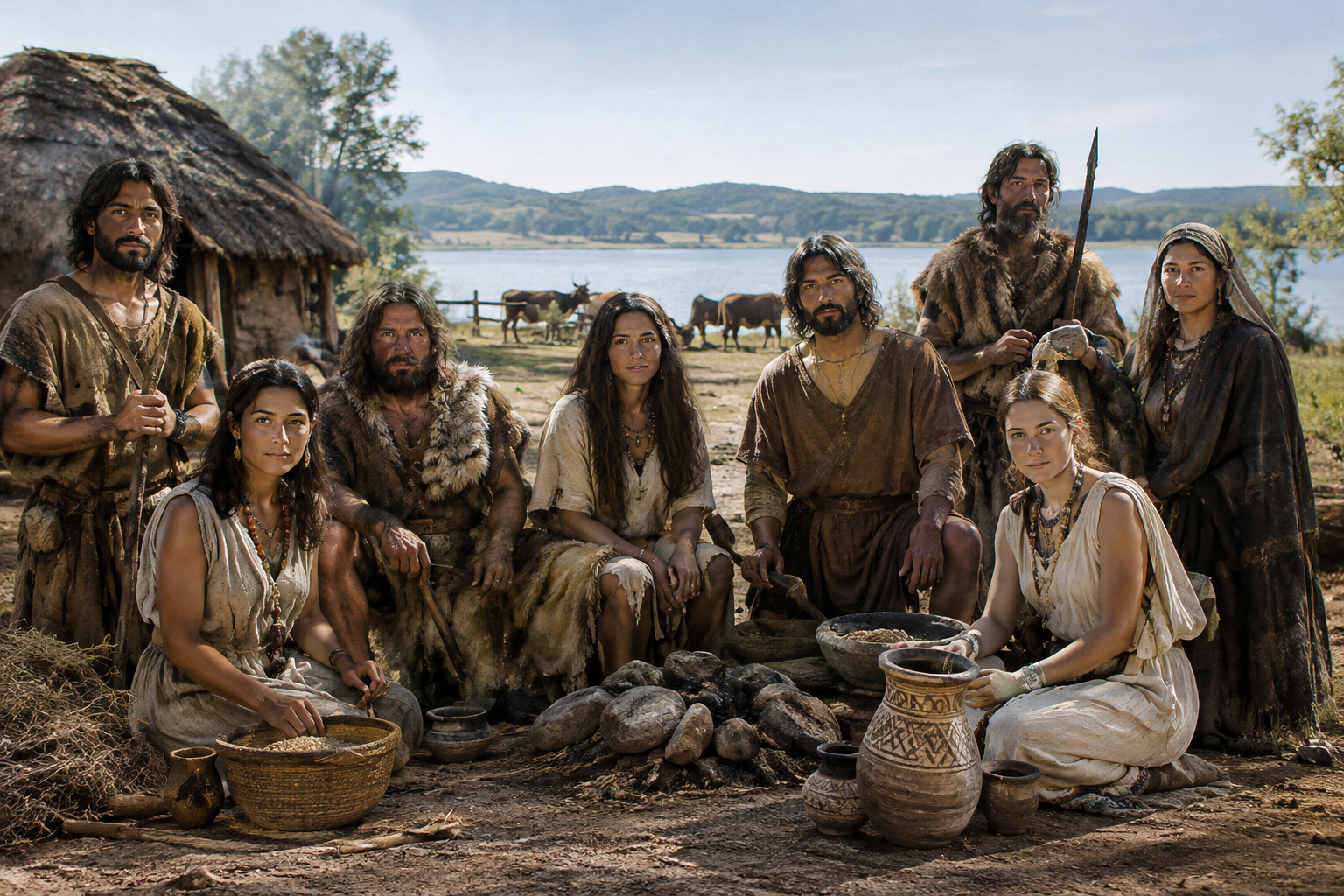
Some Y-DNA haplogroups announce themselves in kings, conquerors, or sweeping historical labels. Haplogroup G2a2a1a2a is interesting for almost the opposite reason. Its story is older, quieter, and in many ways more revealing. It appears in some of the earliest farming communities of northwest Anatolia and the Balkans, then turns up again in later prehistoric Europe, and even in an early medieval burial in Italy. That is the sort of pattern that makes archaeogenetics so useful: not because it gives us a simple ethnic badge, but because it lets us watch paternal lines move through real landscapes, villages, cemeteries, and centuries.
As always, a caution is essential. A Y-DNA haplogroup traces just one direct paternal line - father to father to father - and does not represent a person's full ancestry. Still, paternal lineages can be extraordinarily informative. In the case of G2a and its many branches, ancient DNA has repeatedly linked parts of this broader family to the spread of early farming into Europe. For a more general look at that larger process, readers may enjoy The Neolithic Expansion: A Genetic and Archaeological Journey Through Ancient Europe.
G2a2a1a2a sits within the wider haplogroup G tree, a lineage with deep importance in the prehistoric Near East and early European farming world. For this specific branch, the safest historical frame is not to make grand claims about a single birthplace or one dramatic migration, but to note where the evidence places it. And the evidence begins very early.
One key sample is I1099, from Neolithic Northwest Anatolia Marmara Barcin, dated to 6250 BC. Barcin is one of those sites that matter far beyond its local geography. Northwest Anatolia was one of the gateways through which farming populations moved toward southeastern Europe. When a lineage like G2a2a1a2a appears there, it places this paternal branch in a setting central to the first agricultural expansions into Europe.
Not long after, the branch appears further west in the Balkans. Sample I0698, from Neolithic Yabalkovo Bulgaria, dated to 5950 BC, shows the lineage in an early Balkan farming context. Then there is Urzi65a, from Ancient Romania Urziceni, dated to 4000 BC. Taken together, these finds suggest a line moving, or at least persisting, along the very corridor by which early farmers spread from Anatolia into southeastern Europe.
That does not mean every man in those communities carried this haplogroup, nor that every later bearer descends from these exact individuals. But it does mean that G2a2a1a2a belongs to the paternal landscape of the first farming worlds north and west of the Aegean.
For readers interested in the wider Balkan background behind such finds, Balkan Hunter-Gatherers Shaped Post-Ice Age Europe offers useful context on the region before and during these major transitions.
If northwest Anatolia and the Balkans show us the earlier movement of the lineage, the Swiss material shows something just as important: endurance. Several Late Neolithic burials in Switzerland belong to this haplogroup or its close placement in the supplied dataset. These include MX204 from Late Neolithic Oberbipp Switzerland dated to 3100 BC, SNPRA58 from Late Neolithic Muttenz Switzerland dated to 2910 BC, and two individuals from Aesch: Aesch24 dated to 2890 BC and Aesch6 dated to 2840 BC.
Now this is where the story becomes properly archaeological rather than abstractly genetic. We are no longer just following a route from Anatolia into Europe; we are looking at paternal continuity in settled communities in the European interior. By the later Neolithic, Switzerland was not a frontier of first contact. It was a world of established farming societies, local traditions, and increasingly complex regional networks. The recurrence of this lineage across several sites hints that branches connected with early farmer ancestry remained part of the male population there for many centuries.
That persistence matters because European prehistory was not a single event. The first spread of farming was one phase; later demographic change was another. A lineage present in the sixth millennium BC could survive into the late fourth and third millennia BC, even as the social world around it changed profoundly. Readers interested in that central European setting may want to compare this with Late Iron Age Mobility and Burial Practices in Celtic Switzerland, which shows how the same region continued to be shaped by movement and local identity long after the Neolithic.
Another striking sample is I2792 from Vucedol Bronze Age Croatia, dated to 2740 BC. The Vucedol horizon belongs to a very different archaeological world from the earliest Neolithic villages of Barcin or Yabalkovo. By this stage, metallurgy, long-distance exchange, and new social forms were reshaping southeastern and central Europe. Yet the presence of this paternal line in Bronze Age Croatia shows that it did not vanish with the earliest farmers.
This does not license a simplistic claim that G2a2a1a2a was "the" lineage of any one archaeological culture. Ancient populations were mixed, and the Y chromosome captures only one thread. But finds like I2792 show how a paternal line associated in part with early farming could remain part of later prehistoric societies in the Balkans and beyond.
That same caution applies when later population movements entered Europe. Steppe-related expansions transformed parts of the continent in the third millennium BC, but not every earlier lineage disappeared. Some persisted locally; some were absorbed into new communities; some may have survived in particular valleys, districts, or kin groups more than others. G2a2a1a2a appears to be one of those lines that lets us see survival as well as movement.
The latest sample in the supplied set is particularly intriguing: To_Lav_T1US6, from Dark Ages Italy Torino Lavazza, dated to 550 AD. Suddenly we are no longer in the world of Neolithic farmers or Bronze Age settlements, but in post-Roman Italy - a landscape of collapsing imperial structures, new kingdoms, military movement, and mixed local populations.
This is exactly why ancient DNA is so useful. Written history often begins by talking about Goths, Lombards, Romans, and Franks as if populations arrived in tidy named blocks. Biology is less tidy. A paternal lineage found in early farmers of Anatolia and the Balkans can still appear in an early medieval Italian burial because lineages survive, travel, and are folded into new political worlds. That is not proof of direct descent from a specific Neolithic man to a specific man in Turin. It is, though, a reminder that the Mediterranean and Europe were never reset from scratch.
Readers who want to pursue that Italian angle might look at Genetic ancestry of ancient Amiternum from Roman to early medieval Italy, which explores how continuity and change played out in another part of the peninsula.
Read About Early Medieval Italy
In this case, no associated noble family or castle information has been supplied alongside the haplogroup. That absence is worth stating plainly, because it touches on one of the most common misunderstandings in public DNA history.
It is tempting to leap from an ancient paternal lineage to medieval aristocratic houses, ancestral castles, and named dynasties. Sometimes there are documented genetic studies on ruling families. More often, though, what we have is geographical overlap, not proof of genealogical descent. A branch like G2a2a1a2a can be historically illuminating without being tied to a banner, a coat of arms, or a stone fortress.
And in truth that is no disappointment. The real excitement here lies in seeing how one paternal line appears in northwest Anatolia, the Balkans, Switzerland, Croatia, and early medieval Italy. Castles preserve family memory; ancient DNA preserves something older and less literary: the biological traces of men who ploughed fields, built settlements, joined later communities, and vanished from the written record long before heraldry began.
So what does haplogroup G2a2a1a2a reveal? First, it points toward a paternal history closely tied to the early farming world of Anatolia and southeastern Europe. Second, it shows that such lineages could persist into later Neolithic and Bronze Age communities far to the west, including Switzerland and Croatia. Third, its appearance in early medieval Italy underlines a larger historical truth: paternal lines can endure through enormous cultural and political change.
This is where genetics and history work best together. Archaeology gives us settlements, graves, and material culture. Written history gives us names and kingdoms, but only for relatively recent periods. Ancient DNA joins those two archives in unexpected ways. It does not magically identify your medieval noble house, and it cannot prove direct descent from a named ancient sample merely through a shared haplogroup. What it can do is place your paternal line inside the long human story of migration, settlement, survival, and change.
If your own Y-DNA connects with lineages like G2a2a1a2a, MyTrueAncestry can help you explore how your paternal ancestry fits into the worlds of Anatolian farmers, Balkan pioneers, Alpine villagers, and post-Roman communities. Uploading your DNA may reveal fascinating similarities to ancient individuals and historical populations, while always remembering that genetic matches and haplogroups provide context rather than simple proof of descent from a particular person or noble family.






Comments