Haplogroup G2a1a
– 4 min read


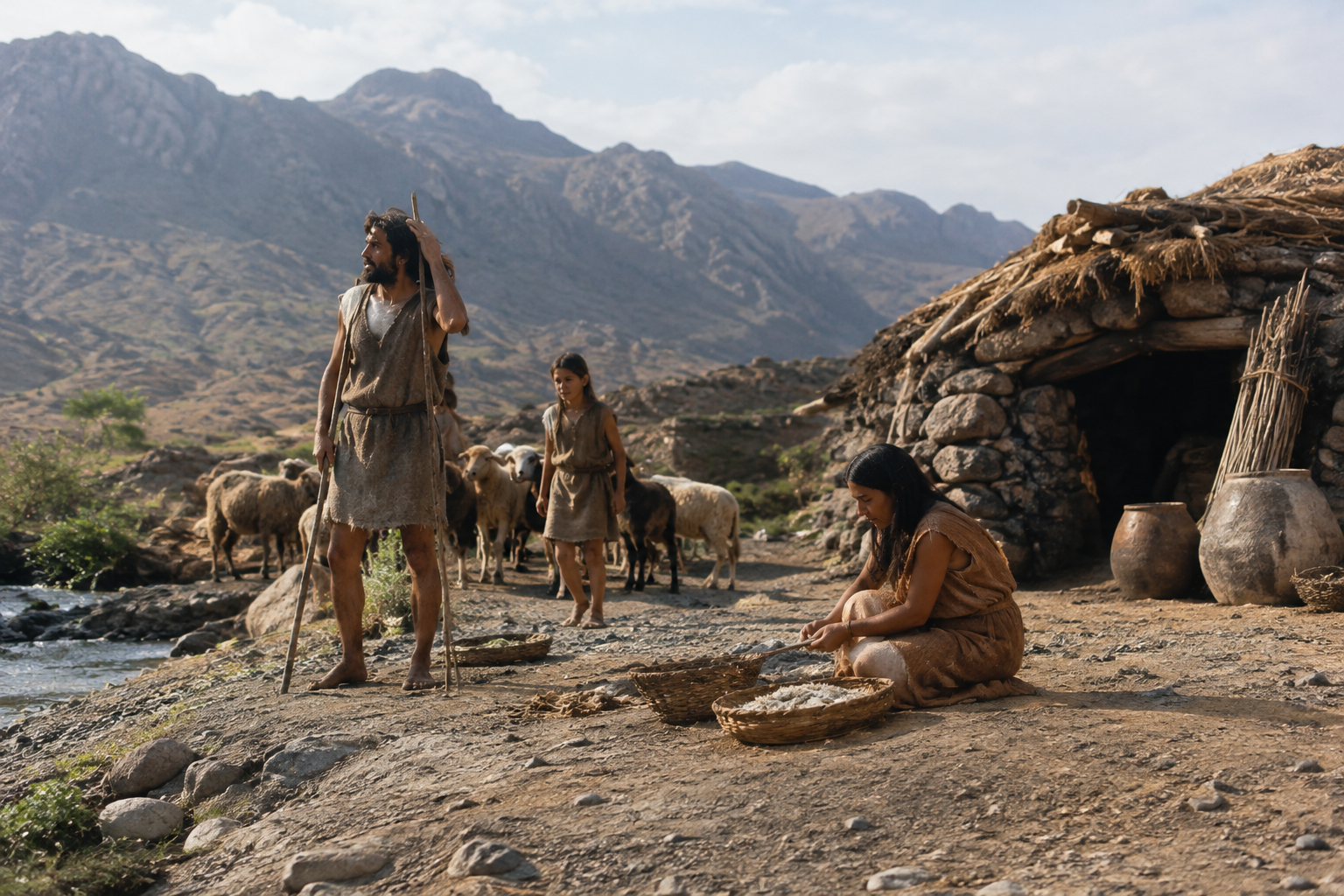
At Seh Gabi in Kermanshah Province, in the Zagros region of western Iran, one early farming community has given us a rare paternal clue from deep prehistory. An individual dated to about 5636 BC, sample I1671, has been associated with Y-DNA haplogroup G2a1a - a branch within the wider G2a lineage that appears again and again in some of the earliest farming populations of western Eurasia.
That makes this one man more than a technical footnote. He stands in a place and time crucial to the history of agriculture, settlement, and human movement: the eastern Fertile Crescent, where village life had already taken firm root long before cities, empires, and written chronicles. A genetic study of ancient populations from the region, published in Nature Communications, helped clarify just how important the Zagros was as a center of early population history rather than merely a corridor between better-known worlds.
Seh Gabi belongs to a landscape that archaeologists have long treated as one of the cradles of early food production. The central Zagros is not simply "near Mesopotamia"; it has its own deep Neolithic history, with communities building settled lives around herding, farming, and local traditions that were not carbon copies of those farther west.
Within that setting, I1671 matters because Y-DNA follows one direct paternal line. It does not tell us everything about the man's ancestry, language, or identity, but it does place his father's father's line within G2a1a, a branch especially interesting in early agricultural contexts. That is why this sample attracts attention: it links a specific paternal lineage to a very early village world in western Iran, not to a later imperial or nomadic horizon.
It is worth being precise here. G2a1a is not the same thing as all of haplogroup G, nor even all of G2a. The wider G family has a long and complex history across western Eurasia, but this article's branch is narrower. With a sample such as I1671, the responsible question is not "what civilization did G2a build?" but rather "where do we securely find this paternal branch in the ancient record, and in what kind of archaeological setting?"
For Seh Gabi, the answer is unusually clear: we are dealing with an early Neolithic or early farming population in the Zagros. That matters because the paternal history of early farmers was not uniform across the Near East. Different regions could produce related but distinct lineages, and those lineages later traveled, mixed, dwindled, or persisted in different ways.
So G2a1a should be understood as one thread in the larger fabric of Neolithic male ancestry. In Europe, branches of G2a became familiar through early farmer burials, but a Zagros sample like I1671 reminds us that some of those deeper paternal roots lie east of the Aegean and Anatolia, in communities already established in Iran's mountain zone.
Popular retellings of prehistory often flatten the Fertile Crescent into a single origin point, as though farming radiated out from one neat center. Archaeology has spent decades showing that the reality was more regional. The Levant, Upper Mesopotamia, Anatolia, and the Zagros each contributed differently to the Neolithic world.
Western Iran is especially important because ancient DNA has shown that early Zagros farmers were not simply interchangeable with early farmers farther west. They were part of a broader Near Eastern mosaic, but with their own genetic profile and history. That makes the appearance of G2a1a here particularly valuable: it ties this paternal branch to a population that was local, early, and historically significant in its own right.
In other words, the lineage behind I1671 was present in a society already living the agricultural transition, not merely receiving its effects second-hand. When people today find themselves on a G2a branch, ancient Iranian evidence like this is a reminder that the paternal story of farming begins in several neighboring homelands, and the Zagros is one of them.
One sample does not map a migration route by itself, but it can anchor a larger pattern. Haplogroup G2a, in broad terms, is one of the best-known Y-DNA signatures associated with many early farming populations in parts of Europe and the Near East. That does not mean every G2a man came from the same source population, nor that every farming expansion carried the same sub-branch. It does mean that the Seh Gabi result belongs to a wider archaeological conversation about how early village populations were structured.
Seen in that light, I1671 is valuable precisely because he is early and eastern. He helps place G2a1a in the world before Bronze Age states, before Indo-Iranian expansions, before the political geographies that usually dominate Iranian history. This is the ancestry of a farming landscape of tells, herds, cultivated plots, and local communities.
That older setting also helps explain why these lineages can feel both familiar and elusive in modern DNA research. Paternal branches that were once common in early farming communities did not necessarily remain dominant forever. Later migrations, demographic bottlenecks, elite expansions, and ordinary family chance all reshaped the male lineages of western Eurasia over millennia.
Kermanshah Province sits in a historic crossroads, but "crossroads" should not make us imagine constant transit and little else. The archaeology of the region shows continuity, settlement, and local development over very long spans. By the 6th millennium BC, communities here were already heirs to many generations of Neolithic life.
That is why a paternal lineage from Seh Gabi deserves to be read historically, not just genetically. G2a1a here is evidence for a real man living in a real early agricultural society of the Zagros. He was not a symbol of all Iran, still less of all later peoples in the region. But he does give us a firm point of contact between a present-day Y-DNA branch and one of the foundational landscapes of Old World farming.
If your direct paternal line falls under G2a1a, the Seh Gabi evidence offers a sober but exciting possibility: one part of your deep male-line history may connect to the world of early farmers in the Zagros of western Iran. Not as a neat family tree, and not as proof of recent ethnicity, but as a sign that this branch was already present among settled agricultural communities more than seven and a half millennia ago.
That is the distinctive strength of this evidence. G2a1a is not appearing here in a legendary dynasty or a vague historical tradition, but in an actual ancient individual, I1671, from one of the key landscapes of the Neolithic Near East. For anyone tracing a paternal lineage, that is a remarkable starting point: not myth, but archaeology.
Comments