Haplogroup E2b1
– 5 min read


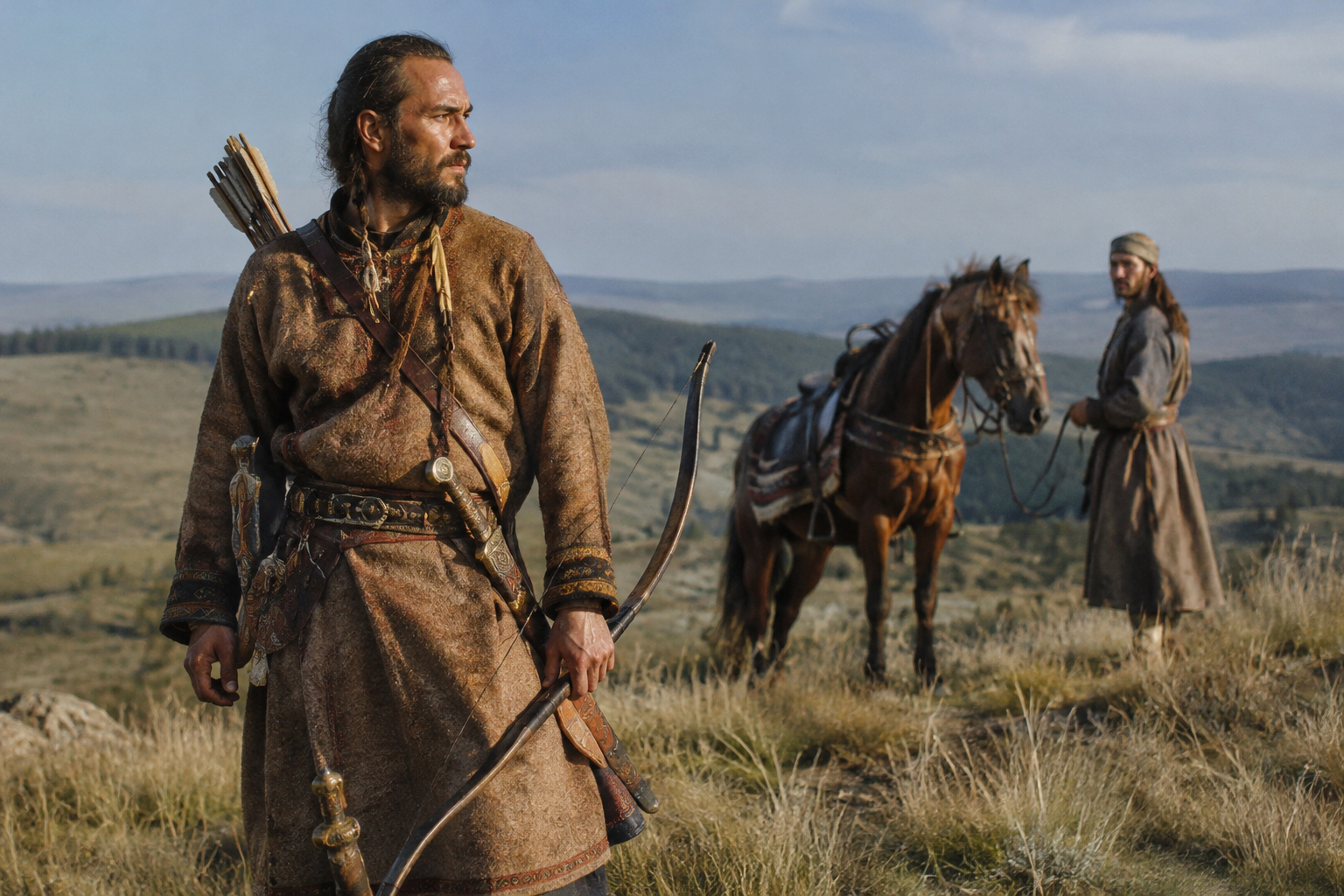
One of the more arresting things about haplogroup E2b1 is that, in the ancient DNA record available here, it turns up not in some tidy homeland story but in a Sarmatian-context individual from the Urals: MJ40, dated to around 350 BC. That is already enough to make the archaeology interesting. The Sarmatians are usually discussed as steppe peoples of the Iron Age, mobile, expansive, and entangled with the wider world of the Eurasian grasslands. Finding a paternal line associated with E2b1 in that setting is a useful reminder that steppe history was never genetically uniform.
That matters because Y-DNA follows only one line of descent, the direct paternal line. It does not sum up a person's whole ancestry, language, or identity. But it can still be historically revealing. In the case of E2b1, this single ancient appearance places the lineage within a world of movement across the southern Urals, where communities linked by herding, exchange, and warfare were drawing people from more than one ancestral background into Sarmatian societies.
The key ancient individual here is MJ40, identified as an outlier from a Sarmatian setting in the Urals and dated to roughly the mid-1st millennium BC, around 350 BC. Even that brief label tells us something important. The word outlier in archaeogenetics usually signals a person whose genetic profile does not sit neatly inside the local average for the group under study. In other words, this was not simply another interchangeable member of a homogeneous burial population.
For E2b1, that makes MJ40 especially valuable. Rather than giving us evidence for a large, settled block of E2b1 men in one excavated cemetery, he points to something more historically plausible for the Iron Age steppe: circulation, contact, and incorporation. Sarmatian communities were not sealed ethnic containers. They were political and social formations operating across huge distances, and their cemeteries can preserve exactly these unexpected paternal signatures.
A genetic study of Iron Age steppe populations published in Current Biology helped establish just how mixed and dynamic these eastern Iranian-speaking nomadic worlds could be. The broad lesson is not that one haplogroup "belongs" to the Sarmatians, but that Sarmatian-era populations could include lineages with quite different deeper histories.
There is a temptation, when a rare haplogroup appears in an ancient sample, to turn it into a grand migration map with arrows going confidently from one region to another. Better to be more careful. What MJ40 shows securely is that a branch associated with E2b1 was present in a Sarmatian-context individual in the Urals by around 350 BC. That is already significant, because it places the lineage inside the social world of the steppe frontier.
The more interesting historical point is about scale. The Eurasian steppe was not just a corridor for elite horsemen charging west and east. It was also a zone where family lines, marriage networks, dependants, captives, and allied groups could be folded into larger confederations. A paternal lineage like E2b1 appearing there does not need a melodramatic explanation. Ordinary ancient mobility is enough.
And ordinary mobility, archaeologically speaking, can be quite extraordinary. The southern Ural zone sat near the hinge between Europe and Inner Asia. Populations there were in touch with forest-steppe neighbours, trans-Ural groups, and the wider Sarmatian horizon stretching toward the Black Sea. An unusual Y-line in such a setting fits the historical geography very well.
Classical authors often wrote about steppe peoples as though they were single, sharply bounded nations. Archaeology is less obliging. Burial traditions, material culture, and now ancient DNA all point to variability within Sarmatian and related nomadic groups. Some continuity existed, of course, but so did mixture. That is the real value of a sample such as MJ40: it gives us a direct paternal clue to that diversity.
It is also worth resisting an older habit of equating culture with bloodline. A man buried in a Sarmatian archaeological context may have spoken the local language, served local elites, married locally, and lived fully inside that world, regardless of whether his paternal ancestry had deeper roots elsewhere. Y-DNA is one thread in the biography, not the whole garment.
That is why steppe archaeology and genetics work best together. The cemetery gives the cultural setting; the genome adds biological relationships and exceptions. When the two are read side by side, lineages such as E2b1 become evidence not of simplistic tribal purity, but of the flexible human realities behind Iron Age confederations.
Readers with E2b1 should be careful about one common confusion. Haplogroup E2b1 is a specific paternal branch, and it should not automatically be treated as equivalent to the entire broader haplogroup E family. The wider E tree has a long and complex history across Africa and beyond, but the presence of one ancient E2b1-associated sample in the Sarmatian Urals does not license us to project the full history of haplogroup E onto this narrower branch.
What we can say, responsibly, is narrower and more useful. By the Iron Age, at least one direct paternal line associated with E2b1 had reached - or was already established within - a Sarmatian-context population in the Urals. That tells us the branch was part of the human traffic of the steppe world. It does not, by itself, identify an original homeland, a language, or a single migration event.
This is where ancient DNA often improves on older historical storytelling. It trims back the grand certainties and replaces them with something more interesting: evidence of real individuals in real archaeological settings, whose family histories were often more complicated than neat modern labels suggest.
The date attached to MJ40, around 350 BC, places him in a period when steppe networks were already mature and far-reaching. This was a world after the early Scythian florescence but still deeply tied to the exchange systems, mounted warfare traditions, and regional political churn of the first millennium BC. The Urals were not peripheral in any simple sense. They were part of a connected frontier.
That broader setting helps explain why an uncommon paternal line can show up there without requiring a dramatic one-off episode. Trade, alliance, fosterage, raiding, marriage exchange, and the absorption of neighbouring groups could all move lineages around. In steppe history, people did not merely migrate as intact tribes; they circulated through looser, messier, and often more human processes.
That wider steppe pattern is exactly why isolated ancient Y-DNA finds are worth noting. A single paternal line does not stand for an entire people, but it can illuminate the social texture of a region. MJ40 suggests that E2b1 belonged, at least in one case, to the mixed and mobile population landscape from which later steppe histories also emerged.
For someone researching an E2b1 paternal line today, the strongest ancient point here is not a promise of descent from a named tribe or royal house. It is something subtler and, in historical terms, more credible: this lineage appears in the ancient record within the multicultural Sarmatian world of the Urals by around 350 BC. That places E2b1 in a setting shaped by mobility, incorporation, and steppe-scale connections rather than isolation.
So the distinctive lesson of E2b1, on present evidence, is one of participation in a broad frontier zone where identities were political and cultural as much as biological. MJ40 does not give us a dynasty. He gives us something better: a real ancient person whose paternal line shows that the Iron Age steppe was every bit as mixed and surprising as the archaeology keeps telling us.
Comments