Haplogroup E1b1b1b2b

– 5 min read


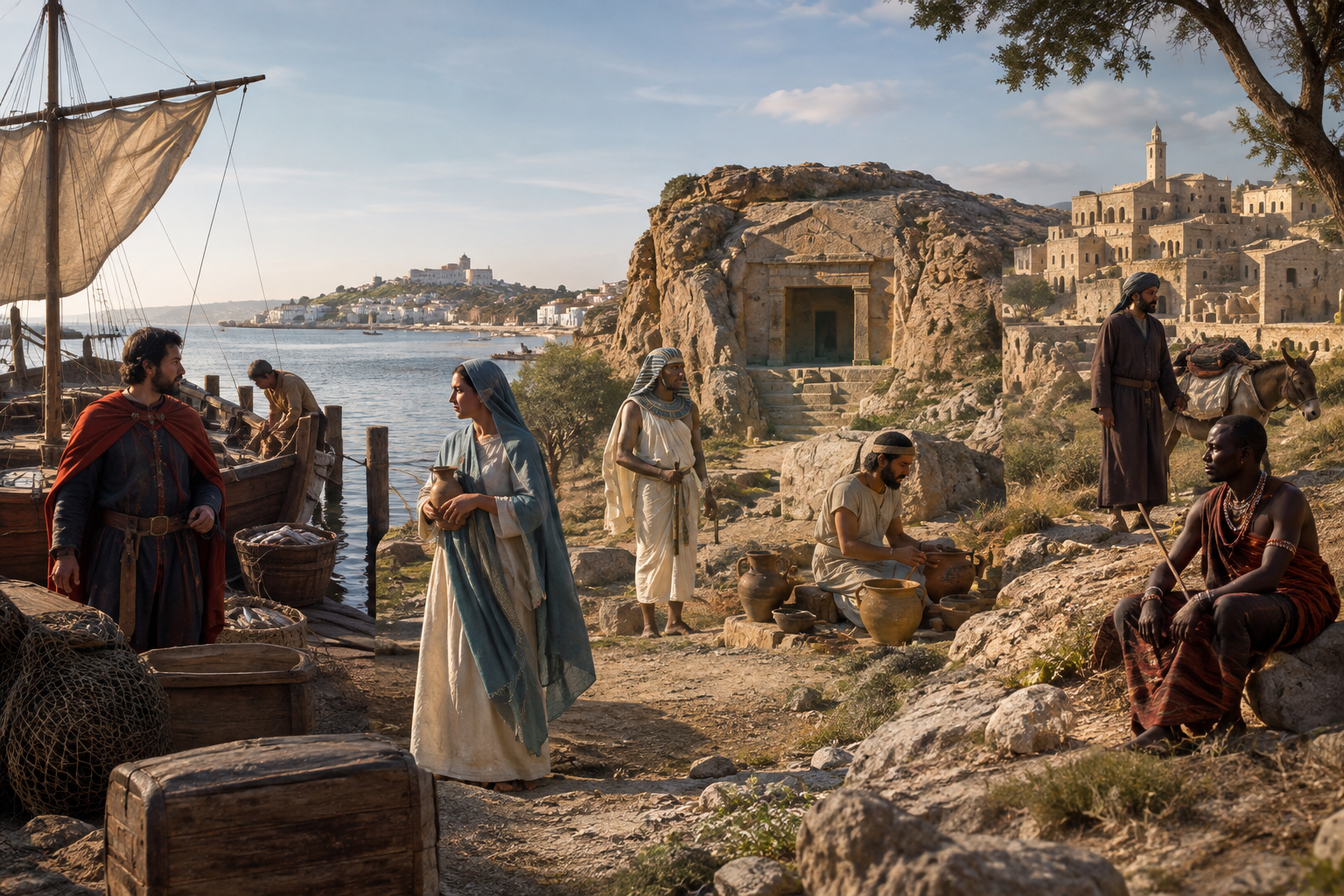
At Nuwayrat in Middle Egypt, one of the most striking ancient men linked here to haplogroup E1b1b1b2b comes from a very old and very grand setting: sample NUE001, dated to around 2712 BC, from a rock-tomb elite necropolis of Egypt's Third Dynasty. That is a useful place to begin, because it reminds us at once that this paternal line is not just a medieval or Mediterranean curiosity. It appears in evidence connected to an Old Kingdom burial landscape, in one of the world's earliest territorially organized states.
That does not mean one Y-chromosome can explain Egyptian civilization, Phoenician trade, medieval Portugal, Cushitic-speaking eastern Africa, and Ottoman-era Anatolia all at once. Y-DNA traces one direct paternal line among thousands of ancestors. But the scattered appearance of E1b1b1b2b in these settings does make for a particularly interesting historical pattern: this is a branch seen again and again around the southern and eastern Mediterranean, and into northeast Africa, in places shaped by mobility, trade, empire, and long local continuity.
Nuwayrat matters because it pushes the discussion far back in time. Sample NUE001 belongs to an elite necropolis in the early dynastic world of Egypt, a context that is historically dense even when the genetic evidence itself must be handled carefully. An individual from such a cemetery was living in a society already marked by royal administration, monumental building, and increasingly formal burial landscapes.
A genetic study that brought attention to ancient Egyptians from sites including Nuwayrat helped show that ancient Nile Valley populations can be approached through DNA rather than through 19th-century guesswork or tidy modern nationalist stories. In that wider research setting, the significance of NUE001 is not that he stands for all Egyptians, but that he places an E1b1b1b2b-associated paternal line in an Old Kingdom mortuary environment of high status and considerable antiquity. For readers interested in that burial world, MyTrueAncestry has also looked more closely at Nuwayrat's Old Kingdom necropolis.
For the haplogroup itself, that early Egyptian appearance is a warning against simplistic maps. E1b1b1 is a large and varied paternal family with deep roots in Africa and important expansions into the Mediterranean and Near East, but this article is about the narrower branch E1b1b1b2b. The ancient sightings here suggest that this branch, or a lineage reported within its orbit, belonged to populations already embedded in connected Afro-Mediterranean worlds very early on.
If Nuwayrat shows depth, I24554 from Mozia, Sicily, dated around 805 BC, shows movement. Mozia was a Phoenician settlement on a small island off western Sicily, part port, part colony, part commercial hinge between North Africa, Sicily, and the wider central Mediterranean. A man there associated with E1b1b1b2b fits a pattern archaeologists would expect from such a place: not ethnic purity, but connectivity.
The temptation with Phoenician sites is always to tell a neat story about eastern colonists planting themselves intact across the sea. Ancient DNA has made that harder to maintain. Research on Punic and Phoenician-linked populations has instead emphasized diversity, local mixture, and the fact that maritime networks moved people as well as goods. In that setting, I24554 is interesting precisely because he belongs to a settlement whose history was made by circulation across sea lanes, not by isolation.
This matters for E1b1b1b2b because Sicily is not merely a stop on a migration arrow. It is a laboratory of repeated contact: indigenous communities, Phoenicians, Greeks, Carthaginians, Romans, Byzantines, Muslims, Normans. A paternal lineage found in Phoenician-era Mozia may signal one thread within that longer traffic of men, families, and communities across the central Mediterranean. MyTrueAncestry readers may want to compare this with the broader picture in Phoenician Sicily and with later island evidence in medieval Sicily's multi-faith genetic history.
The sample I8759 from Naishi Rockshelter in Kenya, dated around 600 BC and described as PN Cushitic, is especially valuable because it prevents the story from collapsing into a Mediterranean-only tale. Here E1b1b1b2b appears in an eastern African context associated with Pastoral Neolithic lifeways and Cushitic-linked populations.
That is a rather different historical landscape from elite Old Kingdom Egypt or Phoenician Sicily. We are dealing instead with herding communities in eastern Africa, where language spread, pastoral adaptation, and regional mobility all matter. A lineage in this setting tells us that branches within the wider E1b1b1 family were part of African demographic histories that cannot be reduced to later Mediterranean empires.
It also helps explain why this haplogroup can feel geographically wide without being historically vague. The breadth comes not from one dramatic migration, but from repeated participation in adjoining zones: the Nile corridor, the Red Sea world, northeast Africa, and the Mediterranean basin. Those are connected arenas, though not identical ones.
The later samples are no less revealing for being younger. LP113_1 from Santarem Rua dos Barcos in the medieval Kingdom of Portugal, dated around AD 1300, places the lineage in western Iberia after centuries of Roman rule, Visigothic kingdoms, Islamic polities, and Christian expansion. Santarem was one of those Iberian towns whose history makes nonsense of any tidy genetic boundary between Europe and the Mediterranean south.
A recent ancient DNA study on Portugal and Iberia has shown just how mixed and historically layered the peninsula could be, especially in places touched by Roman, Islamic, and post-Islamic population movements. In that light, LP113_1 is best read not as an outlier but as evidence for the durable presence of Mediterranean-associated paternal lines in medieval Portugal. That sits well beside broader MyTrueAncestry discussions of Roman Hispania's genetic legacy and Portugal's long genetic history.
Far to the east, I4540 from Midyat, Mardin in modern Turkey, dated around AD 1536, places the same haplogroup in Upper Mesopotamia under Ottoman rule. Midyat has long been a meeting point of Syriac Christian, Kurdish, Arab, Armenian, and wider Anatolian-Mesopotamian histories. Again, the significance is not that one burial solves the region, but that E1b1b1b2b appears in exactly the sort of long-inhabited crossroads where older Near Eastern and Mediterranean lineages might persist through major political change.
The Iberian and Anatolian samples are useful together because they show how this paternal branch could survive in very different societies that nonetheless shared one structural feature: both were deeply entangled with older Mediterranean and Near Eastern networks. A branch like E1b1b1b2b did not need a single homeland-to-destination saga. It could persist because people persisted, locally, through changing empires.
Put these individuals side by side and a pattern emerges, though it is a modest and responsible one. E1b1b1b2b appears here in an Old Kingdom Egyptian elite necropolis, a Phoenician-era settlement in Sicily, a Pastoral Neolithic Cushitic context in Kenya, a medieval Portuguese town, and an early modern community in southeastern Anatolia. That is not a straight line of descent from one named ancestor. It is a map of connected historical worlds.
For someone researching this haplogroup today, the most useful takeaway is that E1b1b1b2b belongs to a paternal history with strong ties to Afro-Mediterranean and eastern Mediterranean zones of interaction. The evidence here does not promise pharaohs, merchants, or noble houses. What it does offer is something better grounded: a lineage that appears in real archaeological settings where Africa, the Mediterranean, and the Near East repeatedly met, mixed, and endured.






Comments