Haplogroup E1b1b1b2a1a1a1a1f1a~

– 5 min read


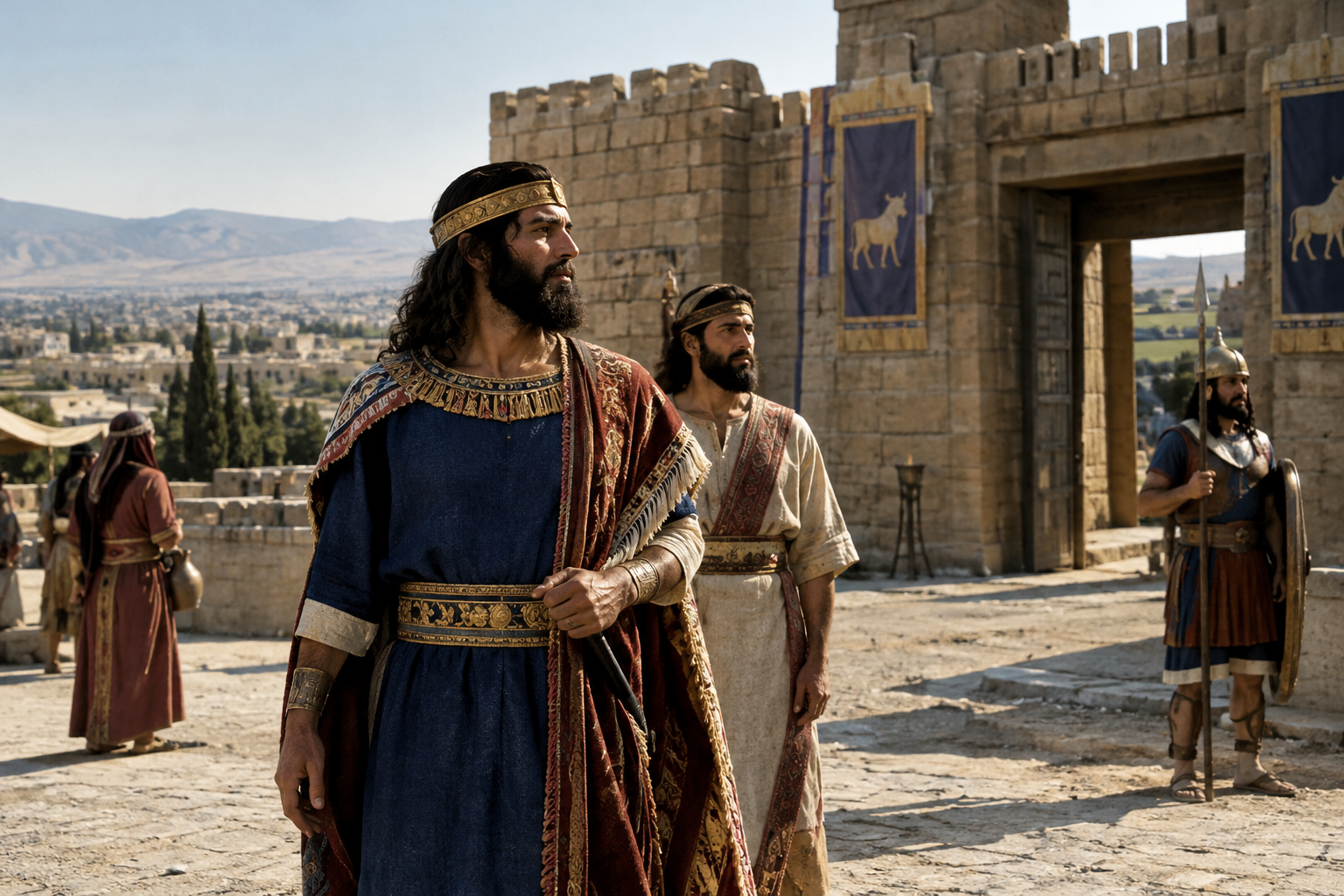
One of the clearest ancient signposts for the Y-DNA branch E1b1b1b2a1a1a1a1f1a~ comes from southeastern Anatolia, in the orbit of the Bronze Age kingdom of Yamhad. The individual known as I14784x, dated to around 1754 BC and associated here with Kilis, offers a small but very telling glimpse into the paternal landscape of a region that sat between inland Syria, upper Mesopotamia, and Anatolia.
That matters because Kilis was no sleepy backwater. In the Middle Bronze Age it lay in a zone of traffic, diplomacy, warfare, and exchange, close to the great urban and political worlds of Aleppo and the Euphrates. When a lineage like E1b1b1b2a1a1a1a1f1a~ appears in that setting, the interesting question is not whether one sample can define a whole kingdom. It cannot. The real interest is that this paternal line was present in a crossroads society where populations, languages, and loyalties were more mixed and mobile than older textbook maps sometimes suggest.
Yamhad, centered on ancient Aleppo, was one of the major powers of the early second millennium BC. Its influence reached across northern Syria and into neighboring districts, and the Kilis region belonged to that broader political and cultural world. Sample I14784x therefore sits in a landscape shaped by palace states, fortified towns, caravan routes, and agricultural hinterlands tied into wider systems of Bronze Age power.
The haplogroup label itself is extremely precise, but ancient DNA reporting does not always give us the same level of certainty at every branch. In this case, it is safest to say that I14784x is reported in association with the article's branch E1b1b1b2a1a1a1a1f1a~, while remembering that Y-DNA traces only one direct paternal line out of the thousands that made up this man's full ancestry. Still, even one direct male line can be historically useful when it is anchored to a specific time and place.
For members exploring their own paternal results, the location is as important as the code. Southeastern Anatolia in the Middle Bronze Age was a meeting ground: not a neat civilizational edge, but a thick frontier of interaction. A lineage found there may reflect long local roots, movement from neighboring Syria or Mesopotamia, or the ordinary circulation of families within a politically connected region.
At first glance, a name like E1b1b1b2a1a1a1a1f1a~ looks almost comically long. But that is simply the grammar of Y-chromosome classification. Each added letter or number marks a narrower branch within a much older paternal tree. The broad parent haplogroup E1b1b1 is well known across parts of Africa, the Mediterranean, and Southwest Asia, but one must be careful here: the history of that wide parent branch is not automatically the history of this exact subclade.
That caution is especially important in popular ancestry discussions, where broad labels can tempt people into drawing very sharp conclusions. A specific branch such as E1b1b1b2a1a1a1a1f1a~ may have had a much more particular distribution in antiquity than its parent lineage. With the evidence presently in view, the strongest claim is a modest one: this branch, or a very close paternal relation to it, appears in the Yamhad-linked world of Bronze Age Kilis.
In historical terms, that places the lineage in one of the most consequential corridors of the ancient Near East. This was a region where Amorite dynasties, Anatolian neighbors, Mesopotamian states, and mobile communities all intersected. Y-DNA cannot tell us what language I14784x spoke or how he identified himself, but it can show that this paternal strand belonged to that Bronze Age human mosaic.
Modern maps can mislead us. Kilis today sits near the Turkish-Syrian border, but in the Middle Bronze Age there was no such line in the modern sense. Instead there were overlapping zones of authority, trade, kinship, and cultural habit. That is one reason ancient DNA from this area is so valuable: it helps recover the human reality behind political names.
A man associated with Yamhad's sphere was living in a world of shifting alliances and intense regional contact. Aleppo was a major royal center, yet its power depended on connections outward, not isolation inward. So the appearance of E1b1b1b2a1a1a1a1f1a~ in Kilis should be read less as a badge of one people than as evidence for the paternal diversity present in a connected Bronze Age society.
This also speaks to a wider archaeological point. Ancient Near Eastern kingdoms were not genetically uniform blocks. Their subjects included town dwellers, villagers, officials, merchants, herders, migrants, captives, and long-settled local families. Every excavated genome reminds us that a kingdom name on a tablet and a paternal lineage in a grave are related to the same world, but they are not the same kind of evidence.
Quite a lot, if we ask the right question. One sample cannot stand for all of Yamhad, all of Anatolia, or all bearers of haplogroup E. But one securely dated male line can anchor a branch in a real historical landscape. It tells us that by the mid-second millennium BC, this paternal lineage was present in a region that linked Syria and Anatolia at a very high level of political and cultural interaction.
That is particularly useful for descendants today whose direct paternal line falls within or near this branch. It places their lineage, at least at one ancient checkpoint, in a world of Bronze Age palace kingdoms rather than in a vague and timeless "Near East." Archaeology sharpens the picture. We are not talking about an abstract population; we are talking about an individual who lived during the age of Yamhad's regional importance.
Research infrastructure matters here too. The preservation, classification, and comparison of such ancient individuals increasingly allow archaeologists to map paternal lineages onto historical landscapes with greater precision. A research resource associated with these ancient genomes can be found at this ancient DNA study archive, which is linked to the sample record behind this case.
People naturally want an origin story: where did this line "come from"? But the Bronze Age Near East resists tidy answers. Southeastern Anatolia was not merely receiving influence from elsewhere; it was part of a living zone of interaction in its own right. A paternal branch found there may reflect older local continuity, regional movement within northern Syria and Anatolia, or deeper connections stretching further across Southwest Asia and the eastern Mediterranean.
That is why the safest historical reading is also the most interesting one. E1b1b1b2a1a1a1a1f1a~ was present in a place where identities were layered and political worlds overlapped. The sample does not reduce the region to one ancestry, but neither does it dissolve into vagueness. It gives us a firm point on the map: a male line in Bronze Age Kilis, in the Yamhad horizon, around 1754 BC.
If your paternal ancestry falls under E1b1b1b2a1a1a1a1f1a~, the most distinctive evidence here is not a grand royal claim or a sweeping migration legend. It is something better grounded: this line is documented in the connected Bronze Age world of southeastern Anatolia, within the sphere of Yamhad. That places your direct male line, or a close neighboring branch, in one of the great contact zones of the ancient Near East, where history was made not by isolated peoples but by communities constantly meeting, trading, ruling, and moving.



Comments