Haplogroup E1b1b1b2a1a1a1a1f1

– 5 min read


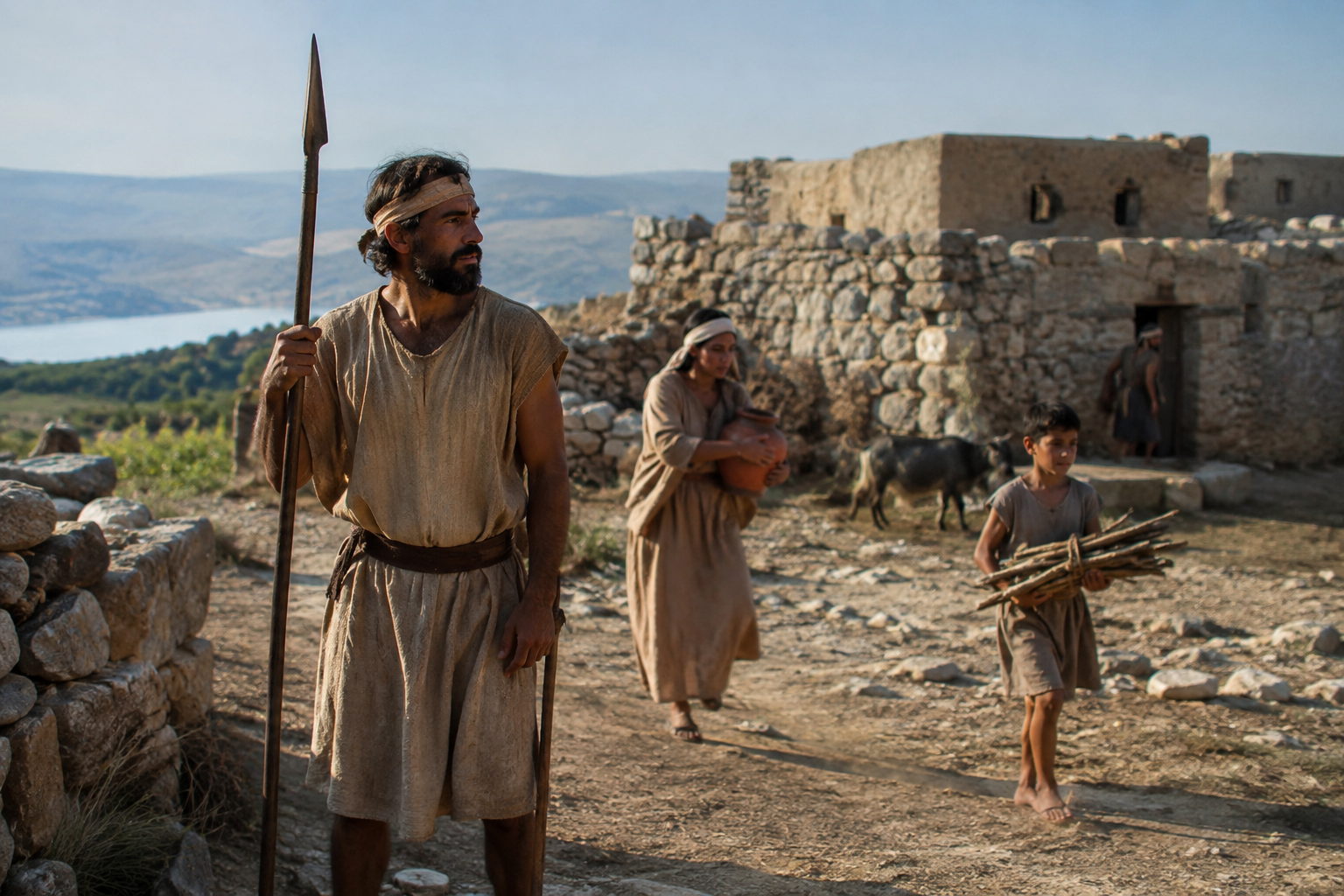
At Hazor in Upper Galilee, one Bronze Age man has become unexpectedly important for the history of a very specific paternal line. He is sample I3966, dated around 1750 BC, from one of the great urban centres of the southern Levant. In MyTrueAncestry terms, he is associated with the Y-DNA haplogroup E1b1b1b2a1a1a1a1f1 - a very narrow branch inside the much larger and older E1b1b family.
That matters because Hazor was not a village at the edge of history. It was a major Bronze Age city, tied into trade, diplomacy, and regional politics. So when a lineage like E1b1b1b2a1a1a1a1f1 turns up there, the interest is not simply that a branch existed in the Levant, but that it appears in an urban world where people, goods, and ideas were constantly on the move.
Hazor is one of those places archaeologists return to again and again because it keeps appearing in the historical record and in the ground. In the Middle and Late Bronze Age it was one of the largest cities in the region, strategically placed in northern Canaan and connected to routes running south toward the Jordan Valley and coast, and north toward inland Syria and beyond.
That setting gives sample I3966 real historical weight. A Y-chromosome lineage found at Hazor is not automatically the sign of one migration event, one ethnic label, or one ruling house. But it does place this paternal branch in a dense, literate, highly connected Bronze Age environment. Y-DNA traces one direct male line only, not a person's whole ancestry, yet even that single line can anchor a family history in a recognisable historical landscape.
A genetic study of ancient Near Eastern populations, linked through research published on PubMed, helped show just how interconnected Bronze Age populations in the Levant could be. For readers with this haplogroup, the important point is not a grand claim of uninterrupted descent from one named city, but the firmer observation that this paternal branch was present in a major Canaanite centre nearly four thousand years ago.
The full label E1b1b1b2a1a1a1a1f1 is a downstream branch: in other words, a very fine subdivision of a broader paternal family tree whose older roots are far deeper and wider than any one site. It would be a mistake to pour the whole history of E1b1b into this one terminal branch. The broader haplogroup has a long and complicated history across Africa, the Near East, and parts of the Mediterranean, while this article's lineage is a much narrower twig on that larger tree.
That distinction is worth making because archaeology and genetics do not work well when everything gets flattened into a single sweeping origin story. A man buried at Hazor around 1750 BC with an association to E1b1b1b2a1a1a1a1f1 tells us that one paternal line in this branch had reached - or developed within - a Levantine urban population by the Middle Bronze Age. He does not, by himself, define the origin, spread, or identity of everyone carrying nearby branches.
Still, narrow branches are often where family history becomes more tangible. A broad haplogroup can describe continental-scale patterns. A fine-grained subclade, when tied to an archaeological individual like I3966, starts to bring that pattern down to the level of actual communities and actual historical periods.
To understand why Hazor matters, it helps to picture Upper Galilee not as a peripheral zone but as part of a corridor linking several worlds. The city sat within the orbit of Canaanite urban culture, but also within reach of inland Levantine and northern networks. That means any paternal lineage found there may have belonged to a family long established locally, or to one woven into wider regional movement. Bronze Age cities rarely offer the simplicity people sometimes want from DNA.
And that is precisely what makes the evidence interesting. Ancient DNA works best when it complicates easy labels. A lineage associated with E1b1b1b2a1a1a1a1f1 at Hazor fits a historical setting in which identities were layered: urban and rural, local and international, political and kin-based. The archaeology of Hazor has long suggested a city plugged into larger systems; the genetic evidence is perfectly at home in that kind of world.
Earlier Burials in Ancient Israel
There is only one ancient individual listed here: I3966. That is not a weakness if handled properly. Single samples should not be forced into grand narratives, but they can be highly informative when the site itself is historically important. Hazor is such a site. A lone Y-DNA data point from an obscure, poorly dated context might tell us little. A Y-DNA data point from Bronze Age Hazor is something else entirely.
It gives us a secure meeting point between a paternal line and a place known from archaeology and history. It says that this branch, or a classification associated with it, belonged to at least one man living in the orbit of Canaanite city life during the second millennium BC. That is already a substantial historical statement.
It also serves as a reminder that paternal lineages do not map neatly onto language or political identity. Hazor's people were participants in a Bronze Age Levantine world shaped by trade, alliance, conflict, and mobility. The Y chromosome records one male-line inheritance through all of that. It is a thread, not the whole fabric, but sometimes a thread is enough to identify the weave.
Ancient urban centres in the Levant were magnets. Merchants, labourers, farmers, officials, craft specialists, and families moved through them or toward them. Over generations, that kind of environment tends to produce genetically mixed populations, not neat biological tribes sealed off from their neighbours. Hazor is exactly the sort of place where a lineage could persist locally while also being part of wider regional connections.
For that reason, E1b1b1b2a1a1a1a1f1 is best approached here through context rather than mythology. The significance of I3966 is not that he can be turned into a mascot for an entire people. The significance is that he places this paternal branch in one of the key urban landscapes of Bronze Age northern Canaan, where history was being made at scale.
Population Change in Mesopotamia
If your paternal line falls under E1b1b1b2a1a1a1a1f1, the clearest ancient anchor in this set of evidence is a man from Bronze Age Hazor, sample I3966, around 1750 BC. That does not prove descent from Hazor itself, nor does it assign a modern identity from a single Y-chromosome branch. What it does offer is something more useful: a historically grounded glimpse of this lineage in a major Levantine city during the age of Canaanite urban power.
For family historians, that is often the real value of ancient DNA. It can place a direct paternal line not in legend, but in a documented human setting - here, the streets, households, and political world of Bronze Age Upper Galilee.
Comments