Haplogroup E1b1b1b1a1c3

– 4 min read


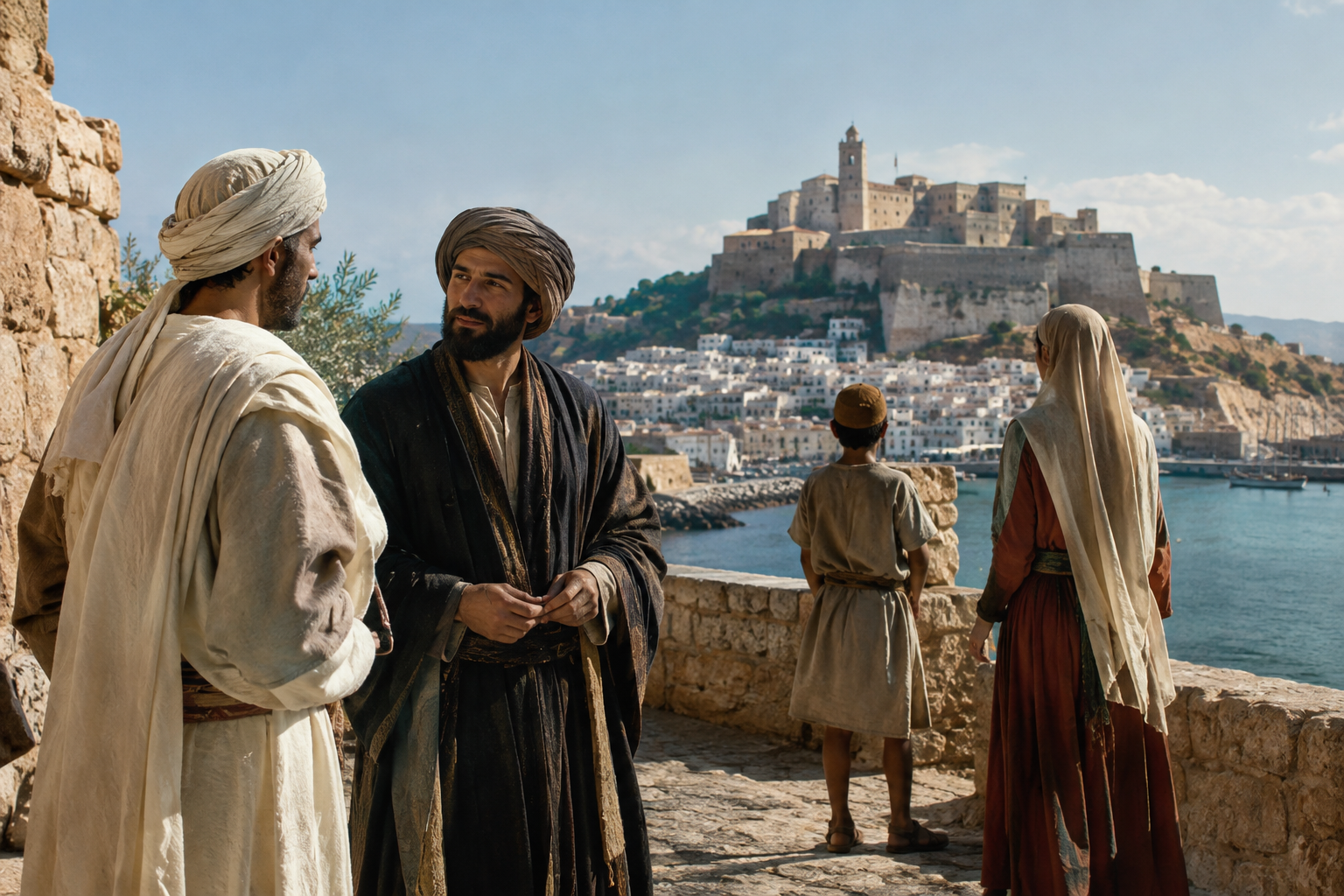
One of the clearest ancient signposts for the Y-DNA haplogroup E1b1b1b1a1c3 in this dataset comes from medieval Ibiza: individual ldo118, dated to around AD 950 and identified with al-Andalus. That is already enough to make the case interesting. Ibiza is often imagined through its Phoenician, Roman, or later Christian past, but in the 10th century it sat within an Islamic western Mediterranean world tied to North Africa, Iberia, and wider sea routes.
So this is not merely a matter of a technical Y-chromosome label turning up on an island. It is a glimpse of one paternal line within a busy medieval contact zone. Y-DNA tracks only a direct male line, not a person's whole ancestry or identity, but in the case of E1b1b1b1a1c3, the Ibiza evidence places that line squarely inside the human mix of Islamic-period western Mediterranean history.
By around AD 950, Ibiza was part of the political and cultural orbit of al-Andalus. That meant maritime connections, trade, religious life, and movement of people across the Balearics, Iberia, and North Africa. A paternal lineage like E1b1b1b1a1c3 appearing in this context is historically plausible not because one route can be proved, but because the island itself was anything but isolated.
The importance of ldo118 lies in context as much as classification. Medieval island communities were often more cosmopolitan than later national stories allow. Ports and coastal settlements gathered soldiers, craftspeople, merchants, enslaved people, administrators, converts, and families with roots in several regions at once. A single Y-line cannot tell us which of those histories belongs to this man, but it can anchor the broader picture in a real excavated person.
That wider picture has become sharper through recent work on Islamic-period burials from the island. An ancient DNA study of these remains, linked here through research on medieval Islamic Ibiza burials, has drawn attention to both genetic diversity and disease history in this community. The larger lesson is an old archaeological one: islands are often crossroads.
The haplogroup name here is very specific: E1b1b1b1a1c3. That matters. The broader E1b1b family is widespread and historically important across parts of Africa, the Mediterranean, and adjacent regions, but a narrow sub-branch should not be handed the entire backstory of its parent lineage as if nothing changed along the way. In this article, the secure point is the medieval Ibiza occurrence.
In other words, it is safer to say that this branch was present in a 10th-century al-Andalus setting on Ibiza than to build an overly neat tale about exactly when or how that branch first arrived in the Balearics. Archaeogenetics is often most revealing when it resists tidy nationalist maps. A medieval Muslim cemetery on an island off eastern Iberia is precisely the sort of place where lineages from different shores might meet.
Ibiza's medieval population did not appear from nowhere. Long before the Islamic period, the Balearics had been tied into wider Mediterranean systems: Phoenician seafaring, Roman administration, late antique transformations, and then the Islamic centuries. Each phase changed who moved, settled, married, ruled, and buried their dead there.
That is why the Ibiza sample should be read against a long regional history rather than a single event. The island world between Iberia and North Africa has repeatedly shown evidence of mobility and mixture. Genetic work on Iberia and the islands has made this increasingly clear, especially for the Roman and medieval periods, when imperial and post-imperial networks reshaped local populations in complicated ways.
Roman Hispania's Genetic Legacy
For readers interested in the deeper island setting, the Balearics are not a genetic footnote to the mainland. They have their own layered demographic history. Studies of island populations repeatedly show a combination of continuity and fresh arrivals, with different periods leaving different signatures. That makes an Islamic-period paternal lineage especially valuable: it belongs to a moment when the Balearics were linked strongly southward and eastward as well as to Iberia.
One trap in writing about medieval Islamic Iberia is to imagine a single incoming population replacing a previous one. The archaeology and genetics both point elsewhere. Al-Andalus was socially and biologically varied, drawing together people with local Iberian roots and others with connections to North Africa and beyond. The result was not uniformity but a shifting spectrum of communities.
That makes ldo118 useful beyond the haplogroup label itself. He stands as evidence that the paternal landscape of Islamic Ibiza included lineages associated with broader Mediterranean and African-linked histories. Yet we should resist turning him into a mascot for an entire island, let alone for all of al-Andalus. Ancient DNA is strongest when many individuals are read together, cemetery by cemetery, century by century.
This broader point fits neatly with other recent work from Iberia. Ancient DNA studies from early medieval and medieval Spanish contexts have been revealing populations that were locally rooted but far from homogeneous. The old idea of neat blocks of "Visigoth," "Iberian," "Muslim," or "North African" ancestry becomes much harder to maintain once excavated individuals begin speaking for themselves.
Diverse Origins in Medieval Spain
At first glance, one sample may seem slight evidence for an article on a haplogroup. But archaeology is full of cases where a single well-placed burial changes the sort of questions we ask. Here, ldo118 places E1b1b1b1a1c3 within a documented medieval Islamic cemetery from Ibiza, not in abstraction but in time and place.
That matters especially for people exploring paternal ancestry today. Modern distributions can be shaped by many later events, but ancient and medieval individuals show where a lineage actually was at a given moment. In this case, the evidence ties the branch to the social world of 10th-century al-Andalus in the Balearics: an island society connected by sea, religion, governance, and trade to several coasts at once.
It also offers a useful corrective to over-simple stories of the Balearics as peripheral. Medieval Ibiza was not a forgotten edge. It was part of a maritime corridor where people, pathogens, goods, and ideas circulated. The genetics now help make that circulation visible in human terms.
Balearic Islands Through 3,000 Years
The most responsible conclusion for E1b1b1b1a1c3 is also the most interesting one. This branch is attested here in a real medieval individual, ldo118, from Islamic Ibiza around AD 950, placing it within the intensely connected world of the western Mediterranean under al-Andalus. For someone tracing this paternal line today, that does not promise a single origin story or a straight road to one people. It suggests something better: that your direct male line may belong to the long, entangled history of movement between Iberia, the Balearics, and the southern shores of the Mediterranean.


Comments