Haplogroup E1b1b1b1a

– 5 min read


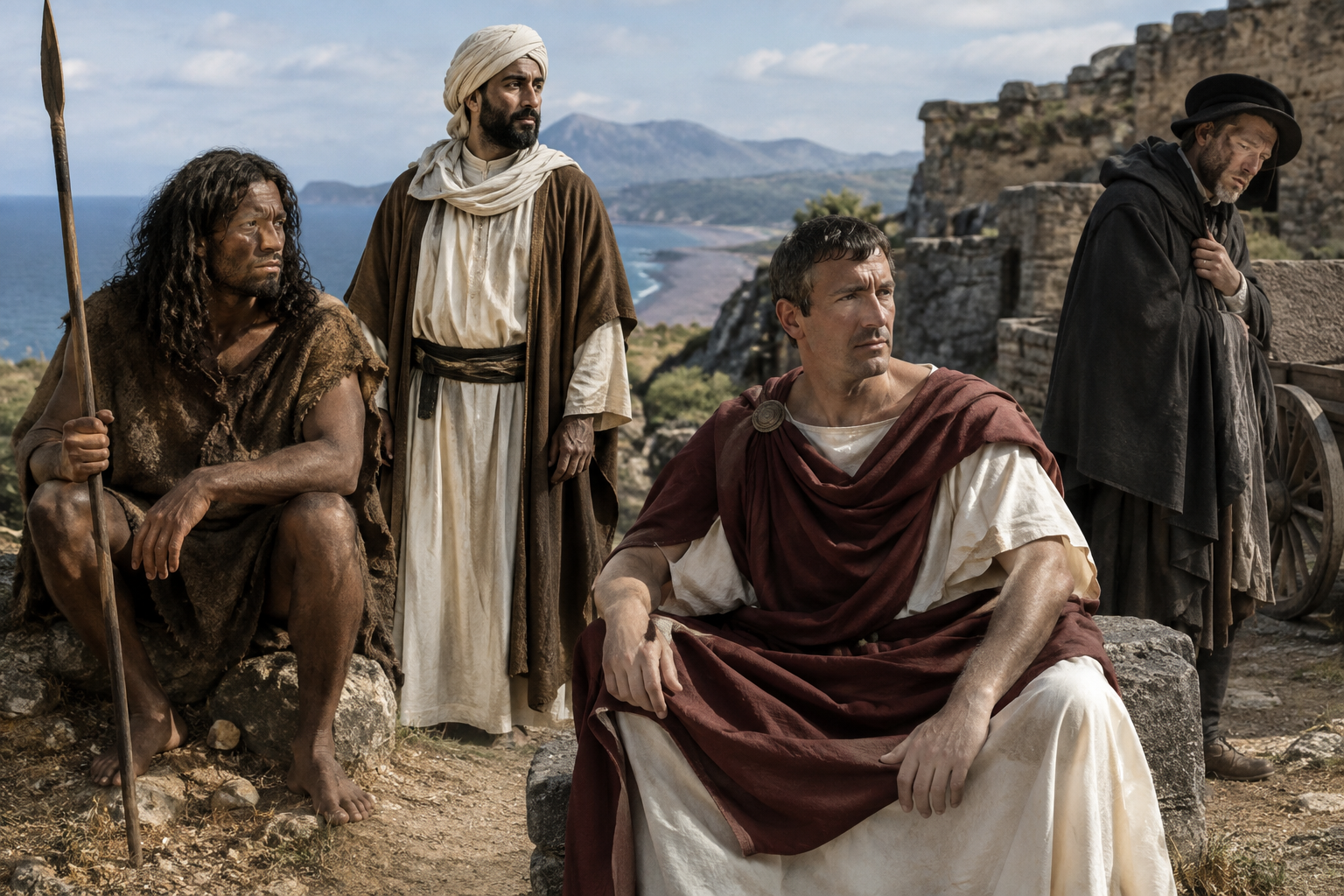
At Lomo Galeon on Gran Canaria, one late Guanche individual dated to around AD 1250, sample CAN.023, carries a paternal line reported here under E1b1b1b1a. That is interesting not because one burial can stand for an entire island, but because the Guanches occupy such a striking place in Atlantic history: an Indigenous North African-derived population living on the Canary Islands before the Castilian conquest, preserving a story of migration, isolation, and local continuity at the ocean's edge.
This is a useful way into the haplogroup itself. E1b1b1b1a is a branch within the wider E1b1b1 family, a paternal lineage with deep roots in parts of Africa and the Mediterranean world. Y-DNA traces one direct male line only, not a person's whole ancestry, yet when the same branch appears in island, Roman North African, Islamic Iberian, and later central European contexts, it becomes a neat reminder of how connected the western Mediterranean could be over many centuries.
The Guanche-related sample CAN.023 belongs to the late pre-Hispanic history of Gran Canaria, a period when island communities had long been developing in relative isolation after their ancestors first arrived from North Africa. Archaeology and genetics together have steadily sharpened that picture: the Canary Islands were not populated from nowhere, nor were they culturally frozen. They were part of a long human story linking Atlantic islands to the Maghreb, while still producing distinct local societies of their own.
A genetic study of ancient Canary Islanders published in Nature Communications has helped clarify that broader background, showing both North African connections and island-specific demographic histories. Within that frame, a paternal lineage such as E1b1b1b1a fits comfortably into the kind of ancestry pattern one might expect from populations shaped by prehistoric and later North African movements, rather than by a single dramatic event.
What matters here is scale. A haplogroup match does not turn CAN.023 into a spokesman for all Guanches, still less for all Canary Islanders. But it does place this one man within a documented archaeological setting where North African-linked paternal ancestry is historically plausible and scientifically meaningful.
A very different appearance of the same haplogroup comes from Roman North Africa: sample R10770 from the Necropolis Orientale at Sitifis in present-day Algeria, dated here to around AD 210. Sitifis was no isolated outpost. Under Roman rule it was an important town in Mauretania Sitifensis, part of an urban landscape tied into imperial administration, trade, military movement, and the dense social life of the Roman provinces.
This context is especially revealing for E1b1b1b1a because it shows the lineage not simply in a vaguely "African" frame, but in a specifically Roman one. The empire did not erase local ancestry. Instead, it brought together old regional populations, newcomers, soldiers, merchants, freed people, and administrators in ways that often left genetic signatures of mixture rather than replacement.
So R10770 is valuable not because it proves a grand migration route all by itself, but because it anchors this paternal branch in a firmly urban, historically legible North African setting during the high Roman Empire. If the Guanche sample hints at Atlantic island continuity from North African founders, the Sitifis burial shows the same broader paternal world operating on the mainland, inside one of Rome's most interconnected provinces.
The sample ldo140, dated here to about AD 950 from Medieval Era Ibiza Al-Andalus, adds another layer. Medieval Ibiza belonged to the Islamic western Mediterranean, and that matters enormously. Al-Andalus and the Balearics were not remote backwaters but active nodes in a world linking Iberia, North Africa, the central Mediterranean, and beyond through trade, migration, warfare, and faith.
That is exactly the sort of setting in which a lineage like E1b1b1b1a becomes historically interesting. Its presence on Ibiza does not by itself identify language, religion, or ethnic label; genetics is not that tidy. But it does sit comfortably within a period when movement across the sea between the Maghreb and Iberian islands was a normal feature of life, not an exception needing special pleading.
Research on medieval Islamic Ibiza has drawn attention to just this sort of diversity. A recent MyTrueAncestry discussion, Genetic and Disease Diversity in Medieval Islamic Ibiza Burials, is a good companion to this evidence because it places these individuals back into the mixed and mobile society to which they belonged.
More broadly, the Balearics have repeatedly shown how island populations can preserve local continuity while also receiving newcomers. That combination makes them especially useful for understanding paternal lines that recur around the Mediterranean rather than in one narrowly bounded homeland.
The most surprising sample in this set may be ELW036, a post-medieval plague victim from Ellwangen, Germany, dated here to around AD 1550. At first glance, Ellwangen seems very far indeed from Gran Canaria, Sitifis, or Ibiza. But of course that is the wrong way to think about early modern Europe. By the sixteenth century, towns in the Holy Roman Empire were linked into long-established networks of mobility that reached across the Mediterranean and deep into the continent.
A burial in a plague context does not automatically tell us where a man or his paternal ancestors came from, and one should resist the temptation to write a dramatic migration story on scant evidence. Still, ELW036 is a useful reminder that paternal branches associated today with the Mediterranean or North Africa can turn up in central European settings for perfectly historical reasons: military service, trade, craft migration, slavery, mercenary movement, religious displacement, or older population layers that written sources barely register.
An ancient DNA study examining plague-era and historical remains in this broad research space is available at this publication. Even without pressing that paper for details it may not explicitly provide about this one sample, the Ellwangen find belongs to a now-familiar archaeological lesson: European communities that look straightforward in the documents often prove more biologically varied when DNA enters the conversation.
Taken together, these four samples do not define the entire history of E1b1b1b1a. They do something more useful. They show the branch appearing in a set of places that make historical sense when viewed as part of the North African and western Mediterranean sphere: Roman Algeria, the Guanche Canary Islands, Islamic Ibiza, and then, later, a central European town whose population was less closed than old stereotypes suggest.
That pattern is worth lingering over. The western Mediterranean has often been narrated in separate boxes - Roman Africa, Al-Andalus, the Canary Islands, Christian Europe - when in reality people, goods, and families crossed those boundaries constantly. A Y-chromosome lineage cannot reconstruct all those movements by itself, but it can preserve one thin, stubborn thread running through them.
If your paternal line falls under E1b1b1b1a, this small but telling ancient set points toward a history that is at home in North Africa and the wider western Mediterranean, and capable of turning up in island, imperial, Islamic, and later European contexts. The most distinctive insight here is not a single origin myth, but a long record of connection: mainland to island, Africa to Iberia, and Mediterranean worlds to inland Europe.
Comments