Haplogroup E1b1b1b
– 5 min read


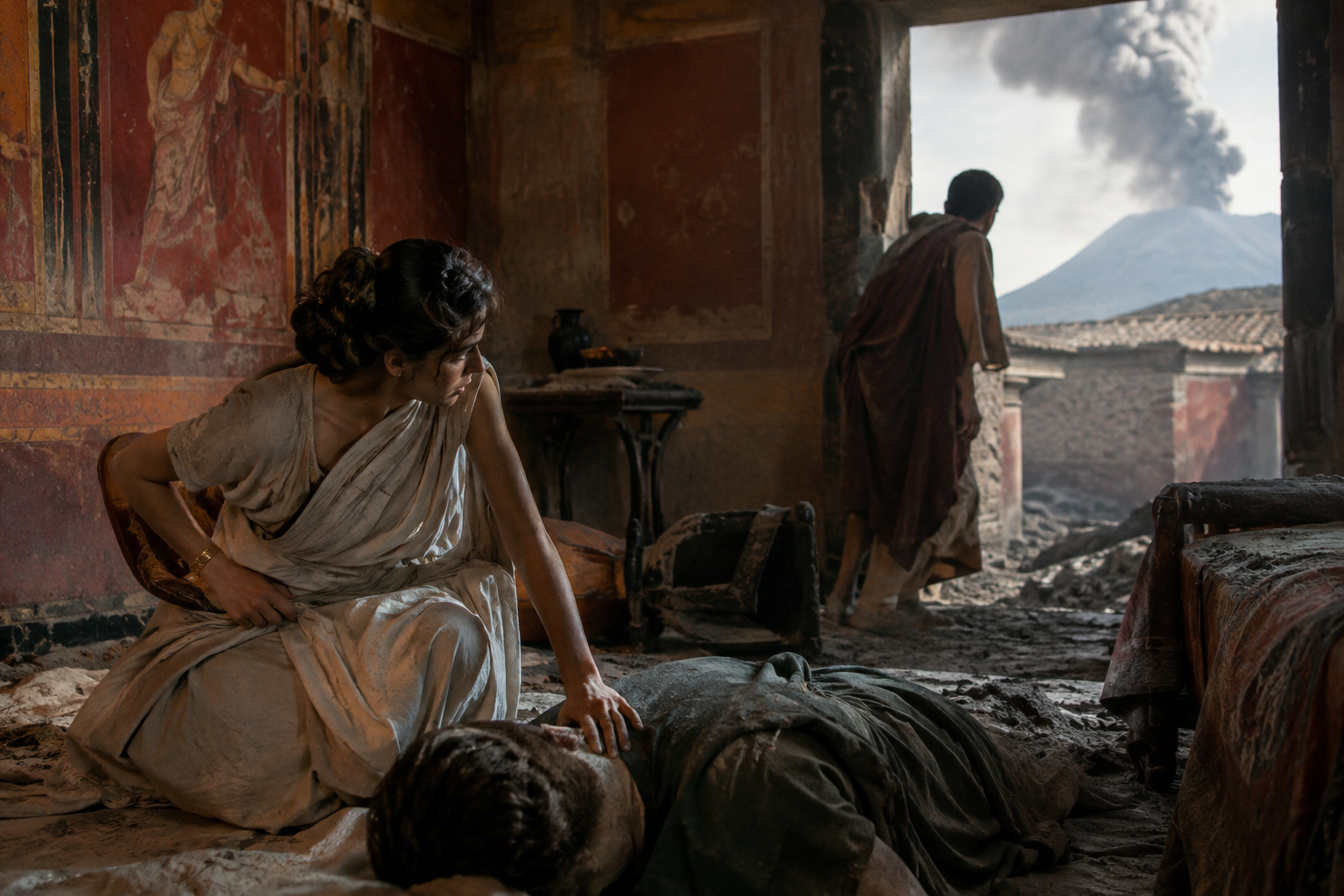
In AD 79, when Vesuvius buried Pompeii under ash and pumice, it also sealed away individual lives with extraordinary precision. One of those lives is known to ancient-DNA researchers as I3691, a victim from the House of the Golden Bracelet. For a Y-chromosome lineage article, that matters because this man has been associated with E1b1b1b, a paternal branch whose history is deeply tied to the Mediterranean world rather than to any single modern nation.
That is the first useful thing to say plainly. Y-DNA traces one direct male line only - father to son to son - so it is never the whole story of a person's ancestry. But in Roman Italy, where empire, trade, slavery, soldiering, migration, and marriage brought people together on a grand scale, even a single paternal line can illuminate just how mixed and mobile ancient urban life could be.
Pompeii has long been famous for its buildings, wall paintings, shops, bakeries, temples, and the terrible intimacy of its destruction. What ancient genetics adds is a new way of looking at the people inside that city at the moment of catastrophe. Sample I3691, identified as a Roman Pompeii Vesuvius victim from the House of the Golden Bracelet, belongs to that rare category of ancient individual who is both archaeologically vivid and historically fixed in time.
The date is unusually secure: AD 79, the eruption of Vesuvius. The place is equally clear: Pompeii, in Campania, one of the best preserved Roman urban sites anywhere in the world. That combination gives this lineage a setting far more informative than a stray bone from an uncertain context. We are not dealing with an abstract branch floating free of history; we are looking at a man caught inside one of the Roman world's most famous cities.
A recent study on Pompeian genomes, published in Current Biology, has helped push this conversation forward by examining individuals from the city within their archaeological setting. Even without forcing more precision than the evidence allows, the broader lesson is important: Roman Pompeii was not genetically simple, and paternal lines associated with Mediterranean populations had a real place in its population history.
E1b1b1b is a substantial branch within haplogroup E, and it has a long and complex history around North Africa, the Balkans, the eastern Mediterranean, and parts of southern Europe. That complexity is exactly why care is needed. The branch name by itself does not tell us whether the paternal ancestors of I3691 came recently from one region, or whether the line had already been present in Italy for many generations before the eruption.
Still, the Roman context makes the finding historically intelligible. By the first century AD, Italy was connected to North Africa, Greece, the Levant, the Adriatic, and Iberia through trade, imperial administration, military service, and movement of enslaved people and freed communities. In that world, a Pompeian man carrying a lineage associated with E1b1b1b is not an anomaly requiring special pleading. He fits the Mediterranean reality of the empire remarkably well.
That is worth emphasizing because Roman identity was civic and social as much as biological. A Pompeian could be local in language, law, dress, and daily life while carrying a paternal line whose deeper history stretched beyond Italy. Ancient DNA keeps forcing us to remember that the Roman world was full of such combinations.
Campania in the early empire was prosperous, densely settled, and outward-looking. Pompeii was not Rome itself, but neither was it a closed provincial backwater. It was a lively urban center tied into coastal exchange networks that linked southern Italy with Sicily, Greece, North Africa, and farther east.
So when a lineage like E1b1b1b turns up there, the real historical question is not "how could that happen?" but "through which layers of Mediterranean history did it arrive?" Some lines may have reached Italy in prehistoric or Iron Age movements across the Adriatic and central Mediterranean. Others may reflect mobility within the Roman period itself. Without a tighter subclade and a broader set of directly comparable local male samples, it would be rash to choose one route too confidently.
But archaeology does not leave us empty-handed. Campania's ports, villas, market towns, and urban households all belonged to an economy that drew in people. The House of the Golden Bracelet, as the context for I3691, reminds us that these were not anonymous demographic flows. They were lives embedded in households, neighborhoods, and the fabric of a Roman city.
Although this article rests on one named ancient individual, the branch itself becomes easier to understand when placed against the wider genetic history of the Mediterranean. E1b1b1b and related lineages appear repeatedly in discussions of southern Europe, the Balkans, and the eastern and southern shores of the Mediterranean. That does not mean every carrier shared the same recent origin, only that this paternal line belonged to the ordinary traffic of Mediterranean history.
Roman Italy is especially important here because it was a meeting ground. By the imperial period, paternal lineages that may once have seemed regionally distinctive were sharing the same streets, households, burial grounds, and civic identities. Ancient DNA from Roman and post-Roman settings increasingly shows that communities across the empire often contained people of varied genetic backgrounds living under the same cultural umbrella.
That broader point lines up well with other work on Roman-era populations in the western Mediterranean. For readers interested in how Roman rule and mobility left durable marks in Iberia as well as Italy, the evidence from provincial communities adds a useful comparison: diversity was not confined to the capital or to a single famous disaster site.
It is easy to underestimate a single Y-DNA assignment. After all, one man cannot stand in for an entire city. Yet Pompeii gives us something unusually powerful: a fixed place, a fixed moment, and an identified ancient individual linked to a known household context. That is far better than a vague statement about population averages.
I3691 shows that a paternal lineage associated with E1b1b1b was present in the urban population of Pompeii at the moment Vesuvius destroyed the city. Historically, that finding sits comfortably within what we know of Roman connectivity. Archaeologically, it anchors the lineage in one of the clearest urban snapshots from the ancient world. Genetically, it offers a tangible reminder that Mediterranean ancestry patterns were already thoroughly entangled inside Roman communities.
There is also a public-facing value to this sort of evidence. People often imagine paternal haplogroups as neat ethnic labels, but Roman Pompeii resists that temptation. A lineage can have deep roots spanning several regions while the individual carrying it lived and died as part of a thoroughly Roman city.
For someone exploring haplogroup E1b1b1b today, the most responsible takeaway is not a grand claim of descent from a famous house or a single migration event. It is something more interesting: this lineage is entirely at home in the connected world of the ancient Mediterranean, and sample I3691 from Pompeii places it squarely inside a real Roman urban community in AD 79. That is a small but vivid piece of evidence - one paternal line, one city, one catastrophic day - and it shows how ancient DNA can turn a haplogroup from a code into a human historical setting.

Comments