Haplogroup E1b1b1a1a1c2

– 5 min read


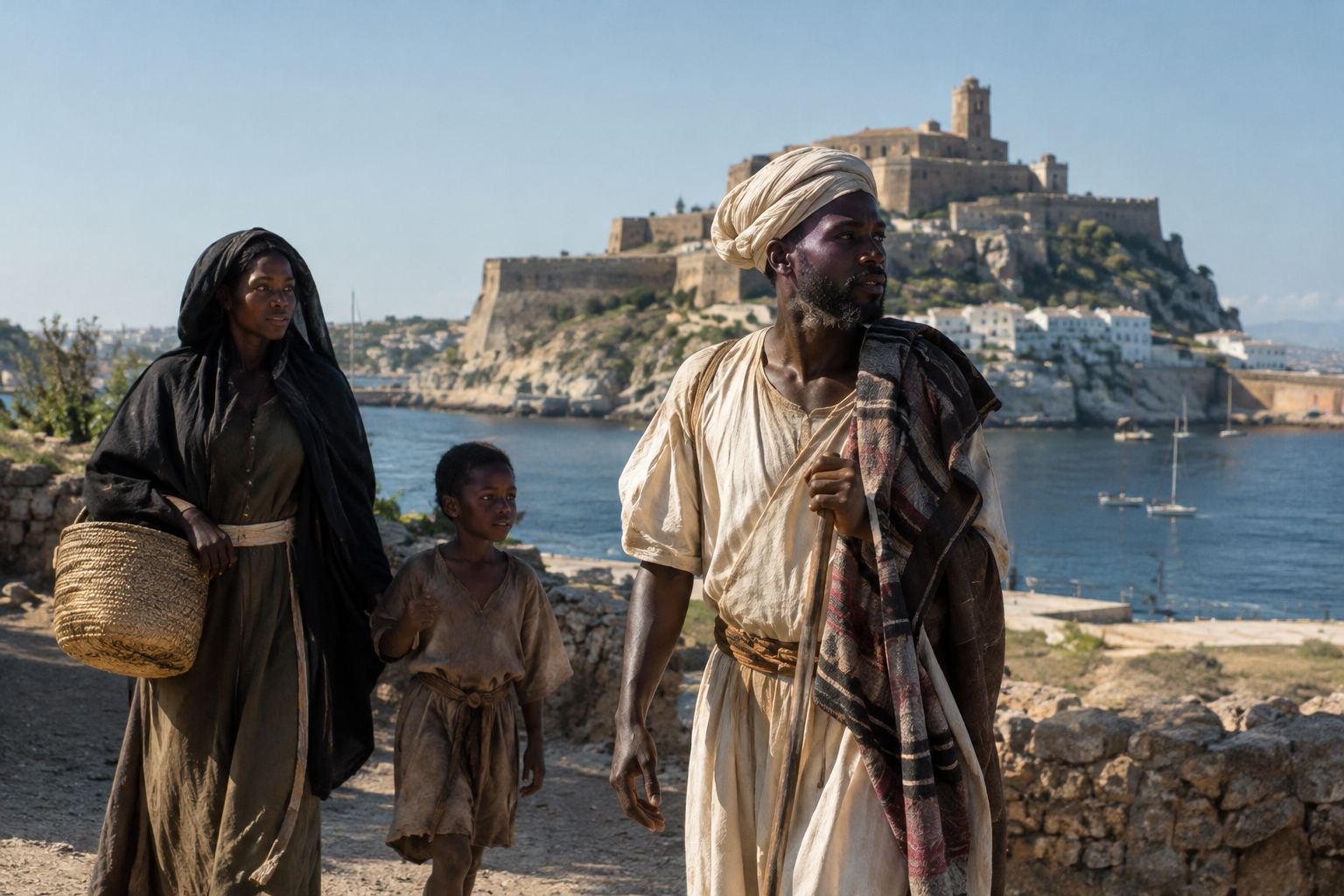
One of the most arresting clues for the Y-DNA haplogroup E1b1b1a1a1c2 comes from a single medieval man buried on Ibiza and identified as sample ldo136, dated to around AD 950. He belongs to the period when the island formed part of al-Andalus, and the striking point is not simply his date or location, but the way his ancestry speaks to the wider human traffic of the western Mediterranean.
Ibiza is often imagined through Phoenicians, Romans, and later Christian conquest, but the medieval Islamic island was also tied into networks stretching far beyond Iberia. In that setting, a paternal line associated here with E1b1b1a1a1c2 appears in an individual described as having Sub-Saharan ancestry. That does not make the haplogroup itself a shortcut to ethnicity; Y-DNA tracks one direct paternal line only. But it does make ldo136 an unusually vivid witness to mobility, connection, and social complexity in the Balearics under Muslim rule.
By the 10th century, Ibiza sat inside a maritime world linking the Iberian Peninsula, North Africa, and the central Mediterranean. Ports mattered, islands mattered, and small communities could still contain people with very different family histories. The burial of ldo136 is important precisely because it shows that this was not an abstract trading map drawn by historians after the fact; it was a world inhabited by real individuals whose ancestors came from different regions.
An ancient DNA study examining medieval Islamic burials on the island has helped bring that population into focus, and the results point to substantial diversity rather than a neatly bounded local gene pool. In that context, ldo136 stands out as evidence that Ibiza was connected not only to nearby al-Andalus and the Maghreb, but also to longer chains of movement that could bring Sub-Saharan ancestry into a Balearic burial ground by the middle of the 10th century. For readers who want the broader archaeological-genetic setting for the island, MyTrueAncestry has a related piece here:
The exact label E1b1b1a1a1c2 is a narrow twig on the larger E1b1b1 tree, a major paternal lineage with a long and complicated history across parts of Africa, the Mediterranean, and western Eurasia. It is worth being careful here. The deeper parent branch has a broad geographic story, but that broad story cannot simply be poured wholesale into this specific subclade without direct evidence.
What the Ibiza case does allow us to say is more modest, and more interesting. It places this paternal line, or a reported association with it, in a documented medieval island context tied to Islamic Mediterranean exchange. That matters because islands are often treated as isolated in popular imagination, when in fact many were busy crossroads. Ibiza was not a sealed jar; it was a harbor society.
Where the evidence is thin, restraint is part of the craft. We should not invent a specific route by which the direct paternal ancestors of ldo136 reached Ibiza, nor assume that one man stands for the whole island. But one securely dated burial can still change the texture of the historical picture by showing that a lineage connected with African ancestry was present in an Islamic Balearic community.
The deeper significance of ldo136 becomes clearer when set against the longer population history of the Balearic Islands. Across prehistory and history, the islands absorbed new people unevenly and at different moments. They were never cut off from the sea around them, and each major political phase brought different kinds of connection.
That makes medieval Ibiza an especially telling setting. Under Muslim rule, the western Mediterranean did not divide neatly into separate civilizations; it functioned through movement, exchange, raiding, resettlement, enslavement, pilgrimage, and commerce. A man like ldo136 fits that historical world rather well. His presence does not need romantic embellishment. The archaeology and genetics are enough to remind us that medieval island communities could be far more cosmopolitan than later national stories like to admit.
For the longer background on island population change, this Balearics overview is useful context:
There is a temptation, whenever African ancestry appears in medieval Europe, to treat it as surprising by definition. But the historical record of Iberia and the Islamic Mediterranean should make us less surprised, not more. Movement between North Africa and Iberia was constant, and those movements could also connect onward, directly or indirectly, to regions south of the Sahara.
What genetics adds is not a dramatic correction to history so much as a firmer grasp of scale and intimacy. Written sources can tell us that long-distance connections existed. A burial like ldo136 shows that those connections entered households, communities, and cemeteries. Human mobility was not just a matter of emirs, merchants, or armies. It could end in an ordinary grave on an island hillside.
Related work on medieval Iberian diversity shows the same broader lesson in other settings: local populations were often more mixed than older narratives allowed. One particularly relevant comparison is Madrid, where ancient DNA has also highlighted varied origins within an early medieval burial ground.
Diverse origins in medieval Madrid
The scientific backdrop to this discussion comes from research on medieval Ibiza and related population history in Iberia. One research lead associated with this sample record can be found here: https://diva-portal.org/smash/record.jsf?pid=diva2%3A2004569&dswid=5259. Since the key point available here is the existence of a medieval Ibiza individual, ldo136, dated around AD 950 and associated with Sub-Saharan ancestry, it is sensible to keep close to that evidence and not embroider beyond it.
Still, a single burial can be powerful. Archaeology often works like that: not by handing us a complete cast list, but by preserving one person in the right place at the right time to force a revision of our assumptions. ldo136 does exactly that for the paternal line E1b1b1a1a1c2. He anchors the haplogroup in a documented medieval western Mediterranean setting shaped by Islamic rule and long-distance contact.
Readers interested in the wider Iberian backdrop may also want this companion article on Roman and post-Roman genetic legacy in Hispania:
Roman Hispania's genetic legacy
For someone exploring E1b1b1a1a1c2 today, the clearest lesson from the ancient evidence is not a grand claim of singular origin, but a historically grounded sense of connection to Mediterranean worlds shaped by movement. Sample ldo136 shows this lineage, or a reported association with it, in medieval Islamic Ibiza, inside a population where African-linked ancestry formed part of the real social landscape.
That is a useful and rather human conclusion. Your paternal line may preserve one narrow thread, but that thread can still lead into some of history's busiest crossroads: islands, ports, frontier societies, and communities made by contact. Ibiza around AD 950 was one such place, and ldo136 is a rare reminder that the medieval Mediterranean was populated by lives far more entangled than older, simpler histories once allowed.


Comments