Haplogroup E1b1b1a1a1
– 5 min read


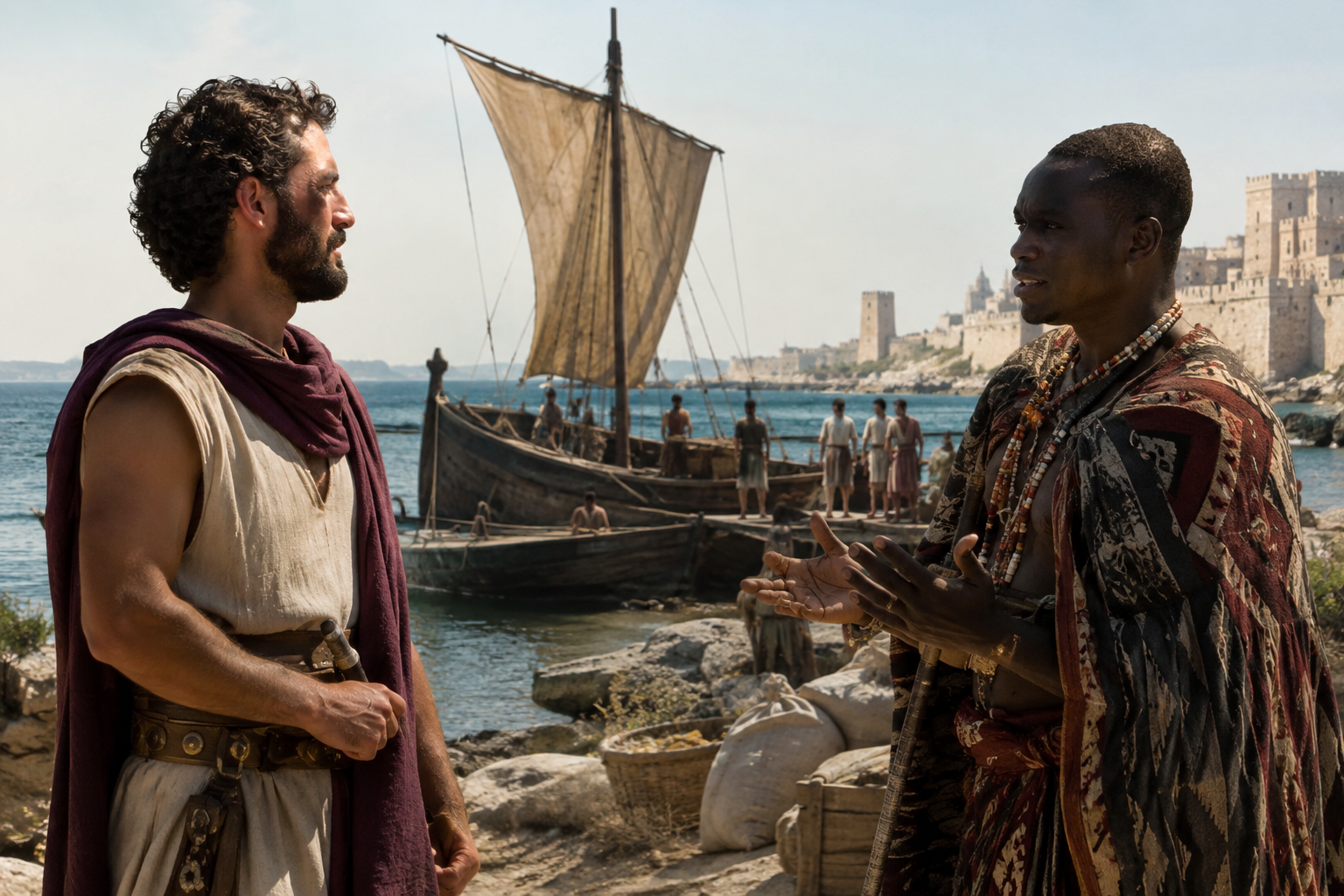
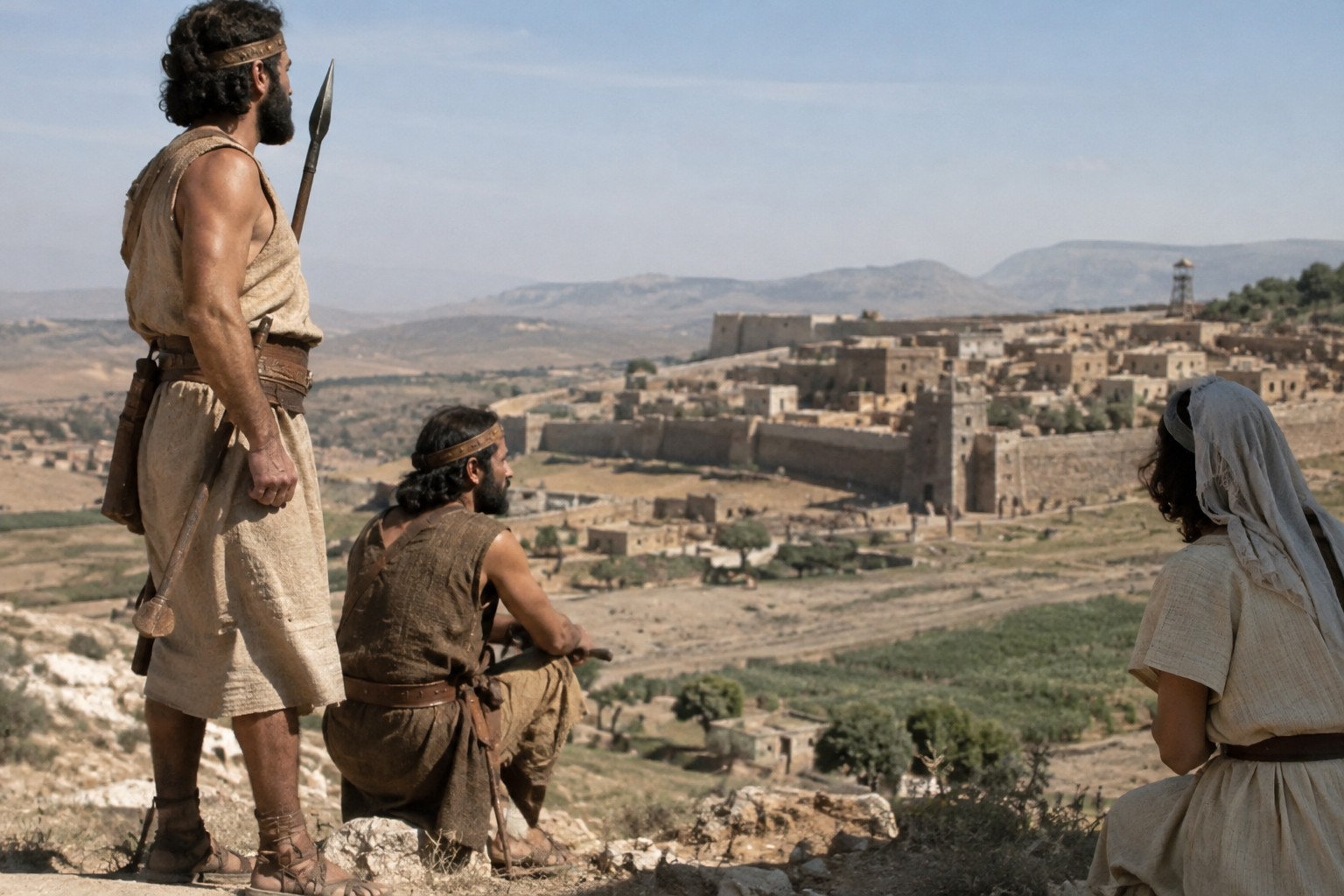
At Achzib on the northern coast of present-day Israel, one ancient man offers a nicely sharp point of entry into haplogroup E1b1b1a1a1. The sample is I11788, dated to around 650 BC and identified as Phoenician. That matters because Achzib was not some remote backwater. It sat in a maritime world of harbours, coastal towns, merchants, sailors, and imperial entanglements, where people, objects, and ideas moved constantly across the eastern Mediterranean.
Finding E1b1b1a1a1 in that setting does not mean "the Phoenicians were this haplogroup", still less that one Y-chromosome can define a people. Y-DNA tracks one direct paternal line out of many. But it does place this branch inside a real Iron Age port community, and that gives the lineage a historically vivid context: not abstract origin stories, but one man from a Levantine coastal settlement embedded in long-distance exchange.
Achzib belonged to the cultural orbit of the Phoenician city-states, the seafaring communities of the Levant famous in Greek and later Roman writing, but better understood archaeologically as urban, commercial, and deeply interconnected societies. A paternal lineage such as E1b1b1a1a1 appearing here fits that wider eastern Mediterranean complexity. The important point is not ethnic labelling, but placement: this branch is present in a documented Iron Age coastal population with strong links outward by sea.
That gives E1b1b1a1a1 a different kind of historical texture from lineages known only from broad modern distributions. Here we can picture the setting with some confidence: a living town on the coast, under the pressures and opportunities of the first-millennium-BC Levant, when Assyrian power loomed and maritime commerce tied ports from the southern Levant to Cyprus and beyond.
A genetic study of ancient Mediterranean populations has helped bring that Phoenician and Punic world into sharper focus, showing just how varied such communities could be biologically as well as culturally. For readers interested in that wider setting, MyTrueAncestry's piece on the diverse origins of the ancient Punic people offers a useful companion to the coastal Levantine story seen at Achzib.
The nomenclature matters here. E1b1b1a1a1 is a specific branch within the much larger E1b1b family, a major Y-chromosome clade with a long and complicated history across Africa, the Mediterranean, and parts of western Asia. It would be careless to pour the whole history of E1b1b into this narrower branch as if every subclade had followed the same route or expanded at the same time.
What the ancient evidence in this article supports is more modest and more useful. This branch, or a classification associated with it, appears in at least two very different archaeological settings: an Iron Age Phoenician coastal site in the Levant, and a much later burial from inland eastern Africa. That is not a tidy single-route migration tale. It is evidence that this paternal line belonged to populations participating in very different historical worlds.
For anyone exploring their own paternal ancestry, that is often the most interesting lesson. Haplogroups do not sit still inside modern borders, nor do they map neatly onto a single language, faith, or identity. The ancient record tends to show them turning up where history was busiest: ports, crossroads, mobile communities, and regions of long contact.
The second sample here is very different in date and geography: I8904 from Kokurmatakore PIA in Kenya, dated to around AD 600. Even from the sparse summary alone, this is already significant. It places E1b1b1a1a1, or a reported association with this branch, in eastern Africa during the late first millennium AD, far from Iron Age Achzib and in a wholly different archaeological landscape.
That distance is precisely why the pairing is interesting. Achzib belongs to a Levantine maritime world; Kokurmatakore points us toward the population history of eastern Africa, where pastoralism, regional mobility, and interaction across ecological zones shaped communities over long periods. One should resist the temptation to draw a straight line between the two men. They are separated by more than a thousand years and by very different local histories.
What they do show, taken together, is that E1b1b1a1a1 cannot be reduced to a single recent historical identity. It appears in both the eastern Mediterranean and eastern Africa, which is exactly the sort of distribution that forces us to think historically rather than tribally. Branches spread, split, persist, and reappear in contexts shaped by trade, marriage, migration, and local continuity.
Research on ancient African population history has repeatedly shown how dynamic these regions were, and a widely cited ancient DNA study of eastern and southern Africa can be linked here as a broad scientific backdrop for understanding the significance of an ancient Kenyan sample: this study of ancient African genomes. It is useful not because it magically explains one Y-lineage, but because it reminds us that eastern Africa's past was densely interconnected.
If there is one historical theme that suits E1b1b1a1a1 especially well on current evidence, it is the importance of contact zones. Achzib was a coast. Kenya, too, belongs to a wider eastern African sphere shaped by movement, whether inland pastoral circulation or links toward the coast and beyond. Ancient DNA often becomes most informative when it turns up in exactly such places, because these are the settings where older local lineages and incoming connections are most likely to overlap.
This does not mean every carrier of the haplogroup was a migrant, merchant, or outsider. Many were surely local people whose paternal lines had been in a region for generations. But archaeology repeatedly shows that the societies in question were not sealed boxes. The Phoenician Levant was tied to Cyprus, North Africa, and the broader Mediterranean. Eastern Africa in late antiquity and the early medieval centuries was equally part of larger regional systems, even when the archaeology is more fragmentary.
That is why a haplogroup article works best when it begins with actual burials rather than grand theories. Sample I11788 and sample I8904 are not symbols; they are ancient individuals from excavated contexts. Their value lies in making E1b1b1a1a1 visible in time and place.
The Phoenician sample naturally invites a Mediterranean reading, but this needs care. A single man from Achzib does not prove that E1b1b1a1a1 was a defining Phoenician paternal marker. Nor does it allow us to project the lineage automatically into every colony and harbour connected with Phoenician expansion. What it does allow is something simpler: this branch was present in an Iron Age Levantine coastal population associated with Phoenician culture.
That matters because the Phoenician and Punic worlds have become increasingly important in archaeogenetics precisely for their diversity. Ancient port populations were often mixtures of continuity and mobility. The more such sites are sampled, the harder it becomes to maintain old-fashioned ideas of neatly bounded "peoples" carrying a single biological signature.
Readers following Mediterranean case studies may also want to compare this with the broader movement of people in Iberia under empire and trade, where lineages from different regions became part of local populations over time.
Some haplogroup articles are dominated by one kingdom, one elite burial ground, or one tightly clustered cemetery. E1b1b1a1a1, at least from the evidence here, stands out for a different reason: its ancient appearances are geographically far apart and socially open-ended. We have a Phoenician-associated coastal individual in the Levant and a later individual from Kenya. That combination resists any lazy one-sentence summary, and that is exactly what makes it historically valuable.
For a present-day tester, the responsible takeaway is not a promise of descent from Phoenician sailors or from one specific African community. It is that your direct paternal line belongs to a branch with credible ancient footprints in regions shaped by mobility and exchange. In other words, E1b1b1a1a1 is a lineage that already appears, in the ancient record, where history was meeting itself.
That is a good place to leave it: not with mythic certainty, but with two real men, two excavated contexts, and a paternal branch that links the Levantine coast and eastern Africa in the only way ancient DNA truly can - by showing that the past was more connected, and more complicated, than tidy labels suggest.
Comments