Haplogroup E1b1a2b2b
– 5 min read


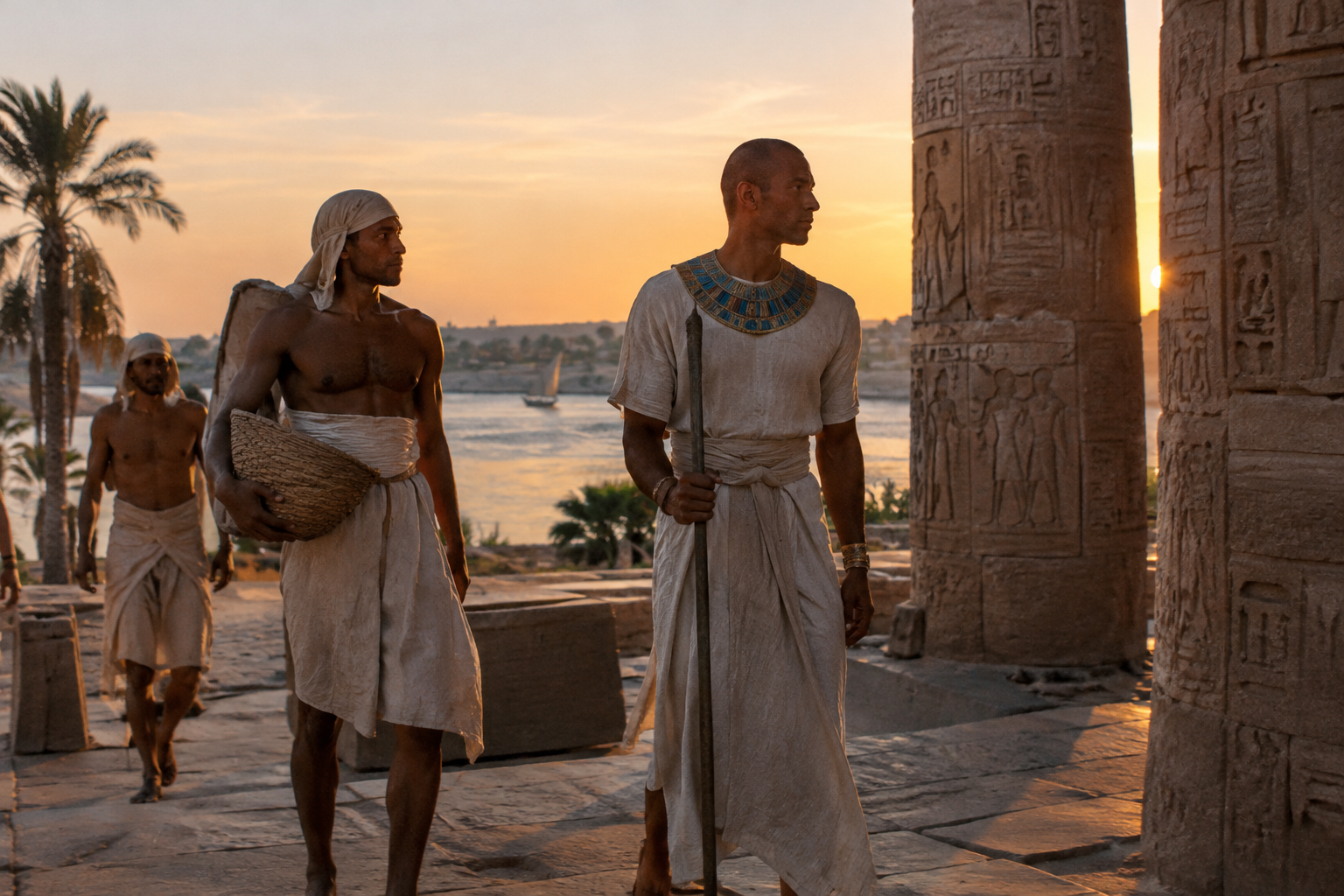
At Luxor, in the long afterlife of pharaonic Egypt, one man from the Third Intermediate Period has become unexpectedly important to the history of paternal ancestry. He is known in the ancient DNA record as THE006b, dated to around 690 BC. His reported Y-DNA association with E1b1a2b2b places a lineage now best known from parts of sub-Saharan Africa directly into the Nile Valley at a historically charged moment, when Egypt was entangled with Nubia to the south, the wider eastern Mediterranean, and shifting powers within the valley itself.
That is what makes this sample so interesting. Not because one burial can stand for all of Egypt, and certainly not because a Y-chromosome line defines a person's whole identity, but because a single paternal lineage can illuminate how connected the Nile world really was. In the case of E1b1a2b2b, the most useful way to understand the evidence is not as a neat tale of one people replacing another, but as part of a much older and more complicated history of movement, family continuity, and mixture along the river.
Luxor was not a marginal place. Ancient Thebes, on the east and west banks of the Nile, remained one of the great ritual and political landscapes of Egypt even after the age of the New Kingdom emperors had passed. By around 690 BC, Egypt had lived through centuries of decentralization, regional power struggles, Libyan dynasts, and the growing importance of rulers from Nubia, especially the Kushite or Twenty-fifth Dynasty.
So when THE006b turns up in Luxor with a Y-line reported as E1b1a2b2b, the finding fits a wider historical truth: Upper Egypt was never sealed off. It sat on one of the great corridors of the ancient world, open southward into Nubia and beyond, and northward into the Delta and the Mediterranean sphere. In that sense, the sample matters less as an isolated curiosity than as a reminder that Egyptian history was made through contact as much as continuity.
An ancient DNA study of Egyptian individuals that includes material from this broad historical setting has helped sharpen that picture, even if each individual must still be treated carefully on his own terms. The relevant research can be found here: https://www.nature.com/articles/s41586-024-07546-2.
E1b1a2b2b is a fairly specific branch within the wider E1b1a family of Y-chromosome lineages. That larger family is strongly associated today with many populations in sub-Saharan Africa, especially across western, central, and parts of eastern and southern Africa. But one must be careful here: the history of a broad parent haplogroup is not automatically the history of every narrower descendant branch, and it would be too simple to project the modern distribution of E1b1a straight back onto one man in first-millennium-BC Thebes.
What we can say is narrower, but still valuable. THE006b shows that a paternal line assigned to E1b1a2b2b, or very near that branch, was present in ancient Luxor by the late seventh century BC. That is solidly compatible with long-standing north-south population links in the Nile corridor. Egypt's southern frontier was never merely a military border; it was also a zone of trade, intermarriage, labor movement, political alliance, and elite mobility.
Y-DNA traces one direct paternal line only: father to son to son across generations. It does not sum up a person's complete ancestry, language, social role, or cultural identity. A man buried in Luxor could carry an E1b1a-derived paternal line and still be, in every meaningful historical sense, part of Egyptian society.
Archaeologists have long known that the Nile connected rather than separated the peoples who lived along it. That sounds obvious, but it is worth dwelling on. We often inherit old maps in our heads, with Egypt in one box and "Africa to the south" in another, as if the cataracts formed a civilizational wall. They did not. They were obstacles, yes, but also channels through which armies, priests, captives, craftsmen, merchants, and families moved.
By the time of THE006b, the political world of the Nile had already been reshaped by rulers from Kush, based farther south in Nubia. The Kushite pharaohs did not appear out of nowhere; they emerged from centuries of interaction between Egyptian and Nubian societies. In that context, a paternal lineage such as E1b1a2b2b appearing in Luxor should not be made exotic. It belongs to the real demographic messiness of the river valley.
This is where ancient DNA is at its most useful. It does not replace archaeology or texts, but it can puncture tidy stories. A lineage found at Luxor may reflect ancestry rooted in Upper Egypt, Nubia, or older movements deeper within northeastern Africa. The responsible answer, for now, is not to force a single route, but to recognize that the evidence points toward connectivity rather than isolation.
North Africa's Genetic History
There is only one ancient individual listed here, and that imposes limits. We cannot turn THE006b into the spokesman for all Thebans, all Egyptians, or all men carrying E1b1a-related lineages. Yet single individuals can still be historically revealing when they appear in a place that matters. Luxor was one of those places: a ceremonial capital, a mortuary landscape, and a node in a river system that linked different populations over very long periods.
In practical terms, samples like THE006b help build a map of where particular paternal branches were present in antiquity. Over time, that matters enormously. It helps distinguish between lineages that arrived recently in a region and lineages that were already there many centuries earlier. For people researching E1b1a2b2b today, the Luxor evidence shows that this branch, or a closely related reported assignment, had reached one of the best-known centers of ancient northeastern Africa by the first millennium BC.
That does not mean every modern carrier of E1b1a2b2b descends from Egypt, nor that Egypt was the point of origin of the branch. It does mean that the Nile valley formed part of the ancient geographical range through which such paternal lines moved and endured.
One of the quieter revolutions of archaeogenetics is that it makes old civilizational categories harder to maintain. Egypt has often been described in ways that pull it away from Africa, or else flatten Africa into a single undifferentiated background. Neither approach survives contact with the evidence. Ancient Egypt was African, but African in a specific northeastern setting, deeply entangled with Nubia, the Sahara, the Levant, and the Mediterranean.
The presence of E1b1a2b2b in an ancient Luxor individual sits very comfortably inside that broader rethinking. It reminds us that the peoples of the Nile were not arranged into neat biological blocks. They were historically connected populations whose identities were made through kingdoms, temples, households, warfare, and exchange. Genetics adds one more strand to that picture, not the whole tapestry.
If your paternal line falls under E1b1a2b2b, the most careful lesson from THE006b is that this branch belongs to an old African story wide enough to include the ancient Nile valley. The Luxor sample does not hand you a royal pedigree or a single homeland. What it offers is something better grounded: evidence that a lineage in this part of the E1b1a family was present in one of the central landscapes of ancient Egypt by around 690 BC, in a world shaped by constant movement along the Nile.
That is a modest conclusion, but an important one. It places E1b1a2b2b inside real archaeology, real chronology, and a real historical landscape where Egypt and inner Africa were connected by far more than modern stereotypes allow.






Comments