Haplogroup E1b1a1a1a1c1a1a3a1d1b

– 5 min read


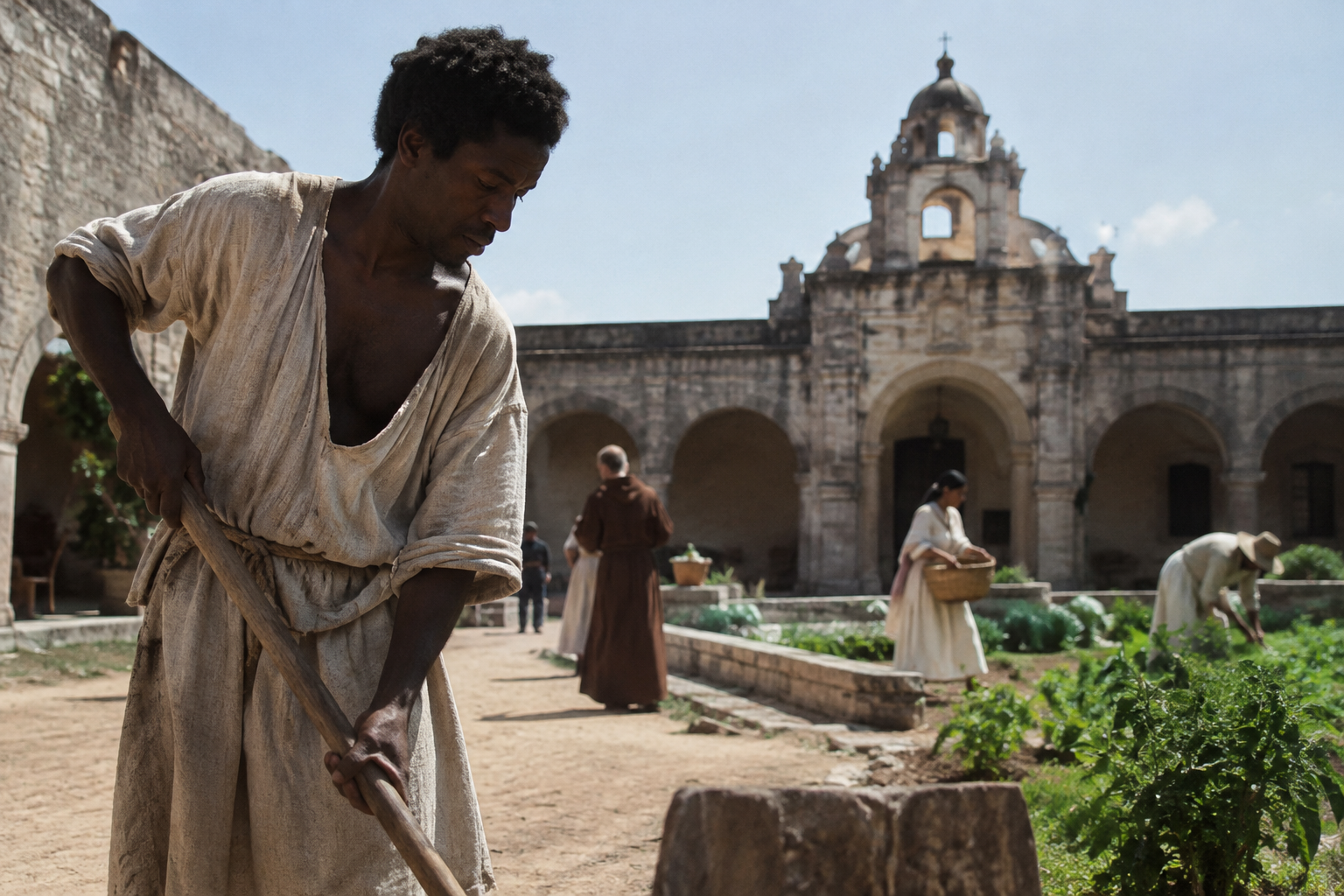
One of the clearest ancient signposts for the Y-DNA lineage E1b1a1a1a1c1a1a3a1d1b comes not from an African kingdom or a deep prehistoric cemetery, but from colonial Mexico. The individual identified as SJN003, described as an African laborer from the Royal Hospital of San José de los Naturales, offers a startlingly direct glimpse of how African paternal lines crossed the Atlantic and entered the documentary world of Spanish America.
That is what makes this lineage historically interesting. The haplogroup itself belongs within the wider E1b1a family, a major set of Y-chromosome branches strongly associated with African paternal ancestry. But this very narrow subclade, E1b1a1a1a1c1a1a3a1d1b, should not be treated as if it automatically carries the whole history of the broader parent branch. What the ancient evidence here shows, more carefully, is that one man in colonial Mexico carried a paternal line tied to African ancestry in a setting shaped by forced migration, empire, labor, and survival.
The Royal Hospital of San José de los Naturales in Mexico City is a remarkable place to encounter this lineage. Founded in the colonial capital to serve Indigenous people, the broader urban world around it was also one of intense demographic upheaval, with Indigenous communities, Europeans, and Africans brought together under Spanish rule. The sample SJN003, dated in the supplied record to 1454 AD, is best understood in practice as belonging to the early colonial context of the site rather than being pressed into an over-precise life story from a single year label.
An ancient DNA study of early colonial Mexico, published in Nature, drew attention to precisely these kinds of individuals: people whose genomes reveal the movement of populations into the Americas under colonialism, including men and women of African origin. In that setting, a Y-chromosome lineage such as E1b1a1a1a1c1a1a3a1d1b is not just a technical classification. It is evidence of the transatlantic slave trade written into the paternal line.
Y-DNA traces one direct male line: father to son, back through time. It does not describe a person's whole ancestry, still less their language, identity, or legal status. Yet in colonial contexts it can be especially revealing, because it sometimes preserves a line of origin even when names, kin networks, and homeland records were broken by enslavement.
For African-descended individuals in Spanish America, that matters enormously. Historical archives tell us that enslaved Africans arrived from multiple parts of West and West-Central Africa, often through brutal commercial systems that reduced human beings to cargo categories. Genetics cannot restore every lost biography. But a lineage like E1b1a1a1a1c1a1a3a1d1b can still point to a paternal ancestry rooted in African population histories long before that line appeared in a colonial hospital burial ground in Mexico City.
It is easy to imagine that the most important ancient DNA comes from royal tombs or richly furnished graves. In fact, hospital burials can be far more revealing about real social history. San José de los Naturales belonged to an urban colonial world marked by epidemic disease, labor extraction, migration, and constant population turnover. Burials from such places capture people who would otherwise be nearly invisible in conventional elite history.
SJN003 matters for exactly that reason. He stands at the intersection of archaeology and the Atlantic slave trade: an African man in colonial Mexico whose paternal ancestry survived in the Y chromosome even though the circumstances that brought him there were part of one of history's greatest systems of coercion. The grave is not important because it is grand. It is important because it is ordinary enough to expose the machinery of empire.
Colonial Mexico City was built on the ruins and continuities of Tenochtitlan, then transformed into one of the great capitals of the Spanish empire. People arrived there from across Mesoamerica, Iberia, Africa, and, indirectly, from other imperial routes as well. Ancient DNA has been especially good at showing that this was not a tidy society of separate boxes, but a city where ancestry, status, and origin could be painfully entangled.
In that larger setting, the presence of an African paternal lineage at San José de los Naturales is not an isolated curiosity. It fits the history of enslaved and free Africans in New Spain, who labored in households, workshops, transport, agriculture, and urban service. Some were born in Africa; others in the Americas. A sample such as SJN003 cannot by itself tell us which applied in his case, but it firmly places African male ancestry inside the early colonial population landscape of central Mexico.
The broader haplogroup family behind this branch, E1b1a, is widely distributed in many African populations today and is often discussed in connection with major demographic expansions within sub-Saharan Africa. That broader background is useful, up to a point. But one must be cautious: the article's lineage is not simply "E1b1a in general" but the much narrower E1b1a1a1a1c1a1a3a1d1b. Without a larger set of ancient samples securely assigned to this exact terminal branch, it would be irresponsible to attach to it a fully mapped migration story of its own.
What can be said is more modest, and more solid. This subclade sits inside a paternal framework that is unmistakably African in deep origin, and one ancient individual associated with it appears in colonial Mexico in a context shaped by forced Atlantic mobility. That is already a powerful historical statement.
African DNA population history
There is also a useful lesson here about scale. A very specific Y-DNA branch can tempt us into overconfidence, as though one label were enough to reconstruct a complete ancestry. It is not. SJN003 was more than a paternal line: he lived in a colonial city, within social systems of race and labor, and among people of many different backgrounds. His genome, if studied more broadly, would speak to much more than one male-line descent.
Still, the Y chromosome has its own peculiar force. For descendants researching paternal ancestry today, lineages like E1b1a1a1a1c1a1a3a1d1b can preserve a connection to African male ancestry across the ruptures of slavery and colonialism. In that sense, the burial at San José de los Naturales is both deeply local and unmistakably global: one man in one cemetery, carrying a history that began far beyond Mexico, and arrived there through the violent remaking of the early modern world.
West African DNA beyond Africa
The strongest evidence for E1b1a1a1a1c1a1a3a1d1b in the ancient record presented here is not a dynasty or a legendary founder, but SJN003 from colonial Mexico. That makes this haplogroup article less a tale of prestige than one of movement, survival, and historical reality. For anyone carrying this paternal branch today, the most responsible takeaway is that your line belongs within a deeply African male ancestry, and that at least one ancient bearer appears in the hard, documented world of the early Atlantic diaspora.
Comments