Haplogroup E1b1a1a1a1c1a1a3a1

– 5 min read


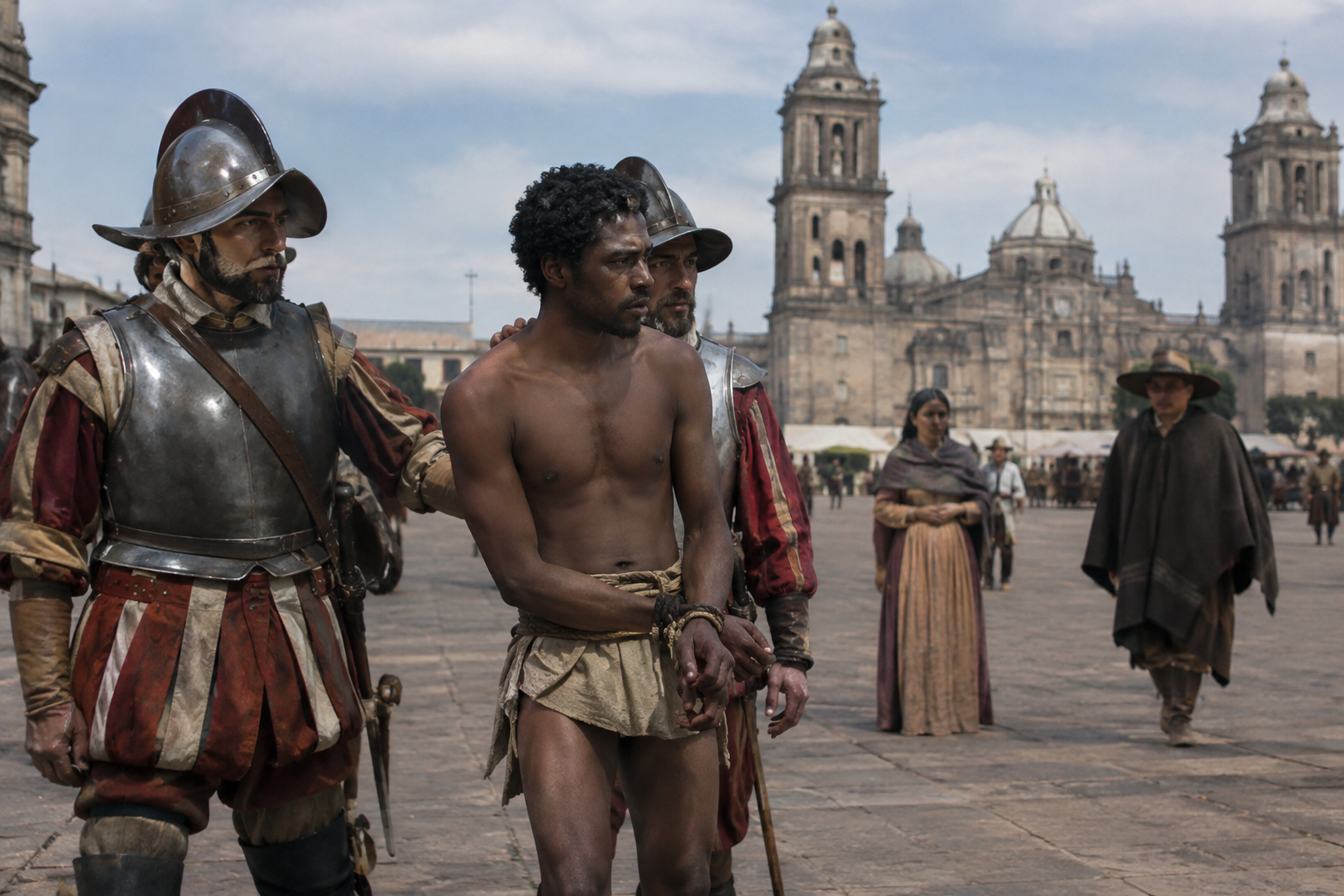
In early colonial Mexico City, one man entered the archaeological record without leaving us his name. He is known instead as SJN003B, dated to around AD 1535 and identified among the remains of people caught up in the first transatlantic slave traffic into New Spain. For a Y-chromosome article, that is already striking enough: the haplogroup attached to him, E1b1a1a1a1c1a1a3a1, places one direct paternal line from Africa firmly inside the violent machinery of the sixteenth-century Atlantic world.
That matters because Y-DNA traces only one line of descent, from father to son to son again, rather than a person's whole ancestry. But sometimes that single line can illuminate a large historical process. In this case, the appearance of E1b1a1a1a1c1a1a3a1 in an early colonial burial from Mexico City gives us a very precise human foothold in a story usually told in vast and impersonal terms: forced migration, imperial expansion, epidemic disease, and the remaking of populations on both sides of the ocean.
SJN003B belongs to the earliest colonial decades, when Mexico City was being built over the ruins of Tenochtitlan and rapidly turned into the administrative heart of Spanish New Spain. This was not a stable or neatly ordered society. It was a city of conquest, rebuilding, coerced labor, epidemic crises, religious transformation, and intense long-distance movement.
Within that world, first-generation Africans were not a marginal presence. They were brought across the Atlantic very early, and often under brutal conditions, to serve colonial households, workshops, transport systems, and urban labor demands. A study focused on these early colonial African individuals in Mexico, available here at ResearchGate, helped bring this buried population into clearer view.
The haplogroup itself should be handled carefully. E1b1a1a1a1c1a1a3a1 is a very narrow branch within the much broader E1b1a family of Y-chromosome lineages, many of which are especially associated with West and West-Central African paternal history. What the Mexican sample shows securely is not the whole history of that branch, still less the identity of every man who carried it, but that one bearer of this direct paternal line was among the Africans drawn into the earliest colonial population of Mexico City.
There is always a temptation, when faced with a long terminal haplogroup name, to turn it into a ready-made migration map. That would be too confident. A deep subclade like E1b1a1a1a1c1a1a3a1 is not the same thing as a neatly documented ethnic label, nor can it by itself identify a language, kingdom, or port of embarkation.
What it does do is narrow the lens. Instead of speaking vaguely about "African ancestry" in the colonial Americas, we can point to a documented paternal lineage in a documented early colonial context. Archaeology and ancient DNA together turn abstraction into biography, even when the biography is painfully incomplete.
This is one reason such finds matter to MyTrueAncestry users. If your paternal line falls somewhere within this branch, SJN003B is not a symbolic ancestor and not proof of a personal genealogical link. He is something better, in a way: hard evidence that men from this paternal background were present in one of the earliest and most consequential colonial cities in the Americas.
The historical setting here is grimly specific. By the 1530s, Spanish colonial society was already drawing enslaved Africans into the urban fabric of New Spain. Mexico City, connected by sea to the Caribbean and to Iberian Atlantic routes, became one of the places where African lives were broken apart and repurposed by empire.
Ancient DNA does not soften that history, but it does sharpen it. Instead of seeing the slave trade only as shipping totals or royal decrees, we meet an individual body in a burial assemblage and a paternal lineage with roots in Africa appearing in the heart of colonial Mexico. That is the sort of scale change archaeology does so well: from world system to human remains.
West African DNA in Early England
There is also an important chronological point. SJN003B is not a late plantation-era case from centuries after the slave trade began. He belongs close to the beginning of Spanish colonial rule in central Mexico. That makes this lineage's appearance especially valuable, because it shows how early African paternal lines were being inserted into the new colonial population structure.
Mexico City was one of the great meeting points of the sixteenth-century world. Indigenous survivors of conquest, Spaniards from different regions, people of African birth, and later their descendants lived in proximity under intensely unequal conditions. In such places, genetic history becomes inseparable from political history.
That is why this sample should not be treated as merely exotic evidence of "mobility." Mobility can sound almost adventurous. In this case, the movement was coerced, and the archaeology belongs to the history of enslavement. The paternal line E1b1a1a1a1c1a1a3a1 appears here not as an abstract marker on a phylogenetic tree, but in the life of a man displaced by one of the most destructive systems in early modern history.
There is a useful parallel with other studies of diverse burials in post-Roman and medieval Europe: ancient DNA often shows that towns, ports, and frontier zones were more mixed than older nationalist histories liked to admit. But colonial Mexico is a harsher version of that story, because the diversity was produced not simply by trade and travel, but by conquest and enslavement on a massive scale.
Diverse Origins in Early Madrid
Broadly speaking, lineages within E1b1a are central to the paternal history of many populations in West and West-Central Africa, regions heavily targeted by the Atlantic slave trade. That wider background makes the Mexico City finding historically plausible. But the exact subclade in this article is much narrower than the parent branch, and we should resist pretending that all the deeper branching history is already mapped in detail for this one ancient individual.
Even so, the find has real interpretive power. It joins genetic evidence to historical records showing that the earliest African arrivals in colonial Mexico were not a vague undifferentiated mass. They carried many different family histories, languages, and regional identities, even when colonial systems tried to erase them. A Y-chromosome branch such as E1b1a1a1a1c1a1a3a1 is one surviving fragment of that lost complexity.
For readers interested in how ancient DNA keeps unsettling older, simpler pictures of movement and ancestry, the wider lesson is familiar: populations are rarely tidy. The same is true in colonial contexts, where African, Indigenous, and European histories met under conditions that were often unequal, violent, and biologically consequential.
How Ancient DNA Rewrites History
The most distinctive thing about E1b1a1a1a1c1a1a3a1, as presently documented here, is not a royal pedigree or a famous battlefield. It is its appearance in SJN003B, an early colonial African in Mexico City, where one paternal line from Africa was caught and preserved in the archaeological record of the Atlantic slave trade. For anyone researching this haplogroup today, that is a serious and meaningful point of contact: not a promise of exact descent, but a reminder that this line belongs to a history reaching from African homelands into the first generations of colonial America.
Comments