Haplogroup E1b1a1

– 6 min read


There is something especially arresting about haplogroup E1b1a1 because it refuses to stay inside modern borders or tidy historical categories. In the ancient DNA record, it appears in places that force us to think less in terms of isolated nations and more in terms of movement: movement across African landscapes in deep time, movement through Indian Ocean trading towns, movement into medieval English communities, and movement under the brutal coercion of the Atlantic slave trade. A Y-chromosome line like this can be narrow in one sense, following only the direct paternal line, yet surprisingly expansive in what it reveals about human history.
That is worth stating clearly at the outset. Y-DNA haplogroups trace one direct paternal lineage only: father to father to father. They do not describe a person's full ancestry, culture, language, or identity. But they are still one of the most useful tools we have for tracing long-range male-line population history. In the case of E1b1a1, ancient and historical evidence places it within the wider E1b1a branch that is especially important in the population history of sub-Saharan Africa, including regions strongly shaped by the spread of farming, metallurgy, and later long-distance exchange. What makes the supplied evidence so compelling is that it shows this paternal line not in abstraction, but in named individuals from Botswana, Tanzania, England, and Maryland.
E1b1a1 belongs to a wider cluster of Y-chromosome lineages that are today strongly associated with many populations of western, central, and southern Africa. In broad terms, scholars often discuss such lineages in connection with the expansion of farming communities and later Iron Age societies across large parts of sub-Saharan Africa. The exact route and timing of every branch is still being refined, and one must be cautious not to flatten the history of a specific subclade into the whole history of a much larger parent lineage. Still, the broad picture is clear enough: E1b1a1 sits within one of the major paternal histories of African population growth and dispersal.
That larger story matters because it helps explain why ancient DNA evidence for this haplogroup can turn up in very different settings. A paternal line that became widespread across much of sub-Saharan Africa could later enter Swahili towns on the East African coast, appear in southern African Iron Age contexts, and, through forced migration in the early modern Atlantic world, be carried into the Americas. The line itself is not a culture. But it can mark the pathways by which men and their descendants became part of very different societies.
Explore African Population History
One of the most informative samples in this set is TAU001, from Taukome Botswana Iron Age, dated to 950 AD. This is a valuable anchor because it places E1b1a1 in an African archaeological context tied to Iron Age society in southern Africa. By this period, southern Africa had long been shaped by communities practicing farming, herding, and metallurgy, and paternal lines such as E1b1a1 form part of that historical background. TAU001 does not, by itself, tell us everything about local identity or language. But it does fit the wider evidence that lineages within E1b1a were well established in African Iron Age populations.
Then there is I19548, from Medieval Tanzania Songo Mnara, dated to 1430 AD. Songo Mnara was no isolated village. It belonged to the Indian Ocean world: a place of merchants, mosques, stone houses, imported goods, and maritime links stretching from the African mainland to Arabia, Persia, and beyond. Finding this paternal lineage in that setting is a reminder that African history cannot be reduced to inland migration alone. East African coastal towns were hubs of exchange, and African paternal lines were part of those cosmopolitan communities. E1b1a1 here is not a relic on the margins; it is part of an urban medieval African story.
These two samples, TAU001 and I19548, already show the line in distinct settings: one in the interior of southern Africa, another on the East African coast. Together they suggest not a single fixed homeland in any simplistic sense, but a history of spread and incorporation into multiple regional societies.
Discover How Ancient DNA Reconstructs History
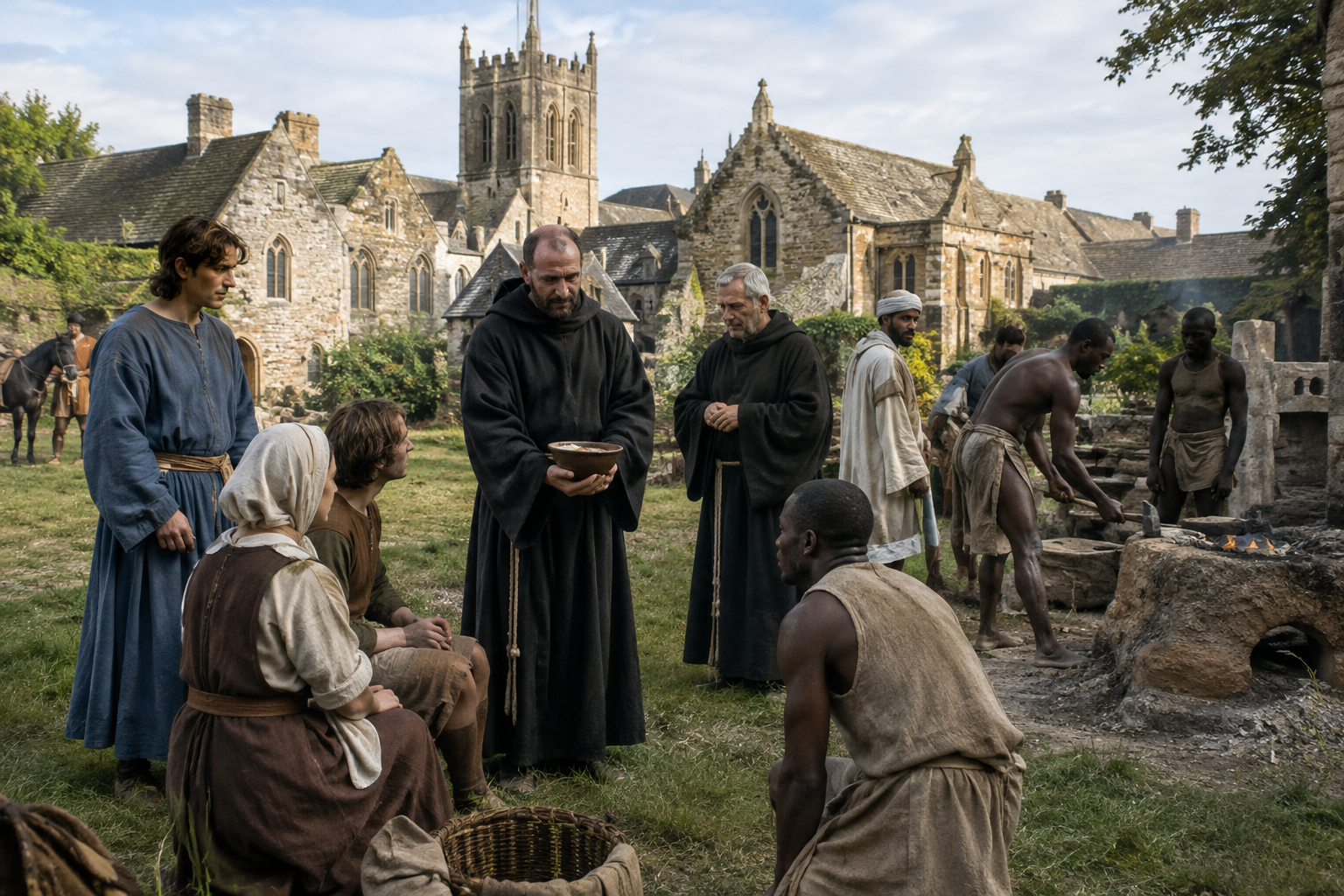
The English samples are perhaps the most startling to readers who still imagine medieval Europe as genetically sealed off from the wider world. Here the evidence says otherwise. We have ATP_PSN_225 and ATP_PSN_25 from Medieval England Cambridge St Johns Hospital, both dated to 1250 AD, and ATP_PSN_193 from the same Cambridge hospital site, dated to 1209 AD. There is also ATP_PSN_742 from Late Medieval England All Saints, dated to 1150 AD; ATP_PSN_517 from Medieval England Augustinian Friars, dated to 1290 AD; and two further individuals from Late Medieval England Clopton Cambridgeshire, ATP_PSN_1270 and ATP_PSN_1267, both dated to 1300 AD.
What do these burials show? First, they show that a paternal lineage associated today above all with sub-Saharan Africa could be present in medieval English contexts. That does not mean all these men shared a recent ancestor, nor does it mean we can assign them a neat ethnic label from Y-DNA alone. It does mean, however, that medieval England contained more human variety than older narratives allowed. Hospital cemeteries, friaries, parish grounds, and village sites could all include people whose paternal ancestry pointed far beyond the British Isles.
Cambridgeshire is especially interesting in this respect. It was not some remote backwater. Medieval Cambridge was a place of clerics, scholars, traders, the sick poor, and travellers. A hospital burial such as St John's or a religious site such as the Augustinian Friars catches precisely the sort of mixed social world that written chronicles often overlook. Ancient DNA lets those hidden biographies re-enter the story, cautiously but unmistakably.
Read More on Cambridgeshire Ancient DNA
The latest sample in the set is also the most sobering: I15341, identified as an Enslaved Laborer Catoctin Iron-Working Furnace Antebellum Maryland, dated to 1810 AD. Here E1b1a1 appears in a context created not by ordinary migration or trade, but by enslavement. This sample is a direct reminder that Y-DNA lineages were carried not only by family expansion or regional settlement, but by coercion, sale, and forced displacement across the Atlantic.
Placed beside TAU001 and I19548, the Maryland individual gives the article its full historical arc. The same broad paternal lineage visible in African Iron Age and medieval African settings later appears in the Americas under the violence of plantation and industrial labor systems. Ancient DNA does not erase that history into a neutral pattern of movement. Quite the opposite: it sharpens it.
This is why E1b1a1 is historically important. It is not merely a label on a tree of mutations. It is one of the paternal signatures through which we can track African demographic history, medieval Afro-Eurasian connectivity, and the devastating consequences of the slave trade.
In this case, the supplied field for associated noble families and castles is empty. That absence is actually a useful reminder of how evidence works. Not every haplogroup article can or should be attached to a named dynasty, baronial house, or ancestral stronghold. Sometimes the most revealing history lies elsewhere: in hospital cemeteries, friary burials, trading towns, village churchyards, and industrial sites where the written record is thin and genetics opens a different window.
That does not make the story lesser. In some ways it makes it richer. Medieval castles preserve the memory of those powerful enough to leave charters, seals, and stone walls. Ancient DNA often preserves the memory of everyone else. For a lineage such as E1b1a1, the supplied evidence pulls us toward communities that formal genealogy rarely captures: patients in Cambridge, townsmen in coastal Tanzania, an Iron Age man in Botswana, and an enslaved worker in Maryland.
Explore African Ancestry in Early England
The real lesson of E1b1a1 is that paternal ancestry can illuminate connections across enormous distances without collapsing all those people into one identity. A man from Taukome, a resident of Songo Mnara, a burial from medieval Cambridge, and an enslaved laborer in Maryland may share a broad paternal lineage, but they belonged to very different historical worlds. Genetics helps us see that those worlds were linked by population history. It does not tell us they were the same.
Used carefully, Y-DNA adds a vital dimension to archaeology and history. It can show continuity across regions, highlight movement where documents are silent, and complicate modern assumptions about who belonged where. E1b1a1 does all of that. It points to the depth of African paternal history, the mobility of people in the medieval world, and the human cost of forced migration in the modern one.
If you want to keep exploring how DNA can transform historical questions, readers interested in wider British population change may also enjoy this look at Genomic History and Natural Selection in Roman and Early Medieval Britain, which helps place surprising lineages in a broader island context.
Upload your DNA to MyTrueAncestry and you can explore whether your results show connections to ancient individuals, archaeological cultures, and long-distance population histories like those discussed here. Those matches do not automatically prove direct descent from any one ancient person, still less membership in a famous family. But they can offer a remarkable new way of seeing where one branch of your ancestry fits into the human past.
Comments