Haplogroup D1a2a1c1a

– 4 min read


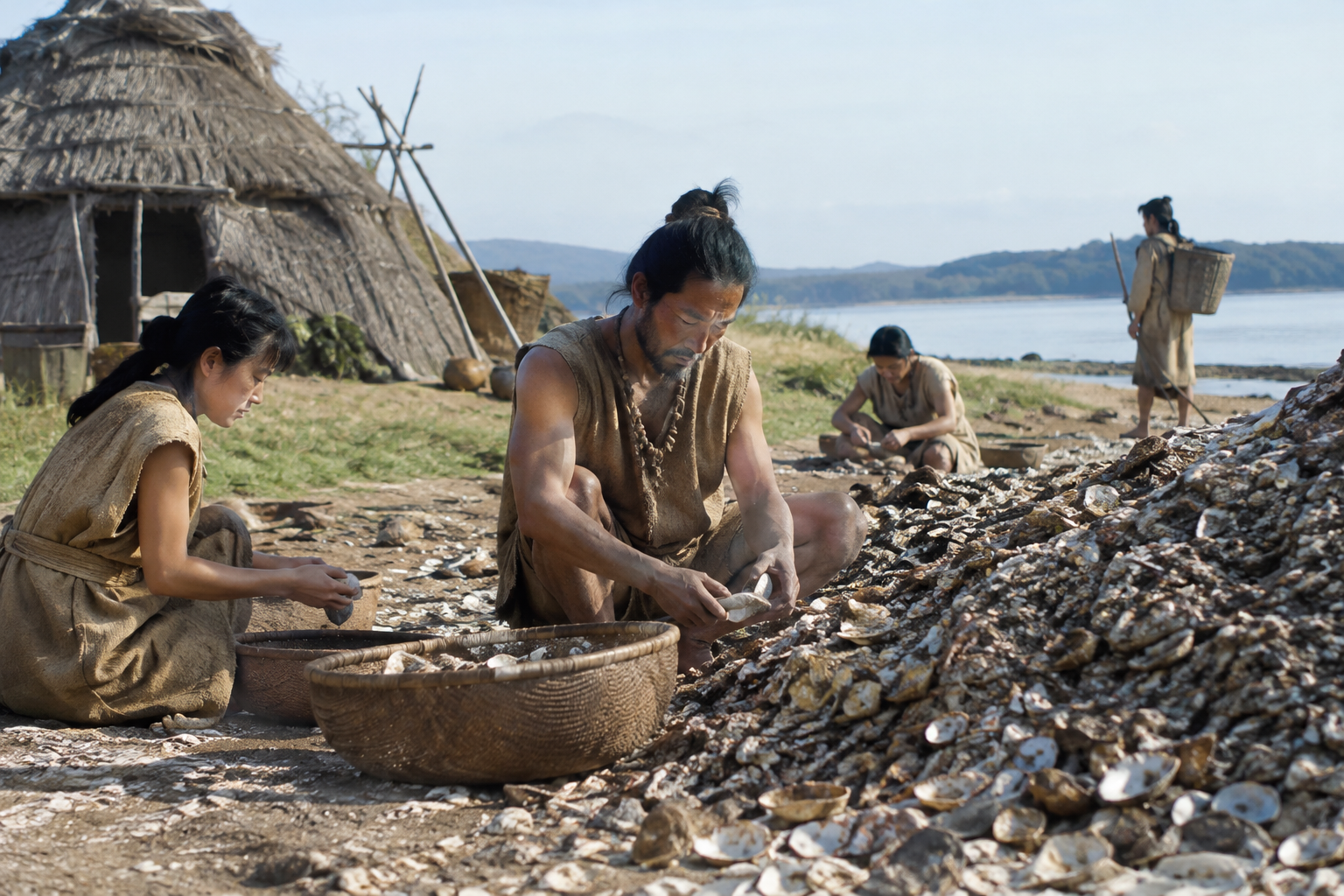
At the Rokutsu Shell Midden in ancient Japan, one man dated to around 909 BC has become unusually important for understanding a very old paternal line. He is recorded as sample I13883, a Jomon-period individual from a shell midden context, and he is associated here with Y-DNA haplogroup D1a2a1c1a. That may look like a string of letters and numbers only a geneticist could love, but in fact it points to a stubbornly local piece of history: a male line deeply tied to the Japanese archipelago.
Shell middens are marvellous archaeological places. They are not just heaps of discarded shells, but layered records of food, settlement, and repeated human activity. When a Jomon individual from such a site can also be placed on the Y-chromosome tree, the result is not a complete biography, but something quite powerful: a direct paternal thread linking one ancient man to a lineage with deep roots in prehistoric Japan.
Y-DNA follows one narrow line of descent, from father to son. It does not describe all of a person's ancestry, still less his language, identity, or every population around him. But because it tracks a single paternal line through time, it can reveal which branches endured in particular regions for very long periods.
In this case, the important point is scale. D1a2a1c1a is a very specific subclade, much narrower than the broader haplogroup D found in parts of Asia. One must be careful here: the large history of haplogroup D cannot simply be pasted onto this exact branch. What the Rokutsu evidence does show is that a lineage associated with this precise branch, or with a very close reported placement within it, was present in Jomon Japan in the 1st millennium BC.
That matters because the Jomon are central to the long prehistory of the archipelago. They were not a single frozen "people" outside history, but communities living across millennia, with regional variation, changing economies, and enduring local traditions. A paternal lineage found among them helps anchor this branch in a real archaeological setting rather than in abstract genetic charts.
The site name itself tells us something important. A shell midden is usually a sign of coastal or estuarine lifeways, regular harvesting of marine resources, and settlement continuity substantial enough to leave dense archaeological deposits. In Japan, such places are among the classic contexts for Jomon archaeology, preserving evidence for subsistence, craft activity, and burial practices over long spans of time.
Sample I13883, dated here to around 909 BC, belongs to the late part of the Jomon sequence, close to the centuries before the major transformations associated with the Yayoi period. That timing is especially interesting. It places this paternal line not in some vague primordial past, but in a moment when older Jomon traditions still persisted even as the wider Japanese archipelago was approaching profound demographic and cultural change.
One should not make this individual carry more weight than he can bear. He is one excavated person, not the whole of Jomon society. But one ancient male from a securely archaeological Jomon setting can still tell us that this paternal branch was part of the human reality of late prehistoric Japan, not merely a modern statistical residue.
A broad ancient DNA study of Japanese populations, including Jomon-related material, has helped make this sort of connection possible by placing ancient individuals into a wider genomic context; see this research on ancient Japan. Even without leaning on details that are not explicitly provided here, the larger value of that work is clear: it lets archaeology and genetics speak to one another at the level of real sites and real people.
For some haplogroups, the ancient record is scattered across huge expanses of Eurasia, making the story one of wide movement and repeated reshaping. D1a2a1c1a is interesting for almost the opposite reason. Its significance lies in regional depth. A Jomon-associated male line suggests continuity within Japan across a very long prehistoric timescale, even if later population history introduced new ancestry and new paternal lineages.
That is a rather important historical correction to older, simpler stories. The peopling of Japan was not a single event, and neither was the making of later Japanese populations. Ancient DNA increasingly shows layered ancestry, with Jomon-related ancestry remaining an essential part of the picture even after later arrivals and admixture. A lineage such as D1a2a1c1a fits naturally into that deeper stratum.
This does not mean every later Japanese male line descended from Jomon men of this branch, nor that one haplogroup can stand in for an entire ancient population. What it does suggest is that some paternal lines in Japan have a demonstrably old local history, and that the genetic landscape of the archipelago cannot be reduced to later historical periods alone.
There is something almost delightfully awkward about the evidence here. Historians often want named rulers, chronicles, and dramatic turning points. Archaeogenetics often gives us instead one excavated skeleton from a shell midden, identified by a laboratory code. Yet that humble evidence can tell us something the chronicles cannot: that a specific paternal line was already present in Japan well before the state traditions of the historical period took shape.
That makes D1a2a1c1a valuable not because it is glamorous, but because it is stubborn. It survives in the record as a reminder that the archipelago's history is older than courts, capitals, and dynasties. The late Jomon world of fishing, foraging, settlement, exchange, and local ritual was not a mere preface. It was one of the foundations on which later Japan was built.
In that sense, the genetics and the archaeology pull in the same direction. The midden is evidence of lived practice and place; the Y-chromosome is evidence of biological continuity down one paternal line. Together they offer a restrained but compelling historical claim: this branch belongs in the deep human story of Japan.
If your paternal line is D1a2a1c1a, the most defensible takeaway is not a romantic tale about one named ancestor, but something better grounded. The branch is associated here with a Jomon-period male, I13883, from the Rokutsu Shell Midden in ancient Japan, dated to around the 1st millennium BC. That places your direct paternal line within a very old archaeological horizon of the Japanese archipelago and links it to one of the deepest documented strata in Japan's human past.
It is a modest claim, but a substantial one. Not every lineage can be tied, even this cautiously, to a concrete prehistoric setting. D1a2a1c1a can.



Comments