Haplogroup C2b1a2b

– 5 min read


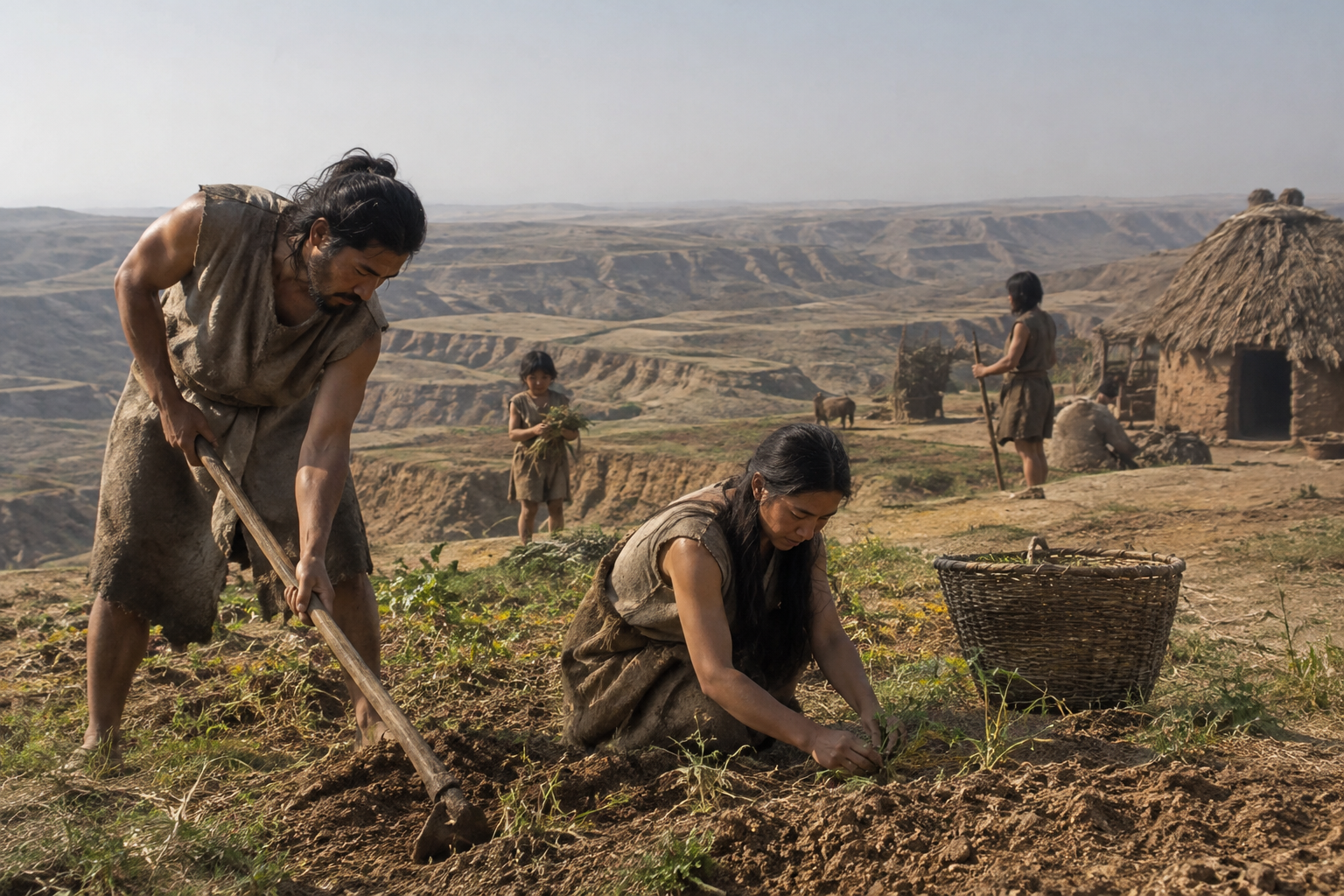
On the Loess Plateau of northern China, one ancient man offers a rare fixed point for thinking about Y-DNA haplogroup C2b1a2b. He is identified as SM-SGDLM27, from Shengedaliang in Shenmu, dated to around 2000 BC. That is already enough to make him interesting: this is not a medieval noble, not a legendary conqueror, but a Bronze Age individual from a frontier landscape where farming communities, herders, and long-distance contacts met.
The haplogroup attached to this article, C2b1a2b, is a paternal lineage, meaning it traces one direct male line rather than a person's whole ancestry. In East and Inner Asian history, broader branches of haplogroup C2 have often appeared in discussions of steppe mobility and northern populations. But the narrower label matters. One ancient sample in this branch, or associated with it, does not give us a grand universal map. What it does give us is something better: a real person in a real archaeological region, living at a moment when northern China was being reshaped by contact across the steppe and the Yellow River world.
Shengedaliang lies in today's Shenmu area, on the northern Loess Plateau. Around 2000 BC, this was a consequential zone. It sat near the shifting boundary between millet-farming societies rooted in northern China and populations tied more closely to steppe and northeastern networks. Archaeologically, this is exactly the sort of place where neat textbook categories begin to wobble.
That is what makes SM-SGDLM27 valuable. Even with sparse biographical detail, the sample anchors C2b1a2b in a northern Chinese Bronze Age setting. It suggests that this paternal line, or at least a branch closely reported with it, was present among communities living in a contact belt rather than in an isolated world. In practical terms for family-history readers, that means this lineage belongs in the story of ancient northern East Asia, not only in later imperial or steppe narratives.
A genetic study of ancient populations from northern China, published in Nature Communications, helped clarify just how dynamic these northern regions were across time. The broader lesson from such work is not that one Y-chromosome equals one culture, but that the Loess Plateau and its northern margins were repeatedly involved in population mixture, movement, and local continuity.
To say that a man belonged to C2b1a2b is to place his direct paternal ancestry within one of the major Y-chromosome clusters historically associated with northern and eastern Eurasia. That broader parent haplogroup has a long and complicated history, appearing in ancient and modern populations across parts of East Asia, Siberia, and the eastern steppe. But the temptation is always to rush from that broad fact to a dramatic conclusion. We should resist it.
What we can say more safely is that the presence of this branch on the Loess Plateau around 2000 BC fits a wider archaeological picture in which northern China was never sealed off from its neighbors. New subsistence strategies, exchange systems, and population links were moving across the region. Some communities were firmly agricultural; others were more mixed in economy and outlook; many were connected by marriage, trade, and seasonal mobility.
So C2b1a2b here is best understood not as a tribal badge but as a clue to paternal ancestry in a frontier world. Y-DNA can preserve a remarkably deep male-line signal even while languages, identities, and political structures change around it. That is one reason why a single Bronze Age sample can still matter enormously.
The Loess Plateau is often imagined as the backdrop to early northern Chinese civilization, but for archaeologists it is also a corridor. Its river valleys and uplands linked the Central Plains to the Ordos region, to the steppe beyond, and to the northeastern zones that would later loom large in Chinese history. By about 2000 BC, these connections were not theoretical. They were part of everyday life.
In that setting, a paternal lineage like C2b1a2b becomes historically legible. It does not announce a single migration event, still less an ethnicity. Instead, it hints that male lines associated with northern populations were already embedded in local communities on China's northern edge during the Bronze Age. That matters because later historical writing often gives the impression that "steppe" and "China" were distinct blocks crashing into one another. The genetics, like the archaeology, usually points to something messier and more human: overlap, contact, absorption, and regional diversity.
This is also why ancient DNA from northern China has been so important in recent years. It has complicated older narratives that assumed simple south-to-north or north-to-south replacements. What we increasingly see instead is a long patchwork of local persistence mixed with fresh incoming ancestry at different times.
SM-SGDLM27 is, by itself, not a dynasty, not a population average, and not a proof of descent from any later historic group. That needs saying plainly, because Y-haplogroup writing can easily slide into mythology. One man from one site tells us that this paternal branch was present there at that time. It does not tell us that every nearby male shared it, or that later peoples in the region inherited it unchanged.
But it would be a mistake to swing too far the other way and treat the sample as trivial. Ancient Y-DNA samples are often sparse precisely because they are hard won. When an identified ancient male can be placed in a known region and period, he becomes a marker for where that paternal lineage had already arrived, persisted, or integrated. For C2b1a2b, that makes the Shenmu evidence genuinely useful.
It is especially useful because the date, around 2000 BC, falls in a formative era for northern East Asia. This was a time before later imperial boundaries, before the historical names that dominate textbooks, and before many of the ethnopolitical identities later projected backward into prehistory. In other words, the sample belongs to the deep background out of which later northern societies emerged.
For people exploring C2b1a2b today, the broader context is that northern East Asian paternal history was shaped by both coastal and inland developments, with different branches appearing in different settings over long periods. Some lineages spread with communities rooted in farming zones; others appear more strongly in steppe and forest-steppe populations; many were later redistributed by state expansion, alliance, warfare, and ordinary marriage patterns.
That makes ancient northern China particularly important. It is one of the places where these strands meet in the evidence. A related MyTrueAncestry discussion on ancient Y-chromosomes in East Asia is useful because it places paternal lines within a much larger framework of regional movement rather than treating them as isolated curiosities.
Another helpful comparison comes from Bronze Age work farther west in Gansu, where ancient DNA has likewise shown that northwestern Chinese populations sat at crossroads of ancestry and burial traditions. That does not make Shengedaliang the same as Gansu, of course. It simply reinforces the larger point that Bronze Age northern China was regionally varied and genetically interconnected.
The most distinctive thing we can responsibly say about C2b1a2b here is that it is anchored by at least one ancient male, SM-SGDLM27, in the Bronze Age northern Loess Plateau around 2000 BC. That places the lineage in a historically important frontier between the farming heartlands of northern China and the wider worlds of the steppe. For anyone researching this paternal line today, the implication is not a tidy ethnic label or a royal claim, but a deep connection to the complicated human geography of ancient northern East Asia.

Comments