Haplogroup C2a1a3a
– 5 min read


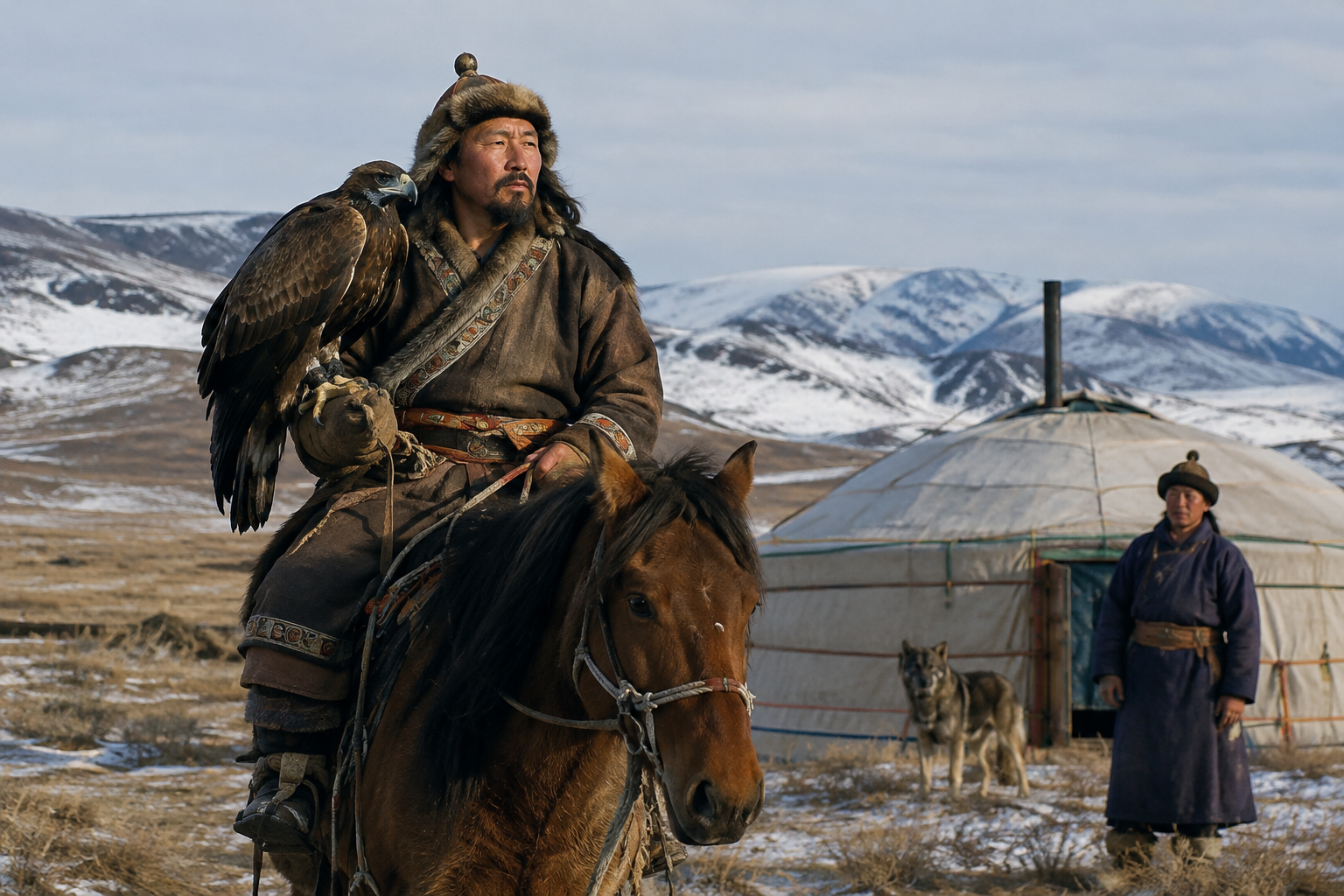
The most concrete ancient signpost here is a single late medieval man from Mongolia: TSA003, identified as a Late Medieval Mongol from Tsagaan Chuluut and dated to about 1350 AD. That is already enough to make this lineage interesting. Haplogroup C2a1a3a belongs to a wider Y-chromosome branch that is strongly associated with northern and eastern Inner Asia, and this one individual places that paternal line in the Mongol world of the fourteenth century, at a time when steppe empires had already redrawn much of Eurasia.
There is something rather bracing about evidence like this. We are not dealing with a legendary founder or a flattering medieval genealogy, but with one excavated person tied to a place, a period, and a paternal lineage. Because Y-DNA follows only the direct male line, it does not tell us everything about TSA003's ancestry or identity. But it does give us a sharply focused thread into the history of men, families, and mobile steppe societies whose political reach was immense.
Tsagaan Chuluut sits within a landscape that matters enormously for Eurasian history. By around 1350 AD, Mongolia was living in the long aftermath of the great imperial expansions associated with Chinggis Khan and his successors. The Mongol Empire had fractured into successor states, but Mongolia itself remained central to the memory, legitimacy, and population history of the steppe.
In that setting, TSA003's assignment to C2a1a3a is historically plausible and archaeologically useful. It offers a direct male-line data point from the late medieval Mongol world rather than a retrospective claim based on later chronicles or modern surname traditions. One sample does not define an entire population, of course, but it does show that this branch was present in Mongolia in the centuries after the imperial conquests.
An ancient DNA study examining populations of the Mongolian steppe helped bring this sort of evidence into focus, and the research trail connected with this sample includes supplementary materials associated with a steppe genomics study. Even without overselling the single sample, the broader importance is clear: medieval Mongolia is one of the key places where paternal lineages of haplogroup C2 can be studied against an archaeological rather than purely modern background.
C2a1a3a is not the whole of haplogroup C2, and that distinction matters. The parent lineage, C2, is broad and old, with a distribution that reaches across large parts of Inner and Northeast Asia. The narrower branch in this article is one twig on that much larger tree, so we should be careful not to paste the entire history of C2 directly onto C2a1a3a without specific evidence.
Still, the general setting is not mysterious. Branches of C2 are repeatedly discussed in connection with populations of the eastern Eurasian steppe, Mongolia, Siberia, and adjacent regions. That makes TSA003 less of an outlier and more of a useful medieval confirmation of a paternal pattern long associated with northern Inner Asia. What ancient DNA adds is chronology: not just where a lineage exists today, but where it appears in the historical and archaeological record.
That temporal depth is especially important for steppe history, where political confederations could expand with extraordinary speed. Language, imperial allegiance, and burial customs could shift or spread far faster than Y-chromosome lineages. So a man carrying C2a1a3a in fourteenth-century Mongolia was part of the Mongol world, but his haplogroup is not a shortcut for ethnicity, rank, or a claim to descent from any one famous dynasty.
The date of TSA003 matters almost as much as the place. Around 1350 AD, the unified Mongol Empire was gone, yet the social world created by the empire had not disappeared. Trade routes, military networks, marriage alliances, and the movement of specialist groups had tied together Mongolia, North China, Central Asia, and the western steppe in new ways.
That means a paternal lineage found in Mongolia at this time sits within a society shaped by both continuity and upheaval. Some lineages may have deep local roots on the eastern steppe; others may have spread through the expansion of aristocratic houses, military followings, or mobile pastoral communities. With only TSA003 named here, we cannot assign him to any one of those pathways. But his date anchors C2a1a3a in precisely the period when Mongol political history and biological history are most tempting to confuse and most important to separate carefully.
In practical terms, this is why ancient samples are so valuable. They let us ask whether a lineage was already present in a region before later states emerged, whether it persisted through imperial centuries, and whether it appears among ordinary burials as well as elite contexts. Even a sparse record can be revealing when the historical landscape is as consequential as medieval Mongolia.
There is a tendency, especially in popular discussions of steppe DNA, to chase grand claims from very small pieces of evidence. Yet archaeology often advances by modest but reliable steps. TSA003 is one such step. He confirms the presence of C2a1a3a in a late medieval Mongol context, which is far more valuable than a dramatic but unsupported leap to named conquerors or supposed royal bloodlines.
This is particularly relevant because lineages within C2 have often attracted public fascination through discussions of elite expansion and historically successful male lines in Inner Asia. That broader conversation is real, but it can become distorted very quickly. A late medieval Mongol sample carrying C2a1a3a tells us that this branch belongs in the demographic history of Mongolia; it does not, by itself, identify a clan founder, a noble pedigree, or an imperial household.
Research on East Asian paternal history has increasingly shown how much detail can emerge when ancient Y chromosomes are studied directly across time. For readers interested in the larger methodological picture, MyTrueAncestry has also explored how paternal lineages illuminate regional movements in ancient Y-chromosome research across East Asia.
Mongolia was never isolated, and that is another reason C2a1a3a deserves attention. The steppe linked forest, desert, mountain, and agricultural worlds. Over many centuries, populations moved between Mongolia, the Altai, southern Siberia, North China, and farther west into Central Eurasia. Some of those movements were slow and local; others were tied to state formation, warfare, alliance, and trade.
So when a branch like C2a1a3a appears in a medieval Mongol individual, it belongs to that bigger northern Eurasian story. The paternal line may have been carried through generations of pastoral families, warrior retinues, local clans, or mixed communities formed through the churn of empire. The archaeological value lies not in choosing one romantic option, but in recognizing that the Mongol world was both mobile and locally rooted.
For someone researching a present-day paternal line in C2a1a3a, TSA003 offers a firm historical clue rather than a fairy tale. This branch was present in Mongolia by the late medieval period, in a society shaped by the Mongol steppe tradition and the aftermath of empire. That does not tell every carrier of the haplogroup that his ancestors were Mongol rulers, but it does place the lineage within one of the most important Inner Asian historical settings yet sampled by ancient DNA.
The distinctive point, then, is not grandeur but placement. C2a1a3a sits comfortably within the paternal history of Inner Asia, and TSA003 shows that this was true in a real fourteenth-century archaeological context. For family historians, that is often the most valuable kind of evidence: not a legend, but a man, a place, and a date.
Comments