Haplogroup C2a

– 5 min read


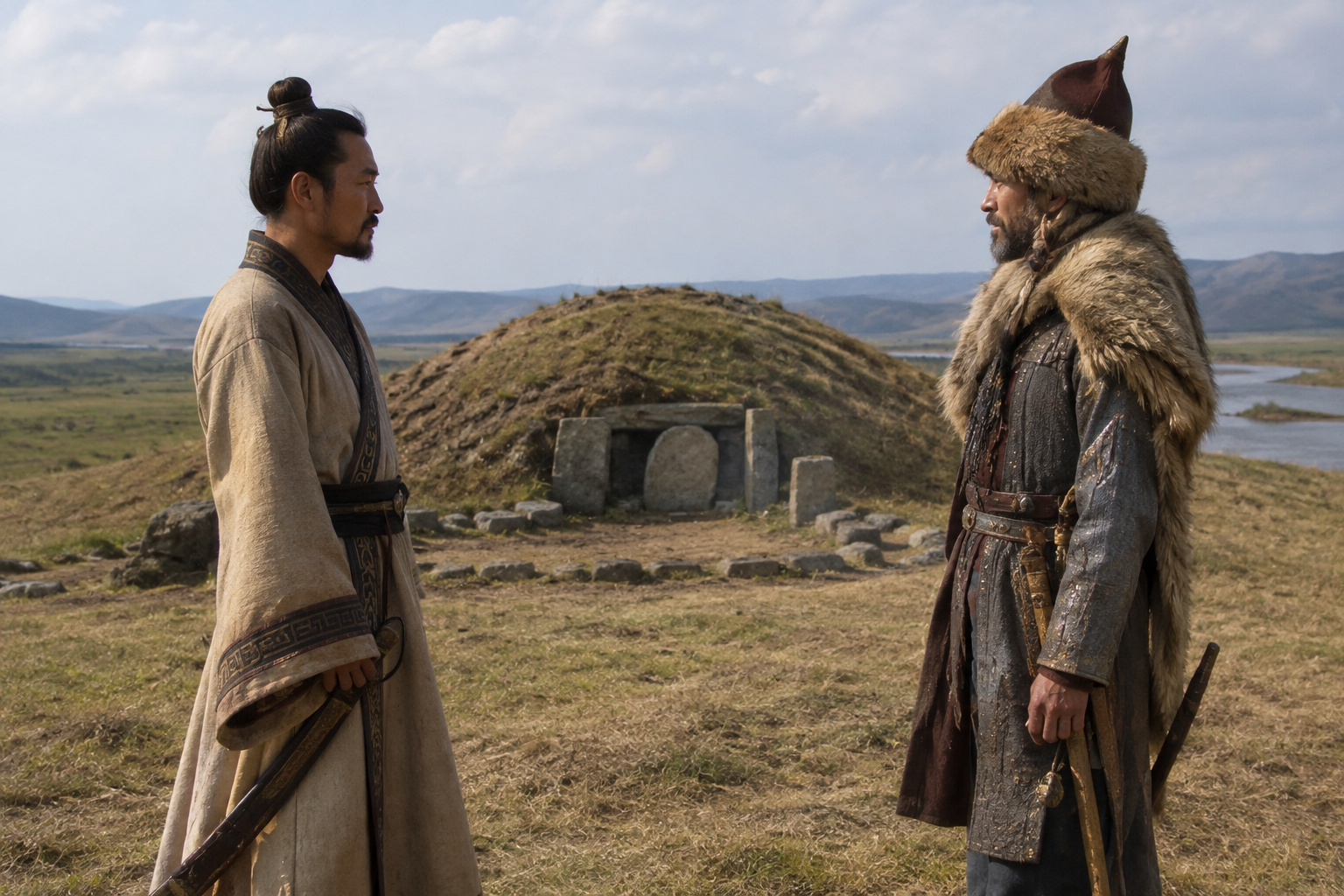
At Daejuk-ri Taejungni in Korea, an ancient man identified as DAJ001 has been dated to around 650 BC, in the period associated with early Gojoseon. He matters here not because one burial can stand in for an entire kingdom, but because he offers a rare, concrete glimpse of a paternal line classified within C2a in an East Asian archaeological setting. When a haplogroup appears in a real excavated individual rather than as a modern map statistic, it stops being an abstraction and becomes part of a lived historical landscape.
That is especially useful for C2a. This is a branch within the wider C Y-chromosome family, a lineage with deep roots in Asia and a long history in northern and eastern parts of the continent. Y-DNA traces one direct paternal line only, so it does not define a person's whole ancestry, language, or identity. But it can show how specific male lines moved, persisted, or appeared in very different historical worlds.
The Daejuk-ri Taejungni individual stands near the threshold of early state development on the Korean peninsula. Around the mid-1st millennium BC, the archaeological record in northern Korea and adjacent regions shows increasingly complex societies, changing burial practices, and growing regional interaction. A C2a-associated male from this setting does not tell us that Gojoseon was genetically uniform, still less that one lineage founded it. What it does show is that this paternal branch was present among people living in the world from which early Korean political traditions emerged.
That matters because discussions of ancient Korea can easily become too tidy. Archaeology rarely gives us a single, neat origin story. Instead, sites like Daejuk-ri Taejungni suggest populations already shaped by movement and mixture within Northeast Asia, where lineages could persist locally while broader social forms were changing.
The larger context is becoming clearer thanks to recent work on East Asian paternal history. A MyTrueAncestry article on ancient Y chromosomes in East Asia shows just how dynamic these paternal landscapes were, with coastal and inland routes both contributing to later populations. C2a fits well within that wider pattern of long-term northern and eastern Asian connections, even if this individual sample should be handled cautiously and specifically.
The second sample is striking for a different reason. BSB004, from Bisoba mound 8 burial 1, is dated to around 400 BC and described as Sarmatian. Here the same haplogroup label appears not in an early Korean context but in the western Eurasian steppe zone, among peoples known from burial mounds, mobile lifeways, and far-reaching connections across the grasslands.
This is exactly the sort of evidence that makes steppe history so interesting and so difficult to oversimplify. The Sarmatians were not a single biological tribe marching across a map with a standard genetic signature. They were part of a wider Iranian-speaking steppe world that interacted with Scythian groups, agricultural neighbors, and populations farther east. A C2a-associated male in a Sarmatian burial underlines that steppe societies could include paternal lines more commonly associated, in modern distributions, with northern and eastern Asia.
In other words, the steppe was not a wall dividing East from West. It was a corridor, often a rough one, but a corridor all the same. The appearance of C2a in Bisoba does not prove one simple migration route from Korea to the western steppe or vice versa. It does, however, fit a broader archaeological picture in which people, goods, and lineages moved across enormous distances long before written empires tried to pin them down.
Placed side by side, DAJ001 and BSB004 are not a complete history of C2a, but they are a revealing pair. One comes from early historic Korea, the other from an Iron Age Sarmatian mound far to the west. That combination immediately warns us against treating ancient paternal lineages as though they belonged neatly to one modern nation or one ancient ethnonym.
It is tempting to look at a haplogroup and demand a single homeland, a single people, even a single historical destiny. Ancient DNA is usually less obliging. What it often gives us instead is a series of snapshots. In this case, those snapshots suggest that C2a could be carried by men living in very different cultural settings across northern Eurasia during the 1st millennium BC.
That broad spread is perfectly plausible in historical terms. The great belt of Eurasia, from the Korean peninsula through Mongolia and the steppe lands westward, was never static. Communities rose and fell, alliances shifted, and male lines could travel through migration, marriage networks, incorporation into new groups, or the success of local elites. A lineage does not need to represent mass movement to appear far from another documented occurrence.
For readers with C2a today, the most responsible historical frame is not a narrow one but a northern Eurasian one. This branch belongs to a paternal world that has long been important across Inner Asia, Siberia, Mongolia, and parts of East Asia, with spillover into steppe populations farther west. The two ancient men here are useful precisely because they sit at different ends of that historical horizon.
A broader ancient DNA study of Eurasian population formation, published in Science Advances, helped show how prehistoric and early historic populations across eastern Eurasia were shaped by repeated movements and mixtures rather than by isolation. Without forcing these two individuals into a single event, that kind of research gives a sensible backdrop for understanding why a paternal branch like C2a might turn up in settings that look, at first glance, surprisingly far apart.
There is also a useful methodological point here. Ancient Y-DNA assignments are sometimes reported at broader or narrower resolution depending on data quality. With only the information attached to these records, the safest course is to discuss them as associated with C2a and not invent a finer subclade or a more precise family tree than the evidence supports.
One of the more misleading habits in popular history is to box ancient peoples into sealed regions. Korea is treated as one story, the Sarmatian steppe as another, and the lands in between as mere empty space. Archaeology suggests otherwise. Over long periods, the Eurasian north formed a chain of contacts, interruptions, and renewed connections linking forest, plain, mountain, and coast.
That does not mean every culture was the same. Gojoseon-period societies and Sarmatian mound communities had very different local histories. But a haplogroup like C2a reminds us that paternal lineages can outlast political borders and appear in settings that historians once studied apart. DNA does not erase cultural difference; it simply shows that human history was less compartmentalized than older narratives often assumed.
The most distinctive thing about C2a in this small ancient record is not royal glamour or a single founding legend. It is range. A man from early Gojoseon-period Korea and another from a Sarmatian mound on the steppe both point to a paternal lineage at home in the larger northern Eurasian world. For someone researching a C2a paternal line today, that is a meaningful clue: your direct male ancestry may connect, at least in deep historical terms, to the mobile and interconnected societies of East Asia and the steppe rather than to one narrowly bounded region alone.
Comments