Haplogroup C

– 5 min read


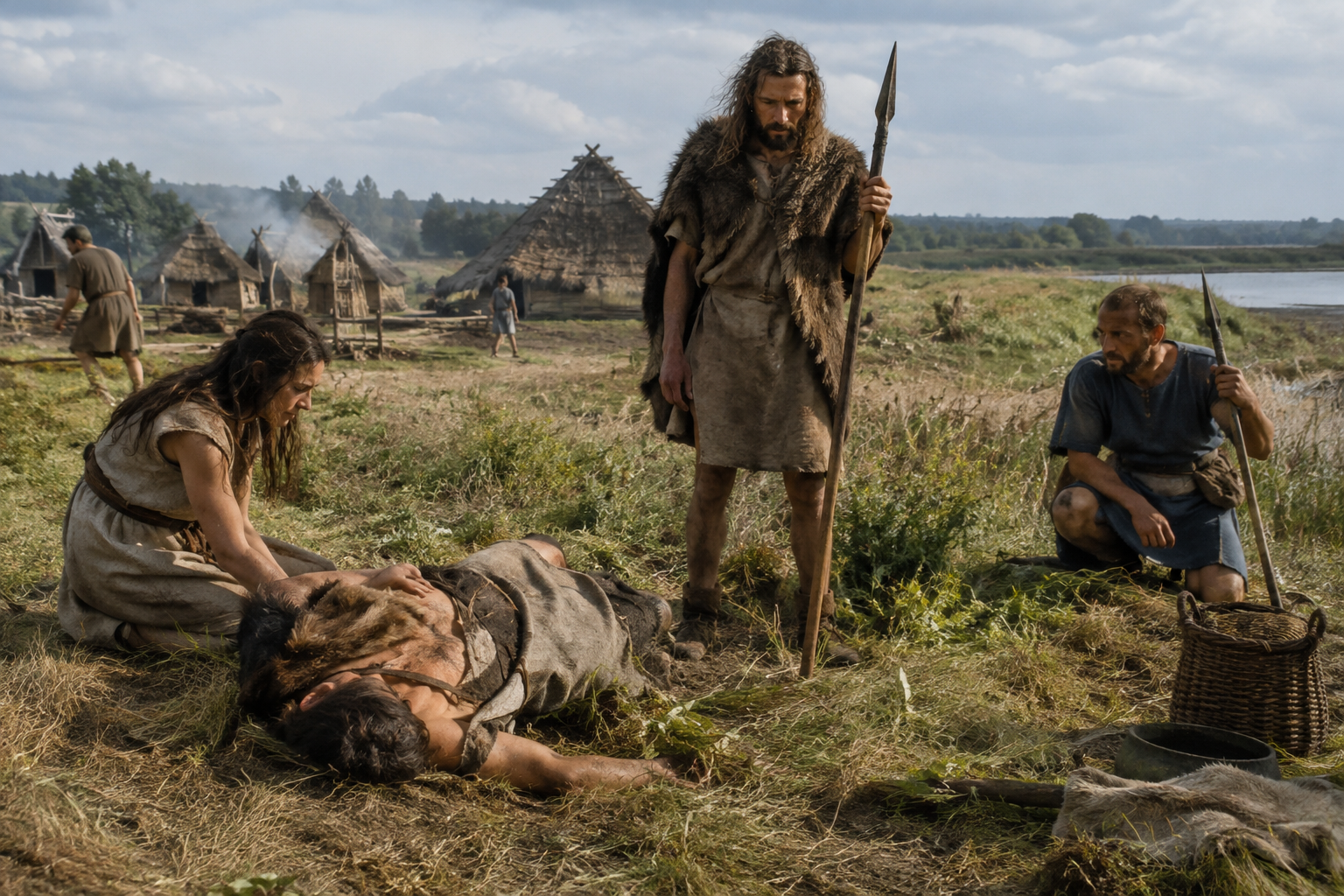
At Asparn-Schletz in Lower Austria, two men from one of Europe's grimmest Neolithic sites have been reported with Y-DNA haplogroup C: samples I27780 and I25323, dated to about 5000 BC. The site is famous because it preserves the aftermath of a massacre at the edge of the early farming world. That makes haplogroup C here especially striking, not because one lineage can explain a tragedy, but because it places a very old paternal branch inside a concrete episode of Neolithic violence.
Haplogroup C is a broad and ancient Y-chromosome lineage, better known globally than in later European paternal histories. Y-DNA tracks one direct male line only, so it does not stand for a person's whole ancestry or identity. Still, when a branch as old and geographically widespread as C appears in a handful of ancient European burials, the archaeological settings matter enormously: these are not abstract markers on a chart, but men buried in very different worlds.
The Asparn-Schletz site belongs to the Early Neolithic of Central Europe, a period when settled farming communities were spreading, consolidating, and sometimes colliding. The remains found there have long drawn attention because they suggest organized violence rather than ordinary cemetery use. In that setting, the presence of haplogroup C in I27780 and I25323 adds a paternal detail to a much larger historical picture: early farming Europe was not genetically uniform, and even within one embattled settlement, male-line diversity could survive.
That is worth pausing over. Popular ideas about the Neolithic often flatten it into a single tide of farmers moving westward. But massacre sites like Asparn-Schletz remind us that these communities were made up of real local populations with their own histories, tensions, and kin structures. A broad branch like C appearing here suggests that some paternal lines present in the early Neolithic landscape later became rare or vanished in much of Europe.
An ancient DNA study examining this wider Central European context is linked through research on Neolithic and later populations, which helps place such burials within larger regional change, even when one individual haplogroup should not be overinterpreted.
A second important appearance comes from the Netherlands. Sample I38121, dated to about 3525 BC, was found at Schipluiden-Harnaschpolder in South Holland. By this point we are no longer in the earliest wave of farming, but in the Middle Neolithic, when communities around the North Sea lowlands were living in landscapes shaped by wetlands, coastlines, and long local interaction between farming and foraging traditions.
This Dutch example matters because it is not just another Austrian case. It shows haplogroup C turning up in a very different ecological and cultural zone, hundreds of years later and far to the northwest. That does not prove direct continuity from Asparn-Schletz, nor a single migration route. What it does show is that the paternal branch C was present, however sparsely, in multiple parts of Neolithic Europe.
The Rhine-Meuse and Low Countries have become increasingly important in ancient DNA because they complicate old textbook divisions between farmer and hunter-gatherer worlds. One rare Y-lineage found in that setting can be historically revealing precisely because it refuses neat categories. A paternal marker that later looks unusual may once have been part of the ordinary background variation of small communities.
There is a temptation, whenever a rare lineage appears, to turn it into a lost people. Archaeology is usually less obliging than that. In these European cases, the safest reading is that haplogroup C represents a surviving paternal branch within mixed prehistoric populations whose ancestry, language, and culture cannot be reduced to one Y-chromosome label.
That caution is especially important because the haplogroup in these records is given simply as C, not as a securely defined downstream subclade in the information at hand. In other words, the article's subject is the broader parent lineage, and we should not pretend to know more resolution than the evidence provides. For family historians, that distinction matters: a high-level ancient assignment can show deep connections, but not a tidy genealogical chain from one burial to a modern surname.
Even so, there is a real historical lesson here. Haplogroup C's ancient reputation today is often tied to Asia, Oceania, and very deep Eurasian prehistory. Yet these European finds show that older paternal branches could persist in local populations far outside the regions where they are now best known. Ancient DNA keeps reminding us that modern distributions are only the latest chapter.
The latest of the supplied examples is I22094 from Tharros in Sardinia, dated to about 400 BC in a Punic context. This is a very different world from Neolithic Austria or the wetlands of the Dutch coast. Tharros was part of a Mediterranean network shaped by Phoenician and Punic expansion, trade, colonization, and local island histories. If the Neolithic cases show deep survival, Tharros shows how much later mobility could bring unusual paternal lines into new historical settings.
Sardinia is particularly interesting because the island preserves both continuity and contact. Punic-period communities there were connected to the wider western Mediterranean, including North Africa and Iberia, while also rooted in older island populations. A sample such as I22094 therefore cannot be treated as "typically Sardinian" or "typically Punic" on Y-DNA alone. But it does fit the larger picture of Mediterranean port societies as meeting grounds, where lineages from quite different backgrounds could appear side by side.
A related genetic study of ancient island populations is available through research on ancient Italian islands, useful for understanding how insular communities balanced continuity with outside connections across long periods.
Tharros also helps correct a common habit in public history: the urge to imagine ancient Mediterranean populations as neatly bounded ethnic blocks. They were not. Ports, colonies, and island towns were full of entanglements. Haplogroup C in this setting is not a badge of one simple origin story, but a sign that the Punic Mediterranean was genetically as well as culturally connected.
Put these finds together and the pattern is modest but memorable. Haplogroup C appears in an Early Neolithic massacre site in Austria, in a Middle Neolithic individual from the Netherlands, and in a Punic-period burial in Sardinia. That is not a continuous dynasty, not a single migrating tribe, and not a claim that one paternal branch drove European history. It is something subtler and, in its way, more interesting: a glimpse of how old male-line variation could persist, disappear, reappear, and travel across completely different archaeological worlds.
For someone researching haplogroup C today, these ancient samples suggest deep time rather than a single homeland legend. Your paternal line may connect to histories far older and more geographically complicated than later medieval surnames or national stories imply. Ancient DNA does not hand us a family tree all the way back to Asparn or Tharros, but it does show that this lineage has left traces in some of the most unexpected corners of the ancient world.






Comments