Haplogroup B

– 5 min read


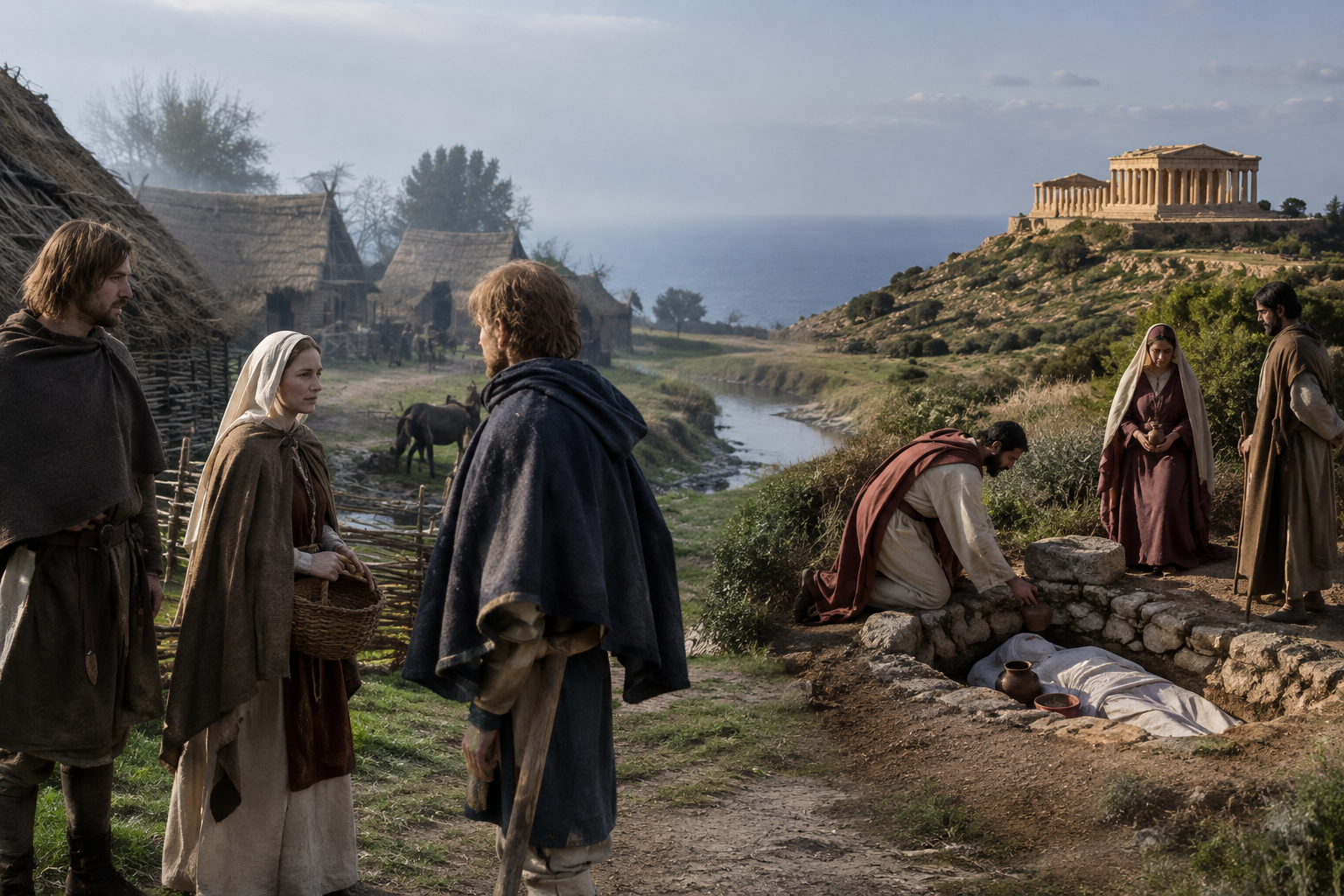
At Melbourn Water Lane in Cambridgeshire, an early medieval burial identified as WLM038 offers one of the more arresting appearances of haplogroup B in a British archaeological context. The burial is dated to around AD 625, in the period when eastern England was a place of intense social change, with communities shaped by local continuity, migration across the North Sea, and new political identities that we now lazily bundle together as "Anglo-Saxon". What makes WLM038 especially interesting is not that haplogroup B suddenly becomes "English" - it does not - but that a paternal line most strongly associated in deep time with Africa turns up in a clearly early medieval English setting.
That is exactly the sort of finding ancient DNA is good at: not confirming old stereotypes, but unsettling them. Y-DNA follows one direct paternal line only, so it tells us nothing like the whole ancestry of a person. Still, when a lineage as old and geographically important as haplogroup B appears in sites as different as Cambridgeshire and medieval Sicily, it becomes a useful reminder that the past was often more connected, mobile, and socially mixed than later myths allowed.
Haplogroup B is one of the oldest major branches on the human Y-chromosome tree and is deeply rooted in Africa. That much is well established. What is not safe to assume, however, is that every ancient man reported under the broad label B must represent the same recent origin story, the same migration event, or the same social identity. A broad assignment can cover a great deal of time and internal diversity.
That caution matters here. The material at hand points to individuals associated with haplogroup B, but not to a securely documented shared sub-branch linking Cambridgeshire and Sicily in any simple genealogical sense. The interest lies instead in the historical settings: two medieval worlds, both tied into long-distance exchange, conquest, enslavement, conversion, and movement across seas.
A wider ancient DNA study of early medieval Britain has already shown how varied the population could be, especially in eastern England, where burial communities do not map neatly onto modern ethnic expectations. For readers who want that broader context, this related article is useful:
The Cambridgeshire sample WLM038 belongs to the early medieval cemetery at Melbourn Water Lane, dated here to about AD 625. Even without embellishing the grave with details we do not have, the context is historically rich enough. This was a period when eastern England sat within overlapping networks of settlement, trade, marriage, and belief, shaped by both local Romano-British inheritances and incoming groups from the Continent.
In that setting, a man carrying haplogroup B is not a curiosity to be explained away, but evidence that the social world of early medieval England could include paternal lines with deeper origins far beyond northwest Europe. That does not mean WLM038 had recently arrived from Africa, nor that one lineage can stand for an entire community. It means only that the paternal history present in England by the seventh century could be more varied than old national stories once imagined.
Research associated with these early medieval British burials is linked through this ancient DNA study dataset, which has contributed to the increasingly detailed picture of population diversity in post-Roman and Anglo-Saxon England. The significance of WLM038 lies in joining that broader pattern: England in this period was not sealed off, biologically or culturally.
This Cambridgeshire finding also sits comfortably beside other evidence for unexpected ancestries in early medieval England, including individuals whose genomes point to wider connections than older textbooks allowed.
Seventh-Century England Diversity
The second ancient individual here, SABN1a, comes from San Leone, Agrigento in Sicily and is dated to about AD 925. If Cambridgeshire shows haplogroup B in an early medieval English burial ground, Sicily shows it in a region where such a paternal lineage is historically easier to imagine, though still not something to simplify. Tenth-century Sicily was a place of extraordinary human traffic: Byzantine inheritances, Islamic rule, Mediterranean commerce, and movement between southern Europe, North Africa, and the wider central Mediterranean.
So a medieval Sicilian burial associated with haplogroup B belongs in a world of ports, farms, monasteries, garrisons, and multilingual communities rather than in any fantasy of isolated peoples. Sicily is one of those places where archaeology repeatedly spoils tidy categories. Religious identity, language, political authority, and genetic ancestry could overlap, but they did not have to coincide.
A related genetic perspective on the island's complexity can be found in this MyTrueAncestry article:
Sicily is not just another dot on the map. It is one of the great test cases for Mediterranean history because almost every period of its past involves contact: Phoenician and Greek settlement, Roman incorporation, late antique transformation, Byzantine administration, Islamic polities, and later Norman rule. By AD 925, when SABN1a was buried, the island had long been entangled with North Africa and the eastern Mediterranean.
That makes the appearance of haplogroup B here historically plausible without making it trivial. A man with that paternal line in medieval Agrigento might reflect recent family movement, older layers of Mediterranean interaction, or lineages already absorbed into local society generations earlier. Ancient DNA can show presence; it rarely gives us a neat little biography.
Research associated with these Sicilian burials is linked through this study on ancient material from medieval Sicily. Even without forcing more from the evidence than it can bear, the sample SABN1a helps anchor haplogroup B within the island's well-known pattern of demographic complexity.
Readers interested in Sicily's longer genetic story may also want this companion article:
Put WLM038 and SABN1a side by side and the contrast is instructive. One comes from early medieval England, a society often described through migration from northern Europe; the other from medieval Sicily, perhaps the most obviously cosmopolitan island in the medieval Mediterranean. Yet both preserve evidence of the same broad paternal haplogroup B.
That does not turn haplogroup B into a "medieval European lineage". Nor does it let us draw a straight line between the two men. What it does do is warn against treating medieval populations as if each region had a single clean biological profile. The archaeological record, especially when enlarged by genetics, keeps showing the opposite: local communities could include people whose paternal, maternal, and genome-wide ancestries reflected very different histories.
In other words, a Y-line can survive far from the region where its deeper ancestry is best known. Once you remember the realities of trade, military service, slavery, pilgrimage, marriage, fosterage, and simple human movement, that should not really surprise us at all.
If your direct paternal line falls under haplogroup B, these ancient samples do not hand you a single medieval identity or a ready-made family legend. What they do offer is something better: evidence that this ancient paternal branch could appear in very different historical settings, including seventh-century England and tenth-century Sicily. For family historians, that is a prompt to think historically rather than romantically - about mobility, contact, and the long survival of lineages across changing societies.
Haplogroup B is, above all, a reminder that paternal ancestry can carry very deep human history into places where later tradition forgot how mixed the past really was.


Comments