Ferenc Báthory

– 5 min read


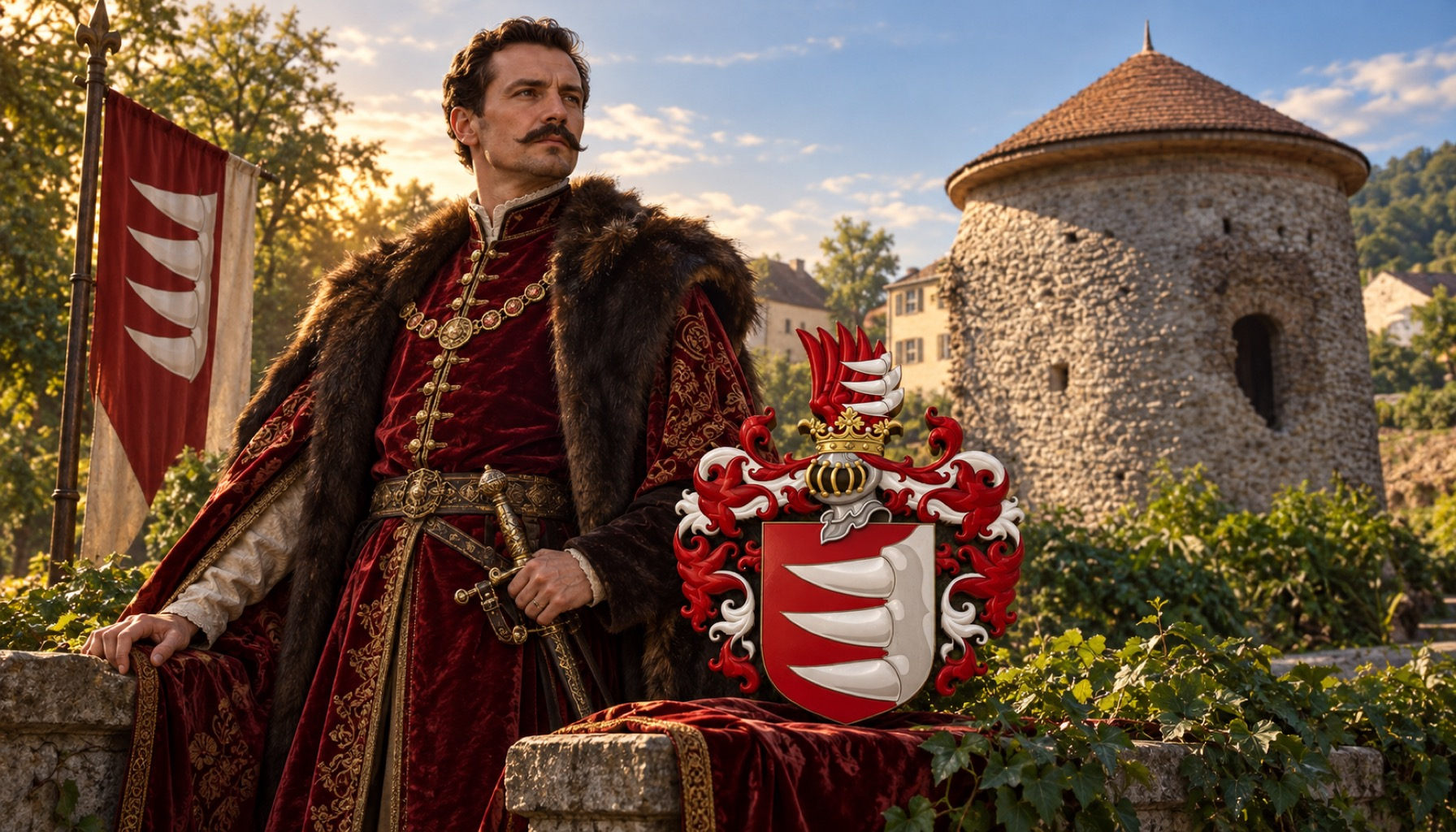
Ferenc Báthory belongs to that rare class of historical figures who step out of the archive and into the laboratory. He was a member of the powerful Báthory family, one of the great noble houses of the medieval and early modern Kingdom of Hungary and Transylvania, a dynasty whose name still carries the clang of frontier warfare, court politics, and aristocratic ambition. In an age when Central Europe was being reshaped by Ottoman pressure, Habsburg power, and the shifting fortunes of Hungarian magnates, the Báthorys stood very near the centre of events.
What makes Ferenc especially interesting is not that he was the most famous Báthory, but that he is one of the few for whom documentary history, funerary archaeology, heraldry, and ancient DNA appear to converge. Historical records state that Ferenc and his relative Elek Báthory were buried in the family church at Pericei, in what is now northwestern Romania. Excavation of that ruined church uncovered elite male burials linked to Renaissance funerary monuments bearing Báthory heraldry, and genetic testing identified two related men sharing the same paternal line. That is an unusually rich chain of evidence.
Ferenc lived in the later sixteenth century, with the sample associated with him dating to about 1589 AD. This was a hard, complicated moment in Hungarian history. After the disaster of Mohács in 1526, the old medieval kingdom had been fractured between Habsburg Royal Hungary, Ottoman-ruled territories, and the semi-independent Principality of Transylvania. Great noble families did not merely decorate this world; they helped govern it, defend it, and profit from it. The Báthory family produced major political figures, including rulers of Transylvania and, in another branch, King Stephen Báthory of Poland. Ferenc himself is not known to history on that grand scale, but his burial context shows that he belonged unmistakably to the elite stratum of this aristocratic network.
There is something rather satisfying, too, in the Pericei discovery because it reminds us that noble identity in this period was expressed through church patronage, heraldic display, and carefully staged burial. Renaissance tomb monuments were not simply decorative. They announced lineage, status, and memory. In the case of Ferenc and Elek Báthory, the archaeology suggests precisely that sort of elite commemorative setting: men buried where one would expect members of a distinguished house to be buried, among monuments that quite literally bore the family arms.
The biological sample is listed as Ferenc Bathory Hungarian Knight Pericei. The remains were recovered from the ruined Báthory family church at Pericei, where historical sources place the burials of Ferenc and Elek Báthory. Archaeologists found elite male burials associated with Renaissance funerary monuments carrying Báthory heraldry, which is already strong contextual evidence. Genetic analysis then showed that two of the men were related and shared the same paternal lineage.
That does not mean the identification is mathematically absolute in the way one might identify a modern individual with a labelled grave and living reference relatives. The careful way to put it is that these are strong candidates for the historically recorded Elek and Ferenc Báthory, not a casually made guess and not a certainty beyond all conceivable doubt. The strength lies in the combination of evidence: the documented burial place, the heraldic monuments, the elite context, and the biological relationship between the men. Ancient history is often built from fragments; here, unusually, several fragments fit together rather neatly.
The main research context for this identification comes from the published study in iScience, which brought together archaeological, historical, anthropological, and genetic data. That multidisciplinary approach is really the heart of the matter. DNA alone did not pull the name Ferenc Báthory out of the ground. Rather, DNA helped test whether the excavated men matched what the historical and archaeological evidence already suggested.
The Pericei sample associated with Ferenc Báthory was assigned the Y-DNA haplogroup R1b1a1b1a1a1c1 and the mitochondrial DNA haplogroup H1c. These two markers tell different, very specific stories. Y-DNA tracks the direct paternal line, passed from father to son, while mtDNA tracks the direct maternal line, passed from mother to children. Neither represents a person’s whole ancestry; they are lineages, not complete portraits.
Ferenc’s Y-DNA result is historically useful because the study found that two related men from the Pericei burials shared the same paternal lineage. In other words, the Y chromosome supported the idea that the men belonged to the same patrilineal noble house, exactly what one would expect in a family burial setting associated with the Báthorys. That is where the genetics becomes especially interesting: not because the haplogroup labels Ferenc as “more Hungarian” or “more noble,” which it cannot do, but because it helps test biological relationship within a documented dynastic context.
The mtDNA haplogroup H1c represents Ferenc’s direct maternal line. On its own, it cannot identify him, nor can it reveal the total ancestry of the Báthory family. What it does provide is another securely measured piece of his biological profile, useful for comparison and for situating the remains in the wider ancient DNA record.
For the paternal lineage, related ancient-DNA comparisons under the broad R1b1a1b1a1a1c1 umbrella span a remarkably wide swathe of time and space: the Pericei Báthory sample itself (PER03-1), the Elite Celtic burial at Magdalenenberg in Germany (MBG004), the Hungarian royal House of Aba sample from Abasár (HUAS390F), medieval individuals from Sicily, Belgium, England, Sweden, and Poland, as well as earlier finds from Bronze Age Germany, Estonia, Iberia, and Iron Age France. That does not mean these people were close kin of Ferenc Báthory. It means only that they belonged to a broader paternal lineage found across much of Europe over long periods. The value here is scale: Ferenc’s paternal line was part of a deep and widespread Eurasian history, not an isolated dynastic curiosity.
For the maternal side, the H1c-linked evidence supplied here is modest but still useful. At present, the directly relevant H1c reference named in this context is the Pericei sample itself, Ferenc Bathory Hungarian Knight Pericei (PER03-1). That is a reminder of a basic truth in archaeogenetics: maternal lines can be informative, but their historical value depends on how many securely comparable samples we have. In Ferenc’s case, H1c helps define his direct maternal lineage, but it does not by itself answer larger questions about Báthory family origins or identity.
Read about Hungary’s Árpád Dynasty DNA
The great merit of the Pericei study is that it shows how ancient DNA can strengthen a historical identification when used alongside archaeology and written sources. In Ferenc Báthory’s case, the genetics supports the interpretation that the excavated men were biologically related members of the same paternal family buried in the documented Báthory church. That is a meaningful historical contribution. It helps turn a plausible burial attribution into a much stronger one.
But the limits matter just as much. Ferenc’s haplogroups do not tell us his language, his political loyalties, his personality, or the full complexity of his ancestry. They do not prove that everyone with the same Y-DNA or mtDNA today descends from him. And they do not reduce the Báthory story to a genetic label. The real fascination lies in the meeting of disciplines: a noble house known from records, a church remembered in local history, heraldic monuments in stone, and, at last, recoverable DNA from the men buried there.
With MyTrueAncestry, you can compare your DNA with ancient populations and archaeological samples from the historical worlds that shaped families like the Báthorys, including medieval and early modern Central Europe. It is a way to explore genetic connections to the past without pretending that a shared lineage marker alone can prove direct descent from a specific noble figure.



Comments