Clan Innes
– 3 min read


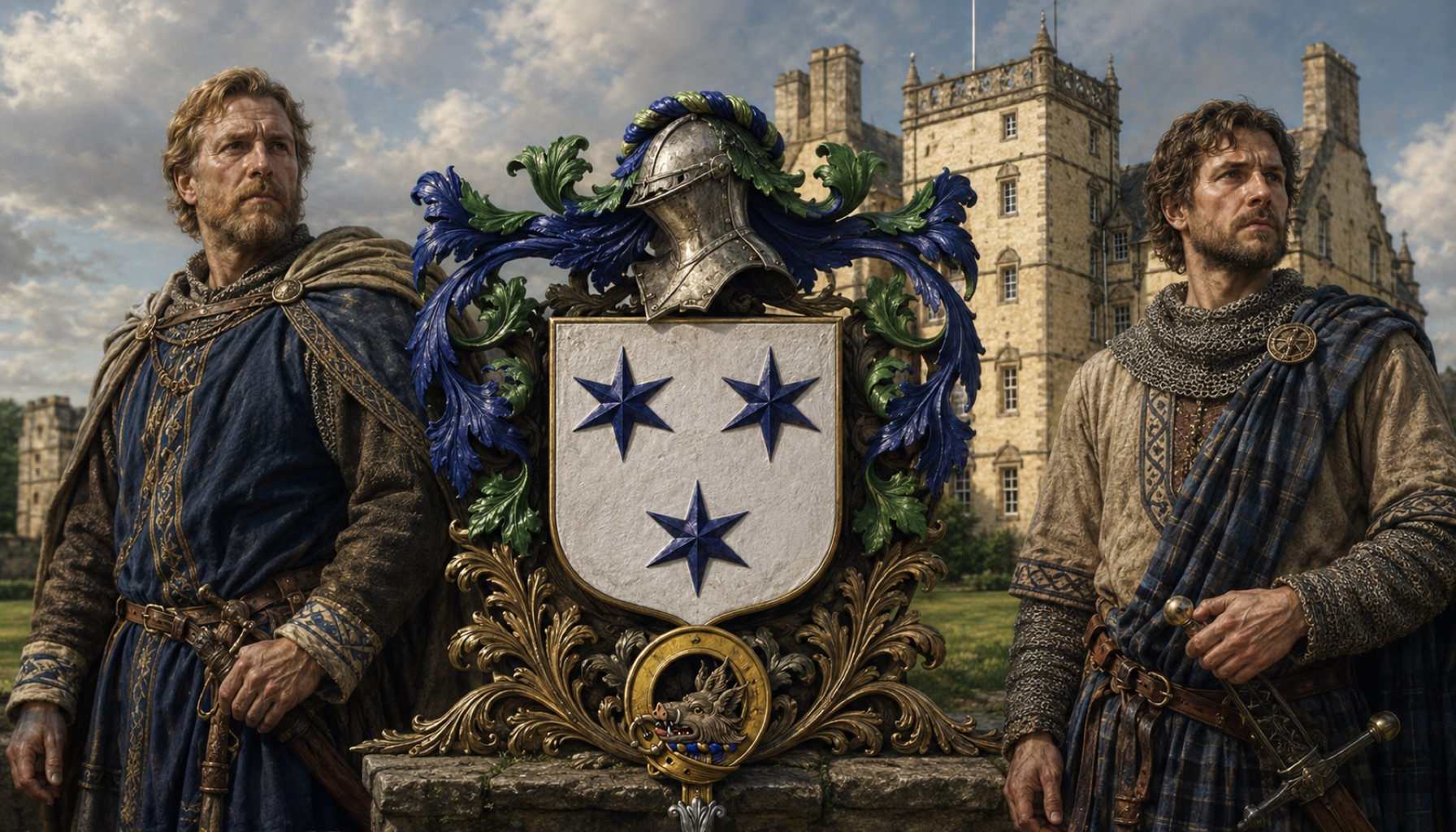
Clan Innes was one of the old landed families of northeastern Scotland, rooted above all in Moray and remembered through chiefship, estate continuity, service, and reputation. This was not a clan story built only on battlefield legend, but one shaped by landholding, marriage alliances, military duty, public office, and the long patience of local authority. In historical terms, the Innes family fits the classic northeastern Scottish landed-clan pattern: a family anchored to place, reinforced by heraldry and inheritance, and sustained across generations by its role in regional society. The primary haplogroup linked with the family is R1b1a1b1a1a1c2c1.
The name itself comes from place. Innes is tied to the old territory of Innes in Moray, near the coast of the Moray Firth, in a region where medieval lordship, church influence, and agricultural wealth all mattered deeply. The family emerged in that historic world of charters, crown service, and local power, where a landed house could become both a territorial presence and a social institution. Over time, branches of the family moved into wider noble and public life while keeping the ancestral association with Moray. Among the notable figures remembered in the family story are Sir Robert Innes, created a baronet in 1650, and Sir James Innes, 1731 to 1823, who belonged to the later era when old Scottish landed families were adapting to a changing Britain while still trading on long-standing family memory and status.
The great location anchor for the family is Innes House in Moray, the principal seat of the chiefs of Clan Innes. The house stands near Elgin and replaces or incorporates the long history of the older family seat on the same ancestral ground. It is a striking example of how Scottish landed identity was expressed in architecture as much as in genealogy: a chief's house was not simply a residence, but a statement of continuity, rank, and local rootedness. Innes House developed into an impressive estate center associated with the family for centuries, and its story reflects the wider evolution of Scottish country houses from fortified lordly residence to a more formal and prestigious seat. It remains one of the clearest physical reminders that Clan Innes was a territorial family first and foremost, with Moray as its enduring base. The house has been known in modern times as a heritage property and, depending on current arrangements and events, it has been accessible to visitors, so it is reasonable to say that it can still be visited in some form.
The Innes family's primary haplogroup, R1b1a1b1a1a1c2c1, also appears in a wide spread of ancient and historic DNA samples across western and northern Europe. These are not evidence of direct descent from Clan Innes, but they do help place the lineage in a broader human story. Related or linked samples include Lombard Warrior Elite Collegno Northern Italy COL_069, Lombard Era Collegno Northern Italy COL_069b, Lombard Warrior Elite Collegno Northern Italy COL_069x, Belgic Suessiones Iron Age France Bucy-le-Long CGG022456, Belgic Suessiones Tribe France Bucy-le-Long CGG022425, Gallic France Bucy-le-Long CGG022419, Early Anglo Saxon Cemetery West Heslerton Yorkshire I20644, I20671, and I20677, Longobard Haeven Mecklenburg-Vorpommern HVN005, Norman Invasion Medieval Lincolnshire Lincoln Castle S3044, Middle Bronze Age Westwoud-Binnenwijzend Netherlands I11972, Post Medieval Plague Victim Ellwangen Germany ELW003, Viking Age Hofstadir Iceland VK102, Bell Beaker De Tuithoorn North Holland I4070, and Medieval Upper Bavaria Germany Petersberg. Taken together, these linked finds show a lineage with deep connections to the populations that moved through Iron Age, Roman, early medieval, and later medieval Europe, exactly the sort of layered background one might expect behind a historic Scottish family whose identity was formed through centuries of regional continuity rather than sudden invention.
If Clan Innes is part of your family story, DNA can add another layer to the history of place, kinship, and memory. Upload your DNA to MyTrueAncestry to see how your results may connect with ancient populations and historic-era samples linked to haplogroup R1b1a1b1a1a1c2c1.
Comments