Bishop Teodomiro of Iria Flavia
– 5 min read


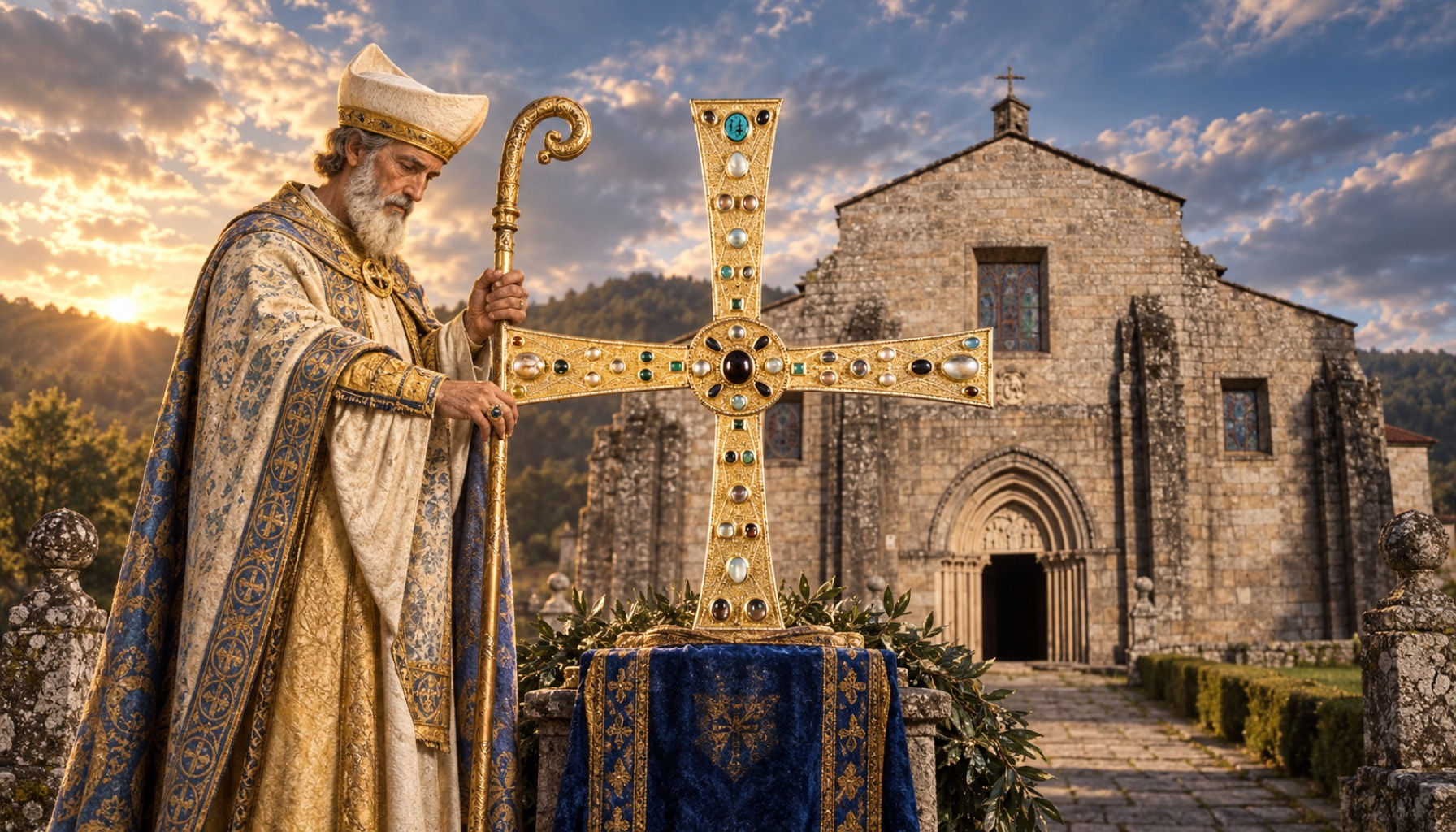
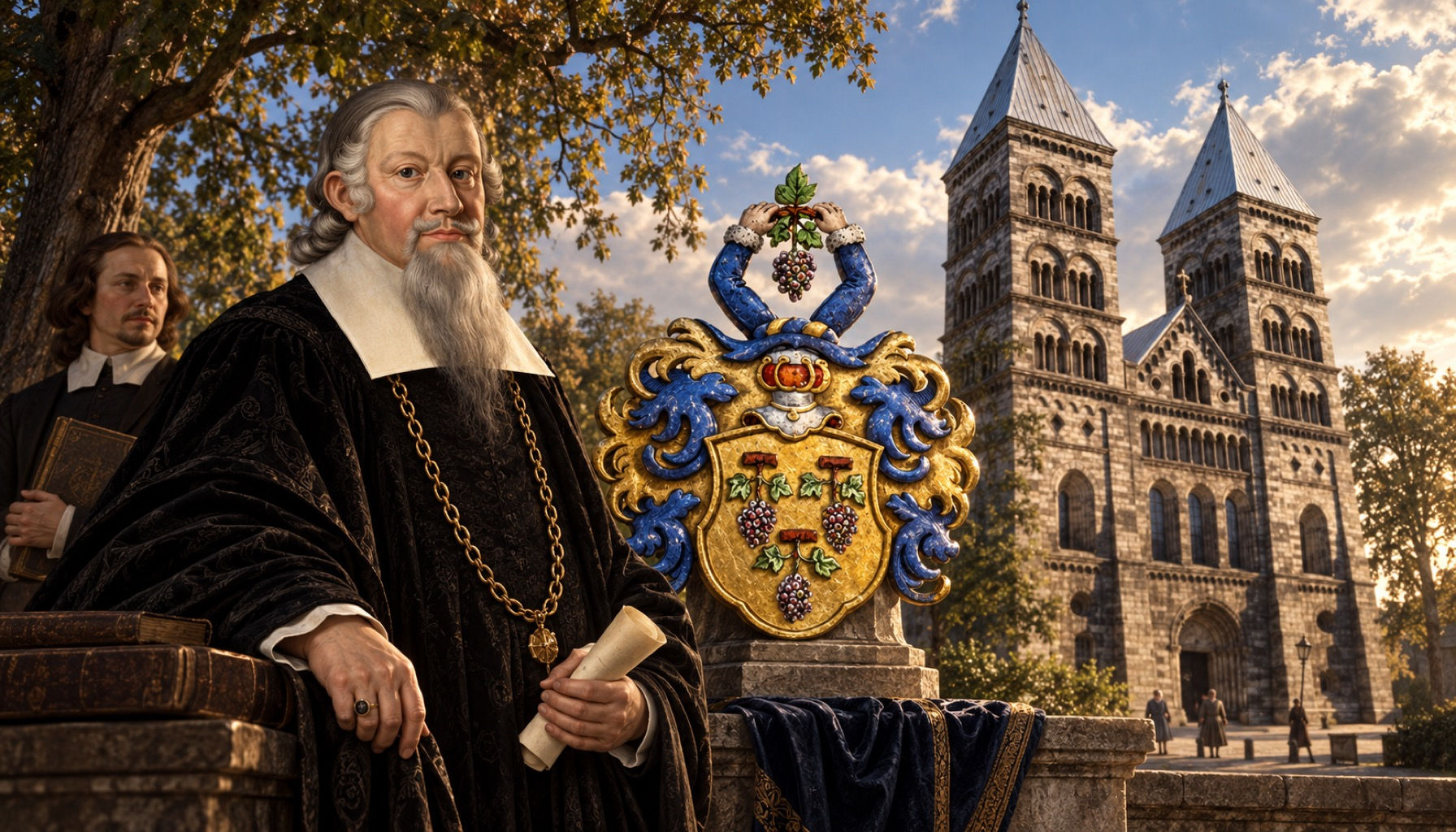
Bishop Teodomiro of Iria Flavia was an early medieval churchman in north-western Iberia, active in Galicia in the first half of the ninth century and traditionally associated with a discovery that changed the religious map of Europe. During his episcopate, a tomb found in Galicia was identified as the burial place of Saint James the Apostle. From that act of recognition grew Santiago de Compostela, later one of the great pilgrimage centres of medieval Christendom and the goal of the Camino de Santiago.
Teodomiro matters, then, not because he founded a dynasty or led an army, but because he stood at the hinge between local devotion and international fame. In the age of the Asturian monarchy, when Christian rulers in Iberia were consolidating power and shaping sacred landscapes, the identification of an apostolic tomb in Galicia gave the region immense prestige. It is a splendidly medieval story: bishops, relics, vision, politics, and place-making, all rolled into one.
Explore Iberian Genetic History
Teodomiro served as bishop of Iria Flavia, an old episcopal centre not far from what would become Santiago de Compostela. Medieval tradition credits him with investigating the newly discovered tomb and accepting it as that of Saint James. Whether we approach that tradition as faith, institutional memory, or political theology, its consequences are beyond dispute. The shrine drew patronage, liturgy, building activity, and eventually waves of pilgrims from across Europe. In other words, Teodomiro belongs to the earliest chapter of Compostela before the vast Romanesque cathedral, before the fully developed pilgrimage road, and before the city became a byword for sacred travel.
His world was one of transition. The old Roman framework of Galicia still lingered in place names and ecclesiastical organization, while the political realities were those of the early medieval kingdoms of northern Iberia. Bishops were not merely spiritual caretakers; they were cultural brokers, guardians of memory, and often key figures in giving authority to places and traditions. Teodomiro’s reputation survived because the shrine he helped authenticate became so influential. If Santiago became one of medieval Europe’s great spiritual magnets, he was there at the beginning, holding the lamp, so to speak.
The biological sample associated with him is recorded as Bishop Teodomiro of Iria Flavia Santiago de Compostela, with an approximate date around 847 AD. Remains traditionally attributed to Teodomiro were recovered near the cathedral area and examined with a mixture of osteology, radiocarbon dating, isotopic study, and ancient DNA analysis. This is exactly the sort of case where archaeology is most interesting: not a simple yes-or-no identification, but a careful weighing of evidence.
The scientific results support the remains belonging to an elderly male in the appropriate broad historical setting, which fits what we would expect for Teodomiro. That is significant. But the radiocarbon range does not provide absolute proof that the skeleton is certainly his. So the most responsible description is not “securely identified beyond doubt,” but rather a probable or strongly supported traditional identification. That distinction matters. The remains are highly relevant to the historical Teodomiro, yet science here refines tradition rather than rubber-stamping it.
This is one reason the study published in Antiquity is so compelling. It treats the bishop not as a legend to be debunked or blindly confirmed, but as a historical problem. The bones, burial context, dating evidence, and biomolecular data all point toward plausibility. They do not, on their own, create certainty.
The remains attributed to Teodomiro produced a Y-DNA haplogroup of R1b1a1b1a1a2a1b3 and an mtDNA haplogroup of T2b9. In plain terms, the Y-DNA traces his direct paternal line, passed from father to son, while mtDNA traces his direct maternal line, passed from mother to child. These are lineages, not ethnic labels, and they tell us only about two very narrow threads in a much larger ancestry.
Teodomiro’s Y lineage, R1b1a1b1a1a2a1b3, sits within a wider branch long documented in many parts of western and central Europe, both in ancient and modern populations. That does not make him “typically” anything in a simplistic sense; it merely places his direct paternal line inside a lineage with a substantial European history. His maternal lineage, T2b9, is a much more specific mitochondrial branch, and in the material supplied here Teodomiro’s sample is the named example for that line. That makes the maternal result interesting, but also limited: without a wider set of securely comparable T2b9 ancient individuals in this dataset, it cannot do much more than anchor one maternal thread in one early medieval man.
There are also some intriguing wider ancient-DNA parallels for the Y lineage. Related R1b1a1b1a1a2a1b3-linked samples appear in a strikingly broad spread of contexts, including Iron Age Britain at Pocklington in East Yorkshire (I21868), Iron Age and later Scandinavian cases from Denmark and Sweden, medieval Belgium at Sint-Truiden (ST1308), a Piast-dynasty-era burial in Poland (PCA0192), Byzantine-era individuals from Anatolia such as Stratonikeia Church (I20147) and Zeytinliada Monastery (I14831), and even the historic St. Mary City Chapel Field Cemetery in Maryland (I15301). That distribution does not imply close kinship with Teodomiro. What it does show is the long geographical reach of this paternal lineage across very different European and Mediterranean settings over many centuries.
For mtDNA, the picture is narrower in the supplied comparison set. The directly relevant T2b9-linked example listed here is Teodomiro himself, sample NCS200. So the maternal result is presently most useful as an identifying genetic detail attached to this burial rather than as evidence for a broad maternal network. In other words, the paternal line invites comparison across other ancient datasets; the maternal line here is more of a precise label than a map.
The value of this DNA lies less in grand claims about identity than in its contribution to a layered historical investigation. The genetics support the reality that these were the remains of a real elderly man from the appropriate broad period, not merely a later invention. Combined with the archaeological and osteological evidence, that strengthens the case that the burial could indeed belong to the bishop remembered in Compostela tradition. But haplogroups alone cannot prove that the bones are Teodomiro, cannot reveal his language or beliefs, and cannot establish direct descent for living people who happen to share one of these lineages.
What they can do is enrich the texture of the story. Teodomiro is already important because he stands at the birth of Santiago de Compostela. Now, through osteology and biomolecular analysis, he also stands at the meeting point of relic tradition, cathedral archaeology, and the modern science of ancient DNA. Very few early medieval bishops can be discussed in quite this way: as both historical actors and laboratory subjects.
With MyTrueAncestry, you can compare your DNA with ancient populations and archaeological samples from the worlds that shaped figures like Teodomiro: Roman and post-Roman Iberia, medieval Europe, and the wider genetic landscape behind pilgrimage-age Galicia. It is a way to explore deep population connections and ancient lineages, not to prove direct descent from this bishop.
Comments