Birka Shieldmaiden
– 4 min read


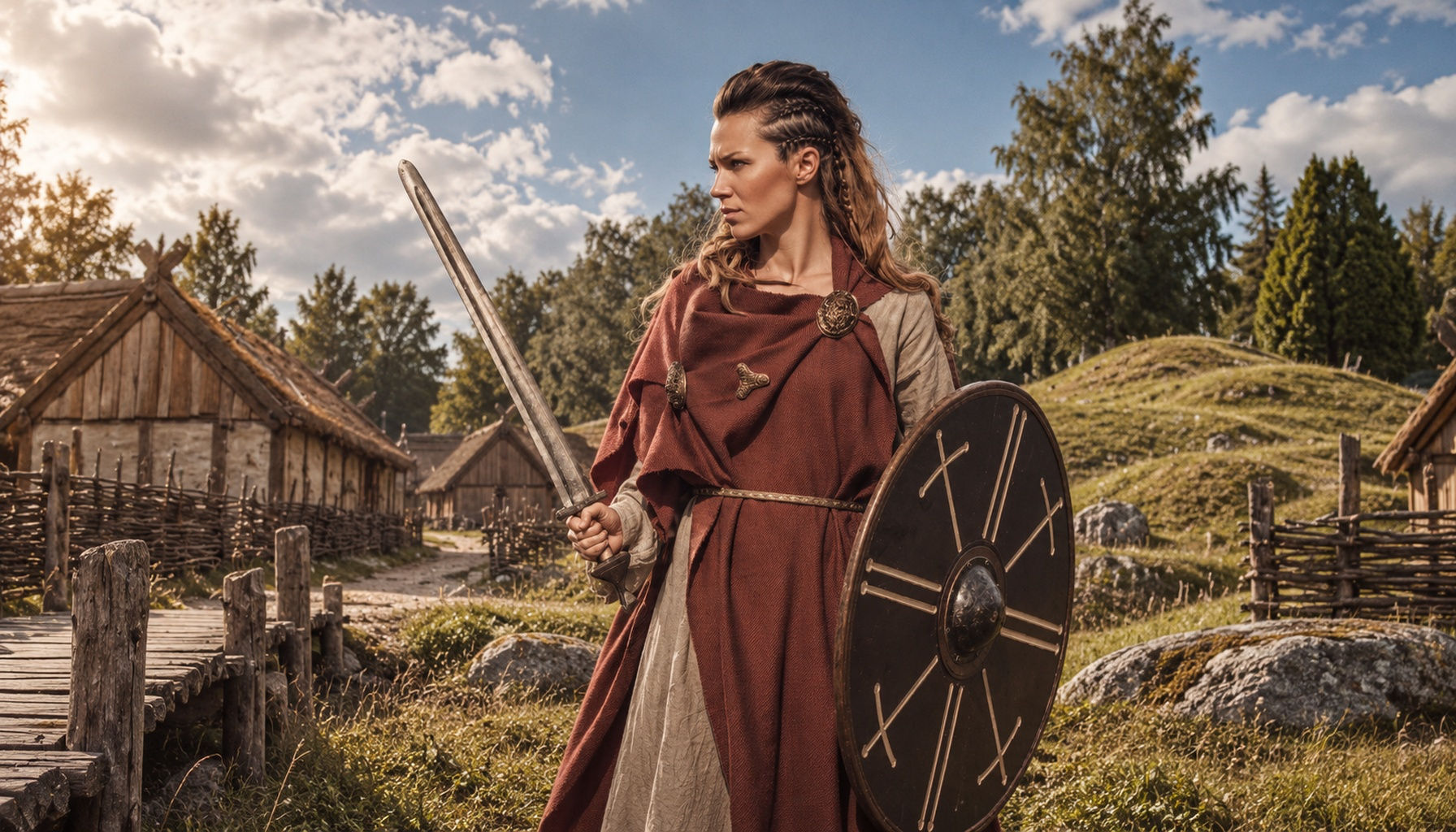
The Birka Shieldmaiden is the modern name given to the person buried in grave Bj 581 at Birka, the great Viking Age trading center on Björkö in Lake Mälaren, Sweden. She lived around 950 AD, in a world of long-distance trade, political rivalry, and expanding Scandinavian influence from the Baltic to the British Isles and beyond. She matters historically because her grave became one of the most discussed burials in Viking archaeology: lavishly armed, clearly elite, and for generations assumed to belong to a man.
That assumption, as so often in archaeology, turned out to say as much about modern habits of thought as about the dead themselves. Bj 581 contained a sword, axe, spear, arrows, shields, two horses, and gaming pieces often associated with strategy and command. For more than a century, these objects led scholars to classify the burial as male almost by reflex. Later osteological work raised doubts, and genomic testing confirmed that the individual was biologically female. As summarized in reporting such as the Smithsonian article on the reassessment of the burial, the result did not end debate, but it did force a serious reconsideration of how gender, status, and martial identity worked in Viking Age Scandinavia.
Birka was no sleepy settlement. Between the 8th and 10th centuries it was a busy nodal point in Baltic exchange, where merchants, craftspeople, warriors, and travellers crossed paths. Silver, furs, textiles, slaves, weapons, and ideas moved through places like this. In such a setting, military power and commerce were not opposites; they were entangled. Protection, raiding, alliance-building, and display all mattered. Bj 581 stands out because the burial assemblage is so emphatically martial that many researchers have interpreted the deceased as a high-ranking warrior, perhaps someone with a command role. Yet caution is necessary. Grave goods are evidence of how the dead were represented in burial, not a neat CV of their life. The Birka woman therefore sits at the heart of a fascinating question: when a Viking grave looks military, what exactly is it telling us about the person inside?
The biological sample is usually described simply as a Viking High-Ranking Shieldmaiden, dated to about 950 AD. The remains come from grave Bj 581 at Birka, excavated in the 19th century. This is not a securely named historical individual in the way that a king in a marked tomb might be. Rather, it is a strongly supported archaeological identification: the DNA and skeletal material are associated with the person buried in that grave, but we do not know her personal name from written sources.
The importance of the sample lies in the combination of context and testing. The burial itself was already famous because of its weapons, horses, and gaming pieces. Osteological analysis suggested the skeleton was female, and later genomic analysis showed the individual lacked a Y chromosome and was biologically female. That does not automatically settle every interpretive issue around occupation or social role, but it does securely address the sex of the sampled individual from Bj 581.
Discover Ancient DNA from Sweden
The Birka Shieldmaiden’s mitochondrial DNA, or mtDNA, belongs to haplogroup T2b. mtDNA traces the direct maternal line: mother to child, through many generations. Her Y-DNA, which traces the direct paternal line from father to son, is not applicable here because the individual was biologically female and no Y-chromosomal lineage was present. This is a good reminder that different parts of the genome answer different questions. mtDNA can speak to one narrow maternal lineage, while genome-wide data can help confirm biological sex and broader ancestry patterns.
Haplogroup T2b is a maternal lineage with deep roots in western Eurasia and appears in ancient individuals from a wide chronological and geographic spread. T2b-linked samples have been reported from contexts as varied as Neolithic Croatia Starcevo Vinkovci-Nama (I28427), Neolithic Belgium Pommeroeul (I21570 and I18605), Neolithic Austria Asparn Schletz (I24028, I27771, I27784, I24017, and I5206), Neolithic Sweden Angdala Farm Kvarnby (NEO46), Neolithic Denmark Sejerby (NEO757), Nordic Bronze Age Denmark Sjaelland Stroby Egede (NEO92), Nordic Bronze Age Sweden Sillvik (NEO261), Medieval Sigtuna Sweden (mbs092), Viking Age Denmark Sjaelland Kongsted Lyng (CGG019689), Viking Age Kaargarden Grav Denmark (VK287), Viking Age Gotland Kopparsvik Sweden (VK452), and Viking Era Kurevanikka Russia (VK161), among many others across Iron Age, Roman, Migration Period, and medieval Europe. In other words, T2b is not a “Viking haplogroup” in any exclusive sense. It is a maternal lineage that had been part of the European genetic landscape for millennia before the Viking Age.
There is also a direct T2b-linked comparison of obvious relevance here: Viking High-Ranking Shieldmaiden (brk581) itself. That sounds almost comically circular, but it matters because ancient DNA databases often connect users to specific archaeological samples as well as broader populations. In this case, the maternal lineage helps place the Birka woman within a long and widespread web of maternal ancestry, while the genome-wide analysis is what made the historical question so striking.
The real historical value of the Birka Shieldmaiden’s DNA is not that it reveals some secret essence. It does something both simpler and more profound. It checks an entrenched archaeological assumption against biological evidence. The DNA supports the conclusion that the armed person in Bj 581 was biologically female. What it cannot do, on its own, is prove exactly how she lived, whether she fought in a particular battle, or how Viking society categorized her role. Those remain matters of archaeological and historical interpretation. But it does insist that discussions of warfare, status, and gender in Viking Scandinavia must start from the evidence rather than from tidy modern expectations.
Read Viking Archaeology in Context
For anyone interested in the Viking world, Birka is a splendid example of how bones, grave goods, and genetics must be read together. A sword is not a chromosome; a mitochondrial haplogroup is not a job description. Yet when the strands are combined carefully, they give us a richer and more complicated past, and a far more interesting one too.
MyTrueAncestry lets you compare your DNA with ancient populations and archaeological samples from the Viking world and far beyond. You can explore whether your genetic profile shows connections to the kinds of ancient lineages and populations that shaped Scandinavia and medieval Europe, without pretending that a match proves direct descent from any one famous burial.
Comments