Beachy Head Woman
– 5 min read


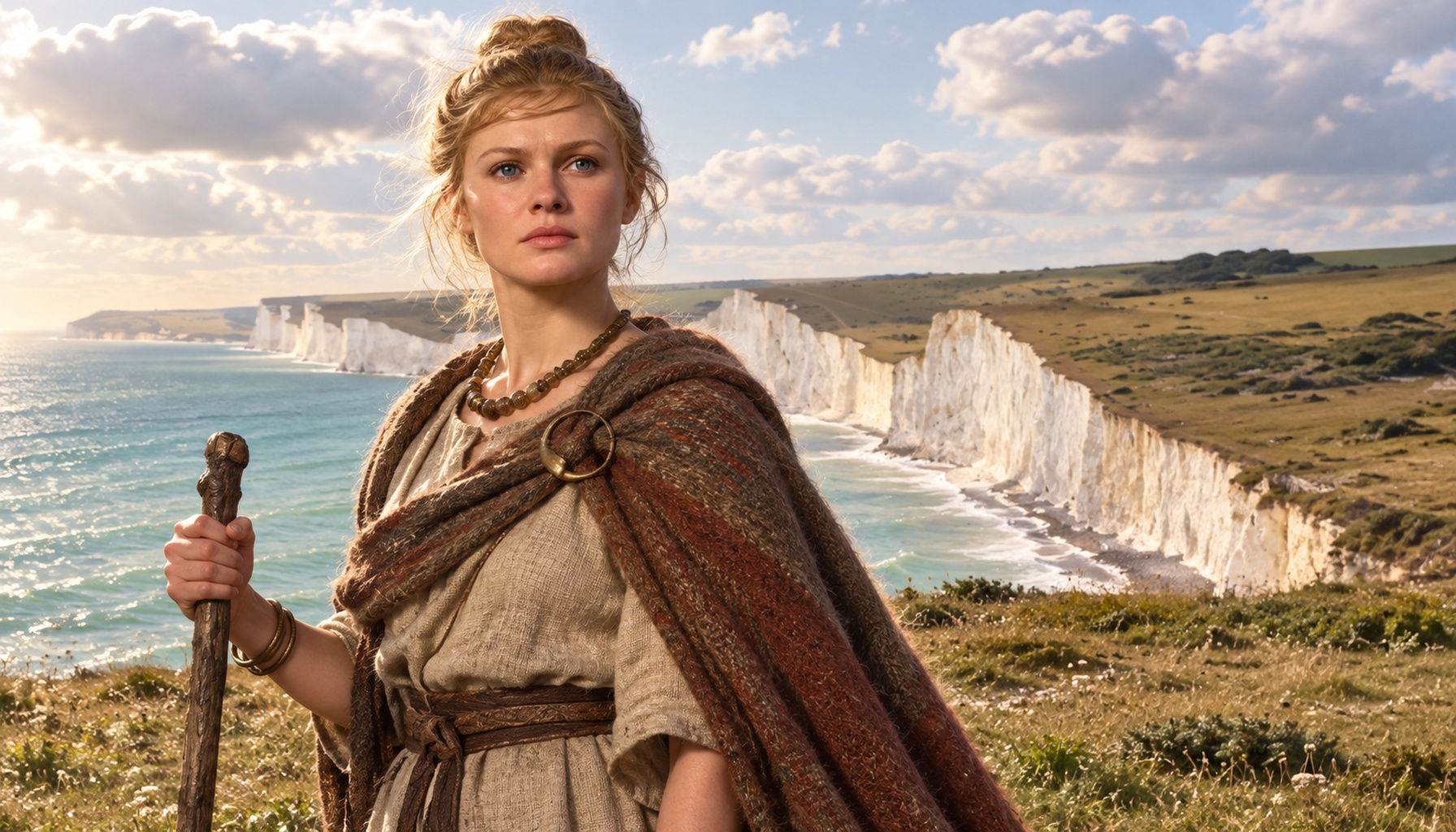
Beachy Head Woman was a young woman who lived in southern England under Roman rule, probably dying sometime between the second and early fourth centuries AD, with an approximate sample date around AD 220. Her remains, believed to have been found near Beachy Head in East Sussex and later rediscovered in the collections of Eastbourne Town Hall, became one of the most discussed skeletons from Roman Britain because scholars kept changing their minds about where she might have come from.
That changing story is precisely why she matters. Early skeletal analysis suggested possible sub-Saharan African ancestry; later limited genetic work leaned instead toward a Mediterranean origin; then a much fuller ancient DNA study published in 2025-2026 substantially revised the picture again, finding that her genome was most similar to the local population of Roman-era southern Britain and showed no evidence of recent sub-Saharan ancestry. In other words, Beachy Head Woman is historically important not because she gives us a neat slogan, but because she shows how archaeology, older physical anthropology, and newer genomics can disagree, and how better evidence can force a rethink.
She lived in a Britain that had been part of the Roman Empire since the invasion of AD 43. By her lifetime, southeastern England was deeply entangled in imperial life: roads stitched together towns and villas, soldiers and merchants moved through ports, imported goods circulated alongside local wares, and people in Sussex lived in a world shaped both by long local traditions and by the power of Rome. Emperors far away in Rome, Milan, or Trier mattered to taxation, military supply, and administration, but daily life in Britain remained resolutely local too. Beachy Head Woman belonged to that Romano-British world, where identity was not a simple matter of “Roman” versus “native,” but something layered, practical, and lived.
Her fame has sometimes rested on the hope that one skeleton might stand for the whole question of migration in Roman Britain. But history is usually more awkward than that. The Roman Empire certainly moved people over great distances, and Britain did include incomers from across Europe, North Africa, and the eastern Mediterranean. Yet one individual cannot bear all that weight alone. Beachy Head Woman is best understood as a case study in caution: a real person from Roman Sussex whose remains became a testing ground for bigger arguments about ancestry, appearance, and movement across the empire.
The sample associated with her is listed as Roman Britain Beachy Head Woman East Sussex. The identification is best treated as a probable rather than absolutely secure historical attribution in the grand biographical sense: we do have an ancient skeleton associated with the name Beachy Head Woman, but she is not a known named person from written sources. Rather, she is an archaeological individual, known through her remains and the scientific work carried out on them.
The available information indicates that her skeleton was believed to have been found near Beachy Head in East Sussex during the 20th century and was later rediscovered in the collections of Eastbourne Town Hall. That rediscovery is part of the story. So often in archaeology, the drama lies not in a glittering treasure but in a box on a municipal shelf. Once re-examined, her bones became the focus of osteological, isotopic, and biomolecular study. The major recent reference, Beachy Head Woman: clarifying her origins using a multiproxy anthropological and biomolecular approach, is important precisely because it does not rely on a single line of evidence. It compares several kinds of data and weighs earlier interpretations against new results.
In broader ancient-DNA context, her genome sits most comfortably within the varied but largely local population landscape of Britain and neighboring northwest Europe rather than standing apart as an obvious recent long-distance outlier. Comparisons with other ancient individuals can help frame that point. Samples such as Neolithic Whitehawk Brighton England (I6761), Neolithic Fussells Lodge Salisbury England (I6750), Bronze Age Wilsford Down England (I6778), and Raschoille Cave Oban Argyll and Bute Scotland (I5370) belong to much earlier periods and very different cultural worlds, so they are not “matches” in any simple sense. But together they remind us that southern Britain had deep population roots stretching back millennia before Rome arrived. Roman-period individuals elsewhere in Europe, such as Late Roman Pannonia Arrabona Szechenyi Square Hungary (GYS038) or Nemetes Tribe Colmar France (COL153A), show the empire’s diversity, while Beachy Head Woman appears, on present evidence, to fit more closely into the local Romano-British side of that story.
Beachy Head Woman’s mitochondrial DNA haplogroup was K1a26. Mitochondrial DNA, or mtDNA, traces the direct maternal line: mother to child, through many generations. It does not describe all of a person’s ancestry, only one narrow line among thousands of ancestors. Her Y-DNA haplogroup was not determined, which is entirely expected because Y-DNA follows the direct paternal line and is only present in males.
Haplogroup K is an old and widespread maternal lineage found in many parts of West Eurasia across prehistoric and historic periods. The more specific branch K1a26 is simply a finer twig on that maternal tree. It should not be treated as an ethnic badge or a shortcut to identity. It tells us something real but limited: Beachy Head Woman belonged to one maternal lineage carried by other women over long spans of time, not that she was therefore “Roman,” “British,” “Mediterranean,” or anything else in a cultural sense.
For K1a26-linked material, the directly relevant reference point available here is Beachy Head Woman herself, listed as SB670_Beachy_Head_Woman. At present, that means the lineage is informative mainly within her own case rather than as part of a large, well-defined cluster of named historical individuals. As more Roman and late Iron Age genomes from Britain and the continent are published, lineages like K1a26 may become easier to place in a finer regional context. For now, the important result is not the mtDNA label by itself, but the genome-wide finding that her overall ancestry aligns most closely with the local population of Roman southern Britain.
This is where the 2025-2026 study matters most. Earlier claims based on skull morphology generated interest in the possibility that she had recent sub-Saharan African ancestry. Later limited DNA work suggested a Mediterranean connection. The newer genome-wide analysis substantially revised both ideas, indicating no evidence of recent sub-Saharan ancestry and placing her closest to local Romano-British people. That does not mean Roman Britain was not diverse; it means this particular woman is no longer good evidence for the older claim once attached to her.
Compare another English ancestry case
Beachy Head Woman’s DNA is historically interesting because it changes the argument. It reminds us that ancestry estimation from skeletal appearance alone can be uncertain, especially when forced into older racial categories that were too blunt for the real complexity of ancient populations. Her case does not tell us that mobility in the Roman Empire was a myth; far from it. It tells us that each individual must be tested carefully, and that scientific interpretation is provisional. In that sense, she is a rather Roman figure after all: part of a connected world, but stubbornly resistant to modern simplifications.
MyTrueAncestry lets you compare your DNA with ancient populations and archaeological samples from worlds like Roman Britain and beyond. You can explore genetic connections to ancient lineages, regional populations, and excavated individuals without claiming direct descent from any one person such as Beachy Head Woman.

Comments