The Piast Dynasty
– 3 min read


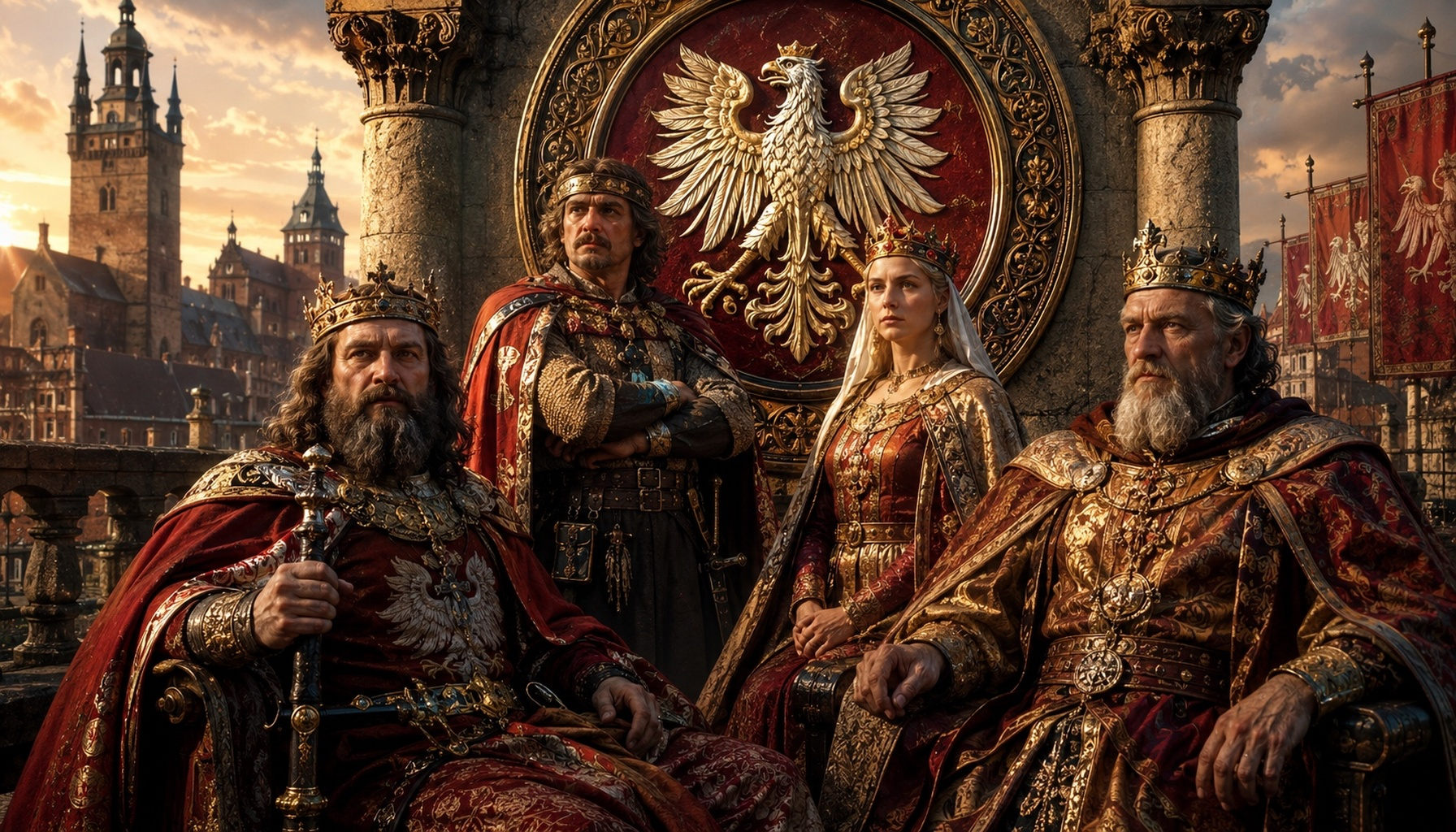
The Piast Dynasty was the first historic ruling house of Poland, the family that stands at the beginning of Polish statehood and the making of the medieval Polish monarchy. Emerging from the early polity of the Polans in what is now Greater Poland, the Piasts rose in the 10th century from a regional power centered on strongholds such as Gniezno and Poznan into a dynasty recognized across Christian Europe. Their linked primary haplogroup here is R1b1a1b1a1a2b, a lineage also seen in a wide scatter of ancient and medieval male samples across Europe, including several Piast-linked burials. In historical terms, the Piasts belong to that great early medieval world of warrior rulers, church founders, dynastic marriages, tribute, frontier politics, and the steady transformation of tribal authority into kingship.
This was not merely a family of isolated princes. The Piasts shaped the political grammar of Poland itself: Mieszko I (930-992) brought the realm into Latin Christendom through baptism, laying the foundations for durable rule; Casimir I the Restorer (1016-1058) rebuilt royal authority after crisis; Wladyslaw I Herman (1044-1102) governed in an age of noble and dynastic pressures; Konrad I of Masovia (1187-1247) became one of the major regional Piast rulers during the era of fragmentation; Boleslaw III of Plock, who died in 1351, belongs to the long Masovian Piast tradition; and Janusz III, who died in 1526, marks the late survival of a Piast branch into the early modern age. Between these figures stands the mighty memory of Boleslaw the Brave, whose kingship, warfare, and international ambition became central to Polish historical imagination. Even when Poland split into regional duchies, Piast branches continued to rule, preserving dynastic legitimacy through local lordship, castles, monasteries, and courts.
No place anchors the Piast story more powerfully than Wawel Castle in Krakow. Set on Wawel Hill above the Vistula, it became one of the chief political and ceremonial centers of the Polish realm and, over time, the symbolic heart of Polish kingship. The site contains layers of history: early medieval occupation, Romanesque remains, Gothic rebuilding, later Renaissance transformation, cathedral complexes, royal tombs, fortifications, and the accumulated memory of coronations, burials, diplomacy, and court life. In the Piast period, Wawel was not just a residence but a statement that rulership in Poland had become monumental, Christian, and dynastic. It is exactly the sort of place where stone, ritual, and politics meet. Better still, Wawel Castle still stands and can be visited today, making it one of the most tangible surviving gateways into the world the Piasts helped create.
From a DNA perspective, the Piast story is especially interesting because Piast-linked and related medieval samples have been associated with haplogroup R1b1a1b1a1a2b, including Piast Dynasty Lubusz-Greater Poland Border Santok Lad (PCA0391), Piast Dynasty Poland Santok Lubusz Province Gorzw Wielkopolski (PCA0503), Piast Prince Konrad I (PCA0665), Piast Masovian Dynasty Male (PCA0646), Piast Dynasty Prince (PCA0621), Piast Dynasty Prince Boleslaw II of Masovia (PCA0657), and Boleslaw III Duke of Plock Piast Dynasty (PCA0659). These do not by themselves prove descent for any modern tester, but they provide a valuable genetic frame around the dynasty and its wider paternal connections. Related or linked R1b1a1b1a1a2b samples also appear across many earlier and later European contexts, from Medieval Northern Spain at Las Gobas such as ldo066 and ldo037, to the Hungarian royal sphere at the Samuel Aba Benedictine Monastery sample HUASper55B, to elite Celtic burials in Germany such as MBG013, APG001, APG003, LWB001, and HOC001, as well as Roman-era and medieval individuals from England, Belgium, Portugal, Hungary, Denmark, Bohemia, Italy, and beyond. What that tells us, in plain terms, is not that the Piasts were "from" all these places, but that their paternal haplogroup belongs to a lineage with deep and widespread European roots, stretching through Bronze Age, Iron Age, Roman, migration-period, and medieval populations.
If the Piasts remind us of anything, it is that history is both personal and enormous: one family, one castle, one baptism, and suddenly a kingdom begins to take shape. If you want to see whether your own DNA links to ancient and medieval populations connected to haplogroups like R1b1a1b1a1a2b, upload your DNA to MyTrueAncestry and explore the deeper story behind your family origins.





Comments