The Barony of Baltimore / Calvert
– 3 min read


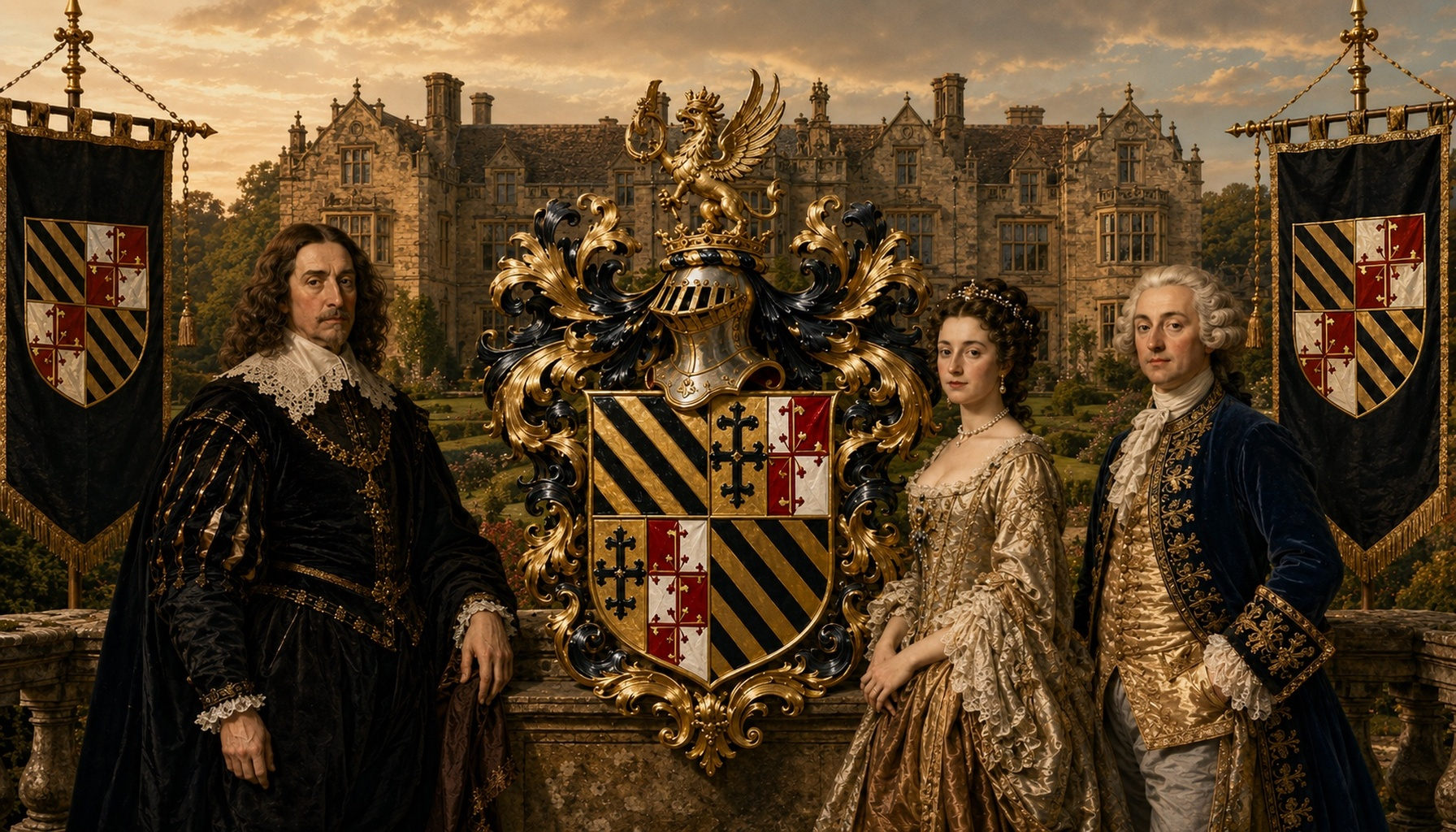
The Calverts, later Barons Baltimore, were an English family whose story became deeply entangled with Ireland and colonial North America, and whose primary linked Y-DNA haplogroup here is R1b1a1b1a1a2c1a1a1a1a1. In historical terms they were not ancient territorial magnates in the old feudal style, but a strikingly early modern kind of dynasty: ambitious, educated, useful to the Crown, and very good at turning office, court access, and political trust into lasting status. Their title, the Barony of Baltimore in the peerage of Ireland, was created for George Calvert, 1st Baron Baltimore (1579-1632), a statesman who moved from royal service into the grand Atlantic project of colony-building.
What makes the Calverts so interesting is that their importance was never just about a noble label. George Calvert and his heirs stood at the crossroads of Tudor and Stuart government, confessional politics, overseas settlement, and aristocratic self-fashioning through heraldry and landholding. His son Cecilius Calvert, 2nd Baron Baltimore (1605-1675), became the great architect of Maryland as a proprietary colony, while Charles Calvert, 3rd Baron Baltimore (1637-1715), and Philip Calvert, Governor of Maryland (1626-1682), helped shape its administration on the ground. The family's history opens out onto big themes: royal favor, English expansion into Ireland, colonial proprietorship, experiments in religious policy, and the uneasy but permanent link between noble identity and Atlantic empire.
Explore the Royal House of Stewart
If you want a physical anchor for the Calverts, Kiplin Hall in North Yorkshire is the place to look. Built in the early 1620s by George Calvert before he became Baron Baltimore, it is one of those houses that quietly tells a much larger story than its size first suggests. Architecturally it belongs to that confident Jacobean moment, brick-built and neatly self-aware, when rising families displayed both taste and advancement through country houses. Historically, Kiplin marks the Calverts at the point just before their name became permanently tied to Maryland. In other words, it is the English seat of a family about to become transatlantic. The hall later passed out of Calvert hands, but its association with George Calvert remains central, and today Kiplin Hall is preserved as a historic house with gardens and grounds. Yes, it can still be visited, which makes it a rare and rather vivid way of standing in the domestic world from which the Baltimore project emerged.
Read more about the House of Howard
From a DNA perspective, the Calvert-linked haplogroup R1b1a1b1a1a2c1a1a1a1a1 sits within a wider northwestern and western European story rather than anything uniquely "baronial". Related or linked ancient samples associated with this branch include individuals from the Gallic Cenomani Tribe horse co-burial at Verona Seminario Vescovile in Italy (3232s), Bronze Age Drasenhofen in Austria (DSH008), Medieval Ireland at Kilteasheen, Roscommon, including KIL033, KIL037, and KIL009, Late Iron Age West Yorkshire at Wattle Syke (I14347), Iron Age Long Bredy in Dorset (I27382), Iron Age Thornholme in the East Riding of Yorkshire (I22060), Iron Age Chemin de Coupetz in Marne, France (I19359), Viking Age Hofstadir in Iceland (VK95), Viking Age Faroe Islands Panum (VK24), Medieval Sandoy Church in the Faroe Islands (VK44), and Viking Iceland (FOV-A1). These do not prove direct descent from the Calverts, of course; what they do is sketch the deeper population world from which later British and Irish lineages emerged, stretching across Iron Age Britain, Gaul, medieval Ireland, and the Norse North Atlantic.
Explore colonial St. Mary's City DNA
The Barony of Baltimore is a reminder that family history is rarely just local. The Calverts began in the world of English service gentry and court politics, acquired an Irish peerage, and left their mark across the Atlantic in Maryland. If your own DNA or surname story points toward the Calverts, Baltimore, early Maryland, or the wider R1b1a1b1a1a2c1a1a1a1a1 network, you can dig further by comparing your results with historic families and related ancient samples. Upload your DNA to MyTrueAncestry and see whether you match the family or any of the ancient individuals linked to this broader lineage.



Comments