Magnus Haroldsson

– 4 min read


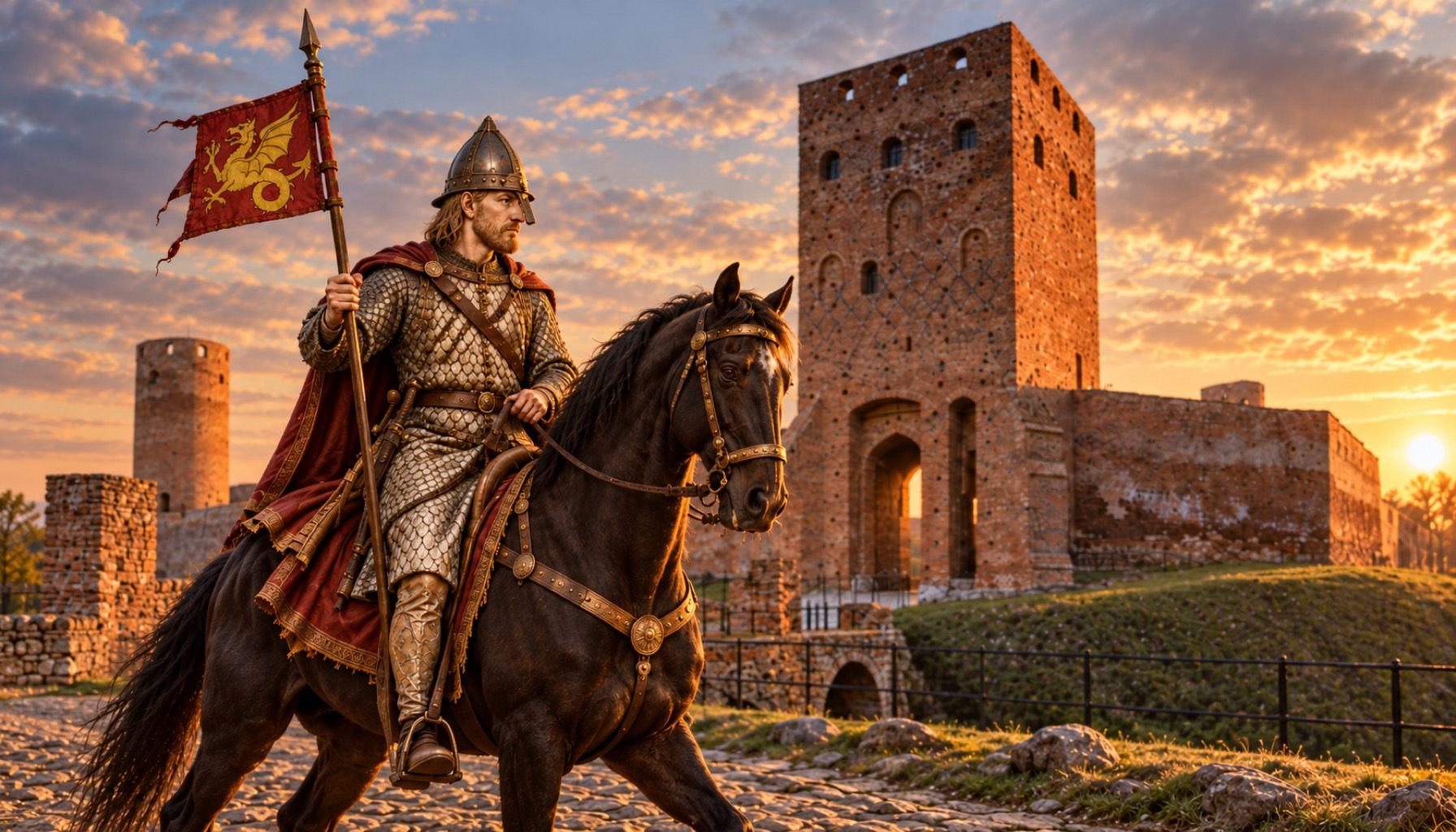
Magnus Haroldsson belongs to one of the most dramatic family stories in English history. He was a son of Harold Godwinson, the last Anglo-Saxon king of England, whose death at the Battle of Hastings in 1066 marked not just the end of a reign but the collapse of an entire political order. In the wreckage of the Norman Conquest, Harold’s sons were pushed into exile, and Magnus appears in the sources as one of the family members who tried, unsuccessfully, to strike back.
That alone would make him historically interesting. But Magnus is especially intriguing because he seems to disappear from the English record. Later historians have wondered whether this vanished prince of a defeated dynasty survived and resurfaced far from England, moving through the Scandinavian world into Poland. There, a foreign-born noble called Magnus appears in medieval sources connected with Wroclaw and Masovia. The suggestion that these two Magnuses were the same man is speculative, but it is exactly the kind of hypothesis that makes archaeology and ancient DNA so tantalising: not because they let us spin fantasies, but because they sometimes force us to ask whether a lost life left traces in unexpected places.
Magnus lived in the violent afterlife of 1066. His father Harold Godwinson had seized the English throne in a moment of crisis, defeated Harald Hardrada at Stamford Bridge, and then been killed facing William of Normandy at Hastings. For Harold’s children, that was not merely a family bereavement. It meant dispossession, danger, and political extinction. In 1068 Magnus and his brothers are recorded joining expeditions against Norman England, attempts to recover something of what had been lost. They failed. After that, Magnus slips into uncertainty, which is where the historical puzzle begins. If the Polish identification is correct, then the career of an exiled Anglo-Saxon prince did not end in obscurity at all, but continued in the aristocratic networks of Central Europe. If it is wrong, the burial and the Polish Magnus still remain fascinating in their own right. Either way, we are looking at the long shadow cast by the Norman Conquest across northern Europe.
The DNA in question comes from an elite medieval burial identified here as Magnus Haroldsson Elite Grave Czerska, sample VK200, dated approximately to 1109 AD. The proposed link is not a secure identification in the way one might identify a king from an inscribed tomb or from a tightly documented burial context. Instead, it is a speculative historical attribution: researchers and historians have considered whether the man buried at Czersk could be the same Magnus known from Polish sources, and whether that Magnus might in turn have been Magnus Haroldsson, son of Harold Godwinson.
That distinction matters. Ancient DNA is excellent at telling us about biological lineages and broader ancestry, but it cannot by itself read a medieval chronicle or certify a name. What makes VK200 so interesting is the convergence of status, date, region, and historical possibility. An elite grave in medieval Poland linked to a foreign-born magnate is already notable. Add to that the hypothesis of an Anglo-Saxon princely exile, and the burial becomes a small historical detective story. The preprint at https://www.biorxiv.org/content/10.1101/703405v1 provides important genetic context for medieval European samples of this kind, but the leap from sample to named individual remains interpretive rather than proven.
Read about Medieval Polish Rulers
The reported Y-DNA haplogroup for VK200 is K2b2a. Y-DNA follows the direct paternal line: father to son to grandson across many generations. The reported mtDNA haplogroup is J1b1a1b. Mitochondrial DNA follows the direct maternal line, passed from mothers to all their children, though only daughters pass it on further. These are not ethnic labels, nor do they tell us that a man was “Anglo-Saxon” or “Polish.” They are lineage markers, useful for tracking deep ancestry and comparing individuals across time.
The K2b2a assignment is historically interesting because it is uncommon in medieval European discussions and so immediately raises questions about how paternal lineages moved across regions and centuries. Related K2b2a-linked ancient samples have been reported from a strikingly wide spread of contexts, including Magnus Haroldsson Elite Grave Czerska (VK200), medieval Las Gobas in northern Spain (ldo041, ldo042, ldo043), Viking Age Fjalkinge in Sweden (fjk109), medieval Zealand in Denmark (CGG101811), medieval Sint-Truiden in Belgium (ST2107, ST2824), early medieval Velim-Velistak in Croatia (VEM067), Nordic Bronze Age Jutland (CGG106486_CGG106491), Viking Age Uppland in Sweden (als007), early Anglo-Saxon Buckland Dover in England (BUK009), Saxon Hannover-Anderten in Germany (ADN006), Iron Age Prague Jinonice (I16270), Celtic Briton Winall Down in Hampshire (I19037), and even more distant examples such as Greenland’s Viking settler VK180, Roman and pre-Roman Iberian samples, and deeper prehistoric individuals from Central Asia. That does not mean all these people were close relatives. It means this paternal lineage, at varying depths, has appeared in many different historical settings.
The mtDNA lineage J1b1a1b is more modestly documented here. In the material supplied, the directly relevant J1b1a1b-linked sample is VK200 itself. Because mtDNA traces one maternal line out of many ancestors, it can be useful for excluding or comparing maternal relationships, but on its own it says little about social identity. In this case, it adds one more biological signature to the burial without turning a proposed identification into a certain one.
The value of this DNA lies less in “proving” Magnus Haroldsson than in sharpening the historical question. If VK200 really belonged to an outsider of high rank in medieval Poland, that fits intriguingly with the idea of an exiled noble from abroad. The genetic data can help place the individual within wider medieval European variation and compare him to other ancient samples from England, Scandinavia, and the Continent. But the DNA cannot on its own demonstrate that this was Harold Godwinson’s son. For that, one would need a stronger chain of archaeological identification and, ideally, comparative relatives. So the result is best understood as a serious clue attached to a fascinating hypothesis, not the last word.
Discover Anglo-Saxon Migration DNA
MyTrueAncestry lets you compare your DNA with ancient populations and archaeological samples from the worlds Magnus Haroldsson may have moved through, from Anglo-Saxon England to Viking-age Scandinavia and medieval Central Europe. It is a way to explore broad genetic connections to the past, not to claim direct descent from a named historical figure.

Comments