Kohanim
– 2 min read


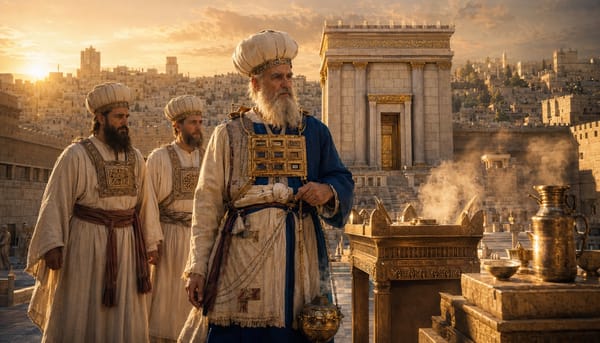
Kohanim are the hereditary priestly line of ancient Israel, remembered in Jewish tradition as the descendants of Aaron, the brother of Moses. In the MyTrueAncestry lineage mapping, Kohanim are linked to the Y-DNA branch J1a2a1a2d2b2b2c2a, making this post a bridge between one of the oldest priestly identities in the biblical world and a deep paternal line that still resonates across Jewish history.
Unlike a medieval clan or royal house, the Kohanim were a sacred lineage defined by ritual duty. Their status centered on Temple service, blessing traditions, and priestly inheritance rather than on a castle or feudal title. Even so, they became one of the most enduring named lineages in world history, surviving the destruction of the Temple, the dispersal of Jewish communities, and the transformation of the ancient Near East into later religious worlds. The memory of that priestly identity still echoes in surnames such as Cohen, Kohn, Kagan, and Katz, and in community traditions preserved for centuries.
The place most closely tied to that story is Jerusalem’s Temple Mount, the hill that held the First and Second Temples and later became one of the most contested and sacred religious spaces on earth. The retaining walls and expanded platform created under Herod still define the site today, even though the visible monuments now belong to later Islamic history. It remains a place that can still be visited in Jerusalem, though under strict access rules and with enormous religious sensitivity, which makes it one of the rare ancient sacred landscapes where the memory of the priestly line is still physically anchored in living space.
The DNA trail is suggestive rather than a claim of direct descent, but it is still striking. The local MyTrueAncestry brief links Kohanim to Aaron through J1a2a1a2d2b2b2c2a, and nearby ancient or historically relevant samples include an Early Israelite male from Megiddo, I4517, carrying the close branch J1a2a1a2d2b2b2c, as well as ETR014 from medieval Chiusi in Italy with J1a2a1a2. Another relevant comparison is ALA018 from Bronze Age Alalakh, a J1-linked outlier that helps show how old and mobile this broader paternal story was across the Levant long before later Jewish priestly traditions were recorded in writing.
That does not prove any excavated individual was literally a Kohen. What it does show is that the broader paternal landscape connected to the Kohanim tradition reaches deep into the eastern Mediterranean and Near Eastern past, touching Bronze Age, Iron Age, and later Jewish-world contexts. For readers interested in how memory, religion, and genetics can overlap, Kohanim are one of the clearest examples of a lineage that remained culturally alive for millennia.
If your results show Jewish, Levantine, or closely related ancient connections, upload your DNA to MyTrueAncestry and see whether your own matches connect you to the Kohanim story, the Temple world of Jerusalem, or the wider J1 paternal network behind this remarkable priestly tradition.


Comments