Haplogroup S1a2a

– 5 min read


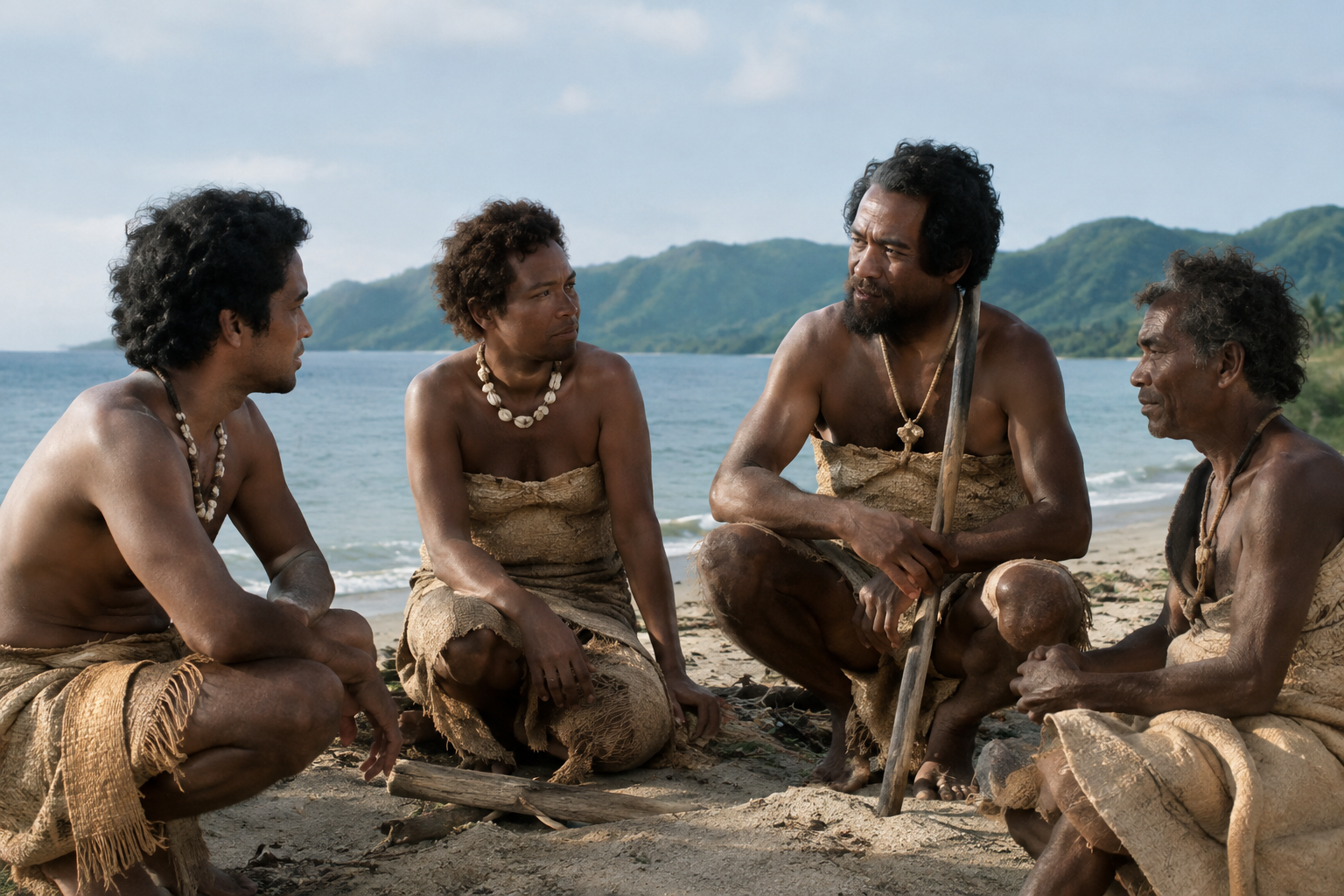
At Sigatoka on Viti Levu in Fiji, two men buried around AD 650, catalogued as SIG010 and SIG014, bring the Y-chromosome haplogroup S1a2a into unusually clear archaeological view. That matters because S lineages are closely associated with Island Southeast Asia and Oceania, yet ancient Y-DNA from this world is still far rarer than from Europe or western Asia. When a paternal branch turns up twice at one coastal burial area, in a period when Pacific societies were already deeply connected by voyaging, exchange, and local community history, it gives us something firmer than romantic talk of "seafarers" usually does: an actual lineage in actual graves.
Those Fijian burials do not stand alone. Another ancient individual, NAK003 from Aniwa in Vanuatu, dates to around 18 BC, and a much later Aboriginal Australian individual from Mapoon on Cape York, FLI2, dates to AD 1880. Taken together, these records suggest that S1a2a belongs to a paternal landscape rooted in the wider Pacific, not a single island story. As ever with Y-DNA, this traces one direct male line rather than a person's whole ancestry, but that one line can still illuminate long regional histories.
S1a2a is a specific branch within the broader Y-DNA haplogroup S, a lineage best known today in parts of Near Oceania and Australia. The narrower label matters. One of the common mistakes in popular genetic history is to treat a parent haplogroup and a sub-branch as though they have exactly the same age, spread, and historical significance. They do not. For this article, the secure point is not some grand universal map of haplogroup S, but the documented appearance of S1a2a in ancient Pacific-associated individuals.
That pattern fits a wider picture emerging from ancient DNA work in Oceania, where researchers are beginning to reconstruct how older Papuan-related ancestry, later Austronesian expansions, and local island histories combined in different ways across archipelagos. For readers interested in that broader background, MyTrueAncestry has also covered Archaic DNA and Long Isolation in Near Oceania.
The strongest cluster here is Sigatoka, on the island of Viti Levu. SIG010 and SIG014 are both dated to about AD 650, placing them in the early centuries of Fiji's late prehistoric sequence, long before European intrusion but well after the first settlement of Remote Oceania. Their importance lies not in lavish grave description, because none is securely provided here, but in repetition: the same haplogroup branch appears in two individuals from the same burial setting.
That repeated presence hints at local paternal continuity or at least the local visibility of this lineage within the community burying its dead at Sigatoka. It does not prove these two men were close relatives, village founders, or representatives of all Fijian men of the period. But archaeologically it is still significant. In a region where preservation is difficult and ancient Y-chromosome data remain thin, even two consistent male-line assignments from one site can sharpen our sense of who was living there.
A major ancient DNA study of Pacific populations has helped frame such findings by examining population history across Island Melanesia and Remote Oceania, including the mixture of ancestries that shaped later island communities. That broader research context can be found in this ancient DNA study on Pacific population history.
If Sigatoka shows S1a2a in Fiji by about AD 650, NAK003 pushes the story farther back in neighboring Vanuatu. This individual comes from Aniwa, at Nakmaroro, and is dated to around 18 BC. Chronologically, that makes him especially useful. He suggests that the branch was already present in the southern Pacific centuries before the Fijian burials discussed above.
Vanuatu is one of the most important places in Pacific archaeogenetics because it sits in the zone where incoming Austronesian-speaking settlers interacted with populations carrying deeper Papuan-related ancestry. A Y-line like S1a2a appearing there is therefore historically suggestive: it belongs to the paternal side of those complex local processes, rather than to a simple one-way migration tale. Pacific history was not a tidy arrow on a map. It was settlement, mixing, isolation on some islands, renewed contact on others, and generations of communities creating something new.
That wider process is explored from another angle in MyTrueAncestry's piece on Papuan-East Asian mixing before the first settlement of Palau, which shows just how early and regionally varied these ancestry blends could be.
The latest individual in this set is FLI2, an Aboriginal Australian person from Mapoon on Cape York, dated to AD 1880. On one level, this is chronologically very recent beside the ancient island burials. On another, it is extremely important, because it shows the same paternal branch in northern Australia, where haplogroup S has long been part of Indigenous male-line history.
Cape York is not an incidental place on the map. It lies close to Torres Strait, a region of movement, exchange, and cultural interaction linking northern Australia with nearby islands. The presence of S1a2a here fits the idea that this branch belongs to an old and regionally entangled paternal heritage spanning parts of Oceania and Sahul-linked populations, rather than a narrowly local episode. It also reminds us that ancient DNA does not stop being historically useful once the date becomes "recent" by archaeological standards. Nineteenth-century Indigenous individuals can still illuminate much older male-line continuities.
There is an obvious ethical point in the background too. DNA from Aboriginal Australian ancestors is not just data for drawing phylogenetic trees. It belongs to human lives situated within communities, landscapes, and colonial histories. Good archaeogenetics in this region has to keep that in view.
At first glance, Fiji, Vanuatu, and Cape York can look like disconnected dots. In fact, they are exactly the sort of evidence needed for Pacific paternal history, because the great challenge here is patchiness. Preservation is uneven, excavation histories differ, and many islands remain underrepresented in genetic sampling. So the value of S1a2a is not that it supplies a neat dynastic pedigree, but that it appears in multiple settings across a meaningful geographic arc.
What emerges, cautiously but usefully, is a branch associated with Pacific populations shaped by deep regional ancestry and later seaborne interaction. That does not make every carrier a voyager, a chief, or a migrant from one named source population. It does, however, place S1a2a firmly inside one of the most remarkable archaeological theaters on earth: the islands and coasts where human societies crossed open water, settled new lands, and then formed distinct local communities over many centuries.
Readers who want a larger interpretive frame for how ancient DNA is changing this kind of historical reconstruction may enjoy Ancient DNA and the Rise of Archaeogenetics.
For someone researching a present-day S1a2a paternal line, the strongest lesson is regional rather than dynastic. This haplogroup points toward a male-line history with credible ancient presence in the Pacific world, including Vanuatu and Fiji, and with continuity into Indigenous Australia. That is a distinctive pattern: maritime, island-linked, and deeply rooted in Oceania's own population history rather than borrowed from the usual Eurasian narratives that dominate popular DNA writing.
So S1a2a is best understood not as a badge of one tribe or one island, but as a signpost into a larger Pacific past. The burials of SIG010, SIG014, NAK003, and FLI2 show that this paternal branch belonged to real communities spread across different places and centuries. For a Y-line often overlooked in mainstream genetic storytelling, that is already a substantial historical footprint.
For another Pacific-facing case study in ancient population structure and movement, see MyTrueAncestry's article on Indonesia's ancient west-east genetic divide across Wallace's Line.
Comments