Haplogroup R2a2b1b2b3
– 5 min read


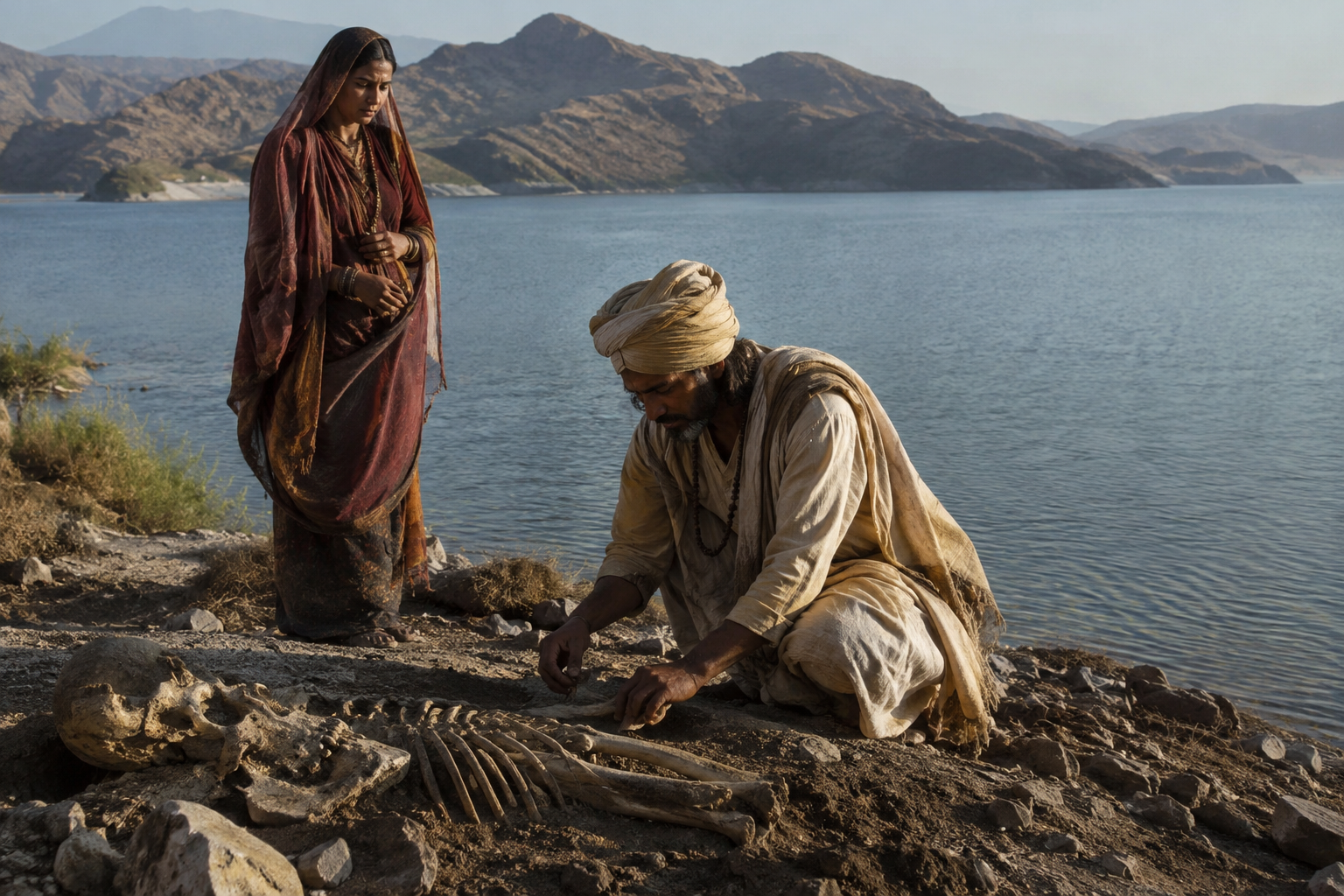
One of the most arresting ancient DNA discoveries linked to the Y-DNA haplogroup R2a2b1b2b3 comes from a man identified as I3352, described as a "Skeleton Lake Sindhi Worshipper" and dated to around AD 785. The label is already enough to make any historian pause. It places this paternal line not in some vague prehistoric fog, but in a very specific early medieval South Asian setting, tied to the famous and unsettling remains from Roopkund, often called Skeleton Lake, high in the Himalayas.
That matters because Y-DNA traces one direct paternal line only, not a person's whole ancestry, language, or identity. Even so, a securely placed male lineage in such an unusual archaeological context can be illuminating. In this case, R2a2b1b2b3 appears not in a royal tomb or a battlefield cemetery, but in a mountain death assemblage that has forced archaeologists and geneticists to rethink who reached these heights, and why.
Roopkund is one of those sites that sound almost invented by folklore: a glacial lake at high altitude, ringed by human remains. Yet the archaeology and genetics have steadily shown that this was not a single disaster involving one neatly defined community. Instead, the dead represent more than one episode and more than one background.
Sample I3352, dated to about AD 785, belongs to the earlier cluster of individuals from the site. The descriptive tag "Sindhi Worshipper" suggests a connection, at least in interpretation, to pilgrims or religious travellers from the Sindh region rather than to a purely local Himalayan population. That is important, because it shifts the story away from the old temptation to imagine Roopkund simply as an isolated mountain tragedy. It starts to look instead like part of a wider world of movement, devotion, and seasonal travel across early medieval South Asia.
An ancient DNA study examining the Roopkund remains helped show that the site does not represent one homogeneous group, but people of different ancestries and from different times in this research paper. That broader finding gives real weight to the appearance of a lineage such as R2a2b1b2b3 here: the men at the lake were not random duplicates of one another, nor can they all be reduced to a single "tribe" or event.
The first thing to say is that R2a2b1b2b3 is a very narrow branch name. It sits deep within the broader Y-DNA family of R, but it should not be lazily treated as if it carries the entire history of that parent lineage on its back. Broad haplogroup R has a huge geographic spread and deep time depth; this specific branch is a much more fine-grained paternal signal.
That distinction matters especially in South Asia, where R-lineages are varied and old, and where regional histories are complicated by repeated episodes of migration, mixture, language shift, trade, and state formation. A subclade like R2a2b1b2b3 is therefore most useful when anchored to actual individuals and actual archaeological settings. Here, our clearest anchor is I3352 at Roopkund in the early medieval period.
The more cautious historical reading is also the more interesting one. Rather than making grand claims about conquest or ethnicity, this branch presently speaks most clearly to the presence of one paternal line within a mobile religious world reaching into the Himalayas. That is a smaller claim, but a sturdier one.
AD 785 was not an age of isolation. The subcontinent was crossed by traders, pilgrims, soldiers, mendicants, herders, and courtly envoys. Sindh, in particular, was no backwater. It sat at a crossroads linking the Indus world to western India, Central Asia, the Arabian Sea, and the wider Islamic sphere after the 8th-century Arab conquest of the region.
If the descriptive identification of I3352 as a Sindhi worshipper is accepted, then this man belonged to that larger connected world. His presence at Roopkund would hint at long-distance religious travel into the mountains, perhaps along routes that drew people from the plains into sacred landscapes of the central Himalayas. That would fit a pattern well known from South Asian history: pilgrimage was never only local. Sacred geographies pulled people across formidable distances, and sometimes into dangerous terrain.
It is worth stressing what the evidence does not automatically show. A Y-chromosome branch does not by itself tell us his language, caste, sect, or exact birthplace. But combined with the site's broader evidence for non-local participants, it does support the idea that paternal lines associated with regions far from Roopkund could appear in Himalayan ritual contexts.
Readers sometimes assume that one sample is too little to say anything useful. In one sense that is true: one man is not a whole population. But archaeology is full of cases where one well-placed individual changes the shape of the question. I3352 does exactly that.
He ties the haplogroup R2a2b1b2b3 to a memorable and historically meaningful context: an early medieval high-altitude death assemblage associated with mobility and probably pilgrimage. That is already more informative than many isolated modern haplogroup labels, which can float free of place and time. Here we have both.
There is also a methodological lesson in the Roopkund case. Ancient DNA works best when it unsettles simple stories. For years, popular retellings of Skeleton Lake leaned toward a single calamity and a single group. Genetic evidence complicated that narrative. The dead did not all arrive together, did not all come from the same background, and should not all be folded into one legend.
South Asia is gradually becoming better represented in ancient DNA, but the record is still uneven compared with parts of Europe. That makes each contextually strong sample especially valuable. Roopkund is important not because it gives a neat national origin story - it decidedly does not - but because it captures a moment where landscape, ritual movement, and biological ancestry intersect.
For a haplogroup like R2a2b1b2b3, this is precisely the sort of evidence that helps turn genealogy into history. Instead of asking only where a branch is found today, we can ask where one documented bearer stood in the past, in what sort of place, and amid what kind of human activity. In this case the answer is vivid: high in the Himalayas, in an early medieval setting that speaks of movement across regions and sacred routes.
The most distinctive thing about R2a2b1b2b3 here is not imperial grandeur or a famous dynasty. It is that this lineage is attached to a real early medieval man, I3352, caught in one of South Asia's most unusual archaeological contexts. That gives the branch a historically grounded foothold in the world of long-distance movement and sacred travel around AD 785.
For someone researching this paternal line today, the sensible takeaway is not a claim of descent from a named people or a single dramatic event. It is something subtler, and in many ways better: this branch has been identified in a man connected to the mobile, regionally linked human landscape of early medieval South Asia, where pilgrimage, geography, and ancestry met in unexpectedly stark fashion at Skeleton Lake.
Comments