Haplogroup R1b1b2

– 5 min read


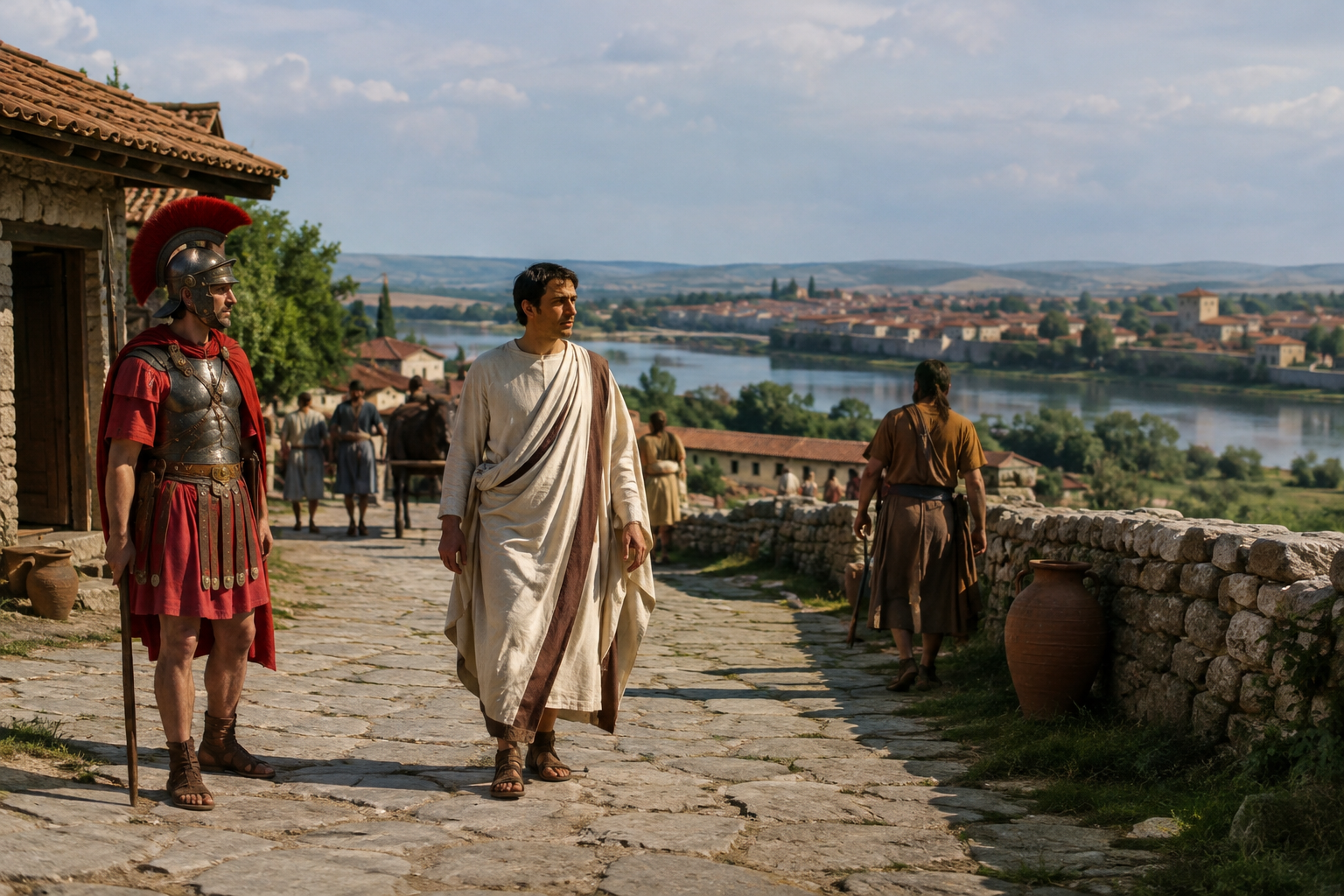
At Viminacium in Serbia, one man from around AD 180 carries us straight into the practical reality of Roman frontier life. The ancient individual known as R6756, dated to the Imperial Roman era, belonged to Y-DNA haplogroup R1b1b2 as reported in the sample set associated with the site. That may sound like a dry genetic label, but in context it is anything but dry: Viminacium was one of the great military and urban centers of the Middle Danube, a place where empire, mobility, and local continuity met face to face.
That is what makes this sample useful. A Y-chromosome line traces one direct paternal line only, not a whole identity or ethnicity, yet even a single paternal marker can become historically interesting when it turns up in a place like Viminacium. Here, on Rome's northern edge, men moved in and out through army service, trade, administration, and family life, and a lineage such as R1b1b2 becomes part of that larger archaeological story.
Viminacium was not some remote outpost in the modern imagination of "edge of empire." It was a legionary base, a settlement, and eventually a major provincial capital in the Roman Balkans. Situated near the Danube, it connected the military world of the frontier with the civilian world of workshops, roads, cemeteries, and river traffic.
So when sample R6756 appears there in the second century AD, the important point is not to force him into a romantic tale of conquest or migration. It is to see him as evidence of the mixed and organized society that sustained Rome's presence in the region. A man carrying R1b1b2 at Viminacium could have been local to the Balkans, descended from families long established somewhere else in the empire, or part of a line shaped by much earlier prehistoric movements across Europe. The site matters because the Roman world brought such strands together in one lived landscape.
An ancient DNA study centered on Viminacium and the wider Balkan-Roman setting has helped draw attention to exactly this sort of complexity, and the research lead associated with this sample can be found here: https://www.biorxiv.org/content/10.1101/2022.05.15.491973v1. Even without overstating any one sample, the broader value of the work is clear: Roman frontier populations were rarely simple or uniform.
R1b1b2 is an older-style naming convention for a branch within the wider R1b paternal family, one of the major Y-chromosome lineages found across much of western Eurasia. In popular genealogy this broad cluster is often associated with later prehistoric expansions in Europe, especially after the Bronze Age. But one must be careful here: a broad haplogroup label is not a shortcut to a complete biography.
In this case, the evidence is strongest when kept close to the sample. R6756 shows that a paternal line classified as R1b1b2 was present at Imperial Roman Viminacium. It does not by itself tell us the man's language, legal status, birthplace, or whether his father's line had arrived recently or had been in the Balkans for centuries. Ancient DNA is at its best when combined with archaeology, not when it tries to replace it.
That is especially important with Roman-era material, because the empire constantly rearranged people without neatly erasing older local populations. A Y-line can persist through major cultural changes, and the same haplogroup can appear in very different historical settings. The interest lies not in claiming too much, but in seeing how one paternal thread sits inside a vast imperial weave.
The Balkans before and during Roman rule were already a region of deep population history. Long before legions, this was a zone of contact linking the Carpathian Basin, the Aegean, the Adriatic, and the steppe-facing plains. By the time Viminacium flourished, its inhabitants were living on top of many earlier layers of settlement and movement.
That background matters for understanding why a lineage like R1b1b2 at Viminacium should not surprise us. The Roman empire inherited landscapes already shaped by Bronze Age dispersals, Iron Age communities, and regional exchange networks. Rome intensified those connections, built roads and forts, recruited soldiers from afar, and fostered new towns, but it did not start history from scratch.
For readers interested in the deeper pre-Roman background of the region, MyTrueAncestry has also explored how older populations helped shape southeastern Europe in Balkan Hunter-Gatherers Shaped Post-Ice Age Europe. That longer timescale is useful because it reminds us that Roman DNA evidence often sits atop much older demographic foundations.
Viminacium is valuable precisely because it was not a single-purpose military camp frozen in time. It was a living urban center with cemeteries that can preserve evidence for ordinary people as well as the wider machinery of empire. In such places, genetics often reveals a social fact historians have long suspected: Roman communities were made up of people with different ancestries whose lives became entangled in the same institutions.
That does not mean every burial represents long-distance migration. Some individuals were surely local or regionally connected, while others may have had family histories stretching across provinces. The point is that Roman rule created conditions in which paternal lines like R1b1b2 could appear in settings far from any simplistic homeland narrative.
This is one reason Roman frontier archaeology has become so exciting in the age of ancient DNA. The old opposition between "Roman" and "barbarian," or between "native" and "colonist," often breaks down when we look at real human remains. At frontier sites, identities were political and social as much as biological, and communities could be mixed without being chaotic.
It is tempting to think that a single man cannot tell us much. In one sense, that is true: R6756 is not the entire population of Viminacium, nor a spokesman for the Roman Balkans. But archaeology advances by accumulation, and each securely placed ancient genome helps pin a paternal lineage to a real place and time.
That matters particularly for broad lineages such as R1b1b2, which are widespread today and can otherwise feel frustratingly abstract in family history. An ancient sample gives the haplogroup historical texture. Here it appears not in a mythical founding tribe or a vague map of Europe, but in a documented Roman-era city on the Danube, around AD 180, amid the administrative and military pulse of empire.
It also sits well beside other MyTrueAncestry work on Roman populations farther west and south. The empire did not move one kind of person in one direction; it created a world of repeated contact, settlement, and reshuffling. That broader pattern is visible in studies of Iberia, Italy, and the Balkan frontier alike.
If your paternal line falls under R1b1b2, the Viminacium sample offers a sober but meaningful point of connection. It shows that this lineage was present in a major Roman Balkan center during the Imperial period, embedded in the sort of population that made the empire work day by day. That does not prove descent from this individual, nor does it narrow your ancestry to one nation or ancient people. What it does offer is something better than fantasy: a real archaeological anchor for one branch of the paternal past, in a place where Europe's older lineages and Rome's imperial networks met in the same ground.






Comments