Haplogroup R1b1a2a2
– 5 min read


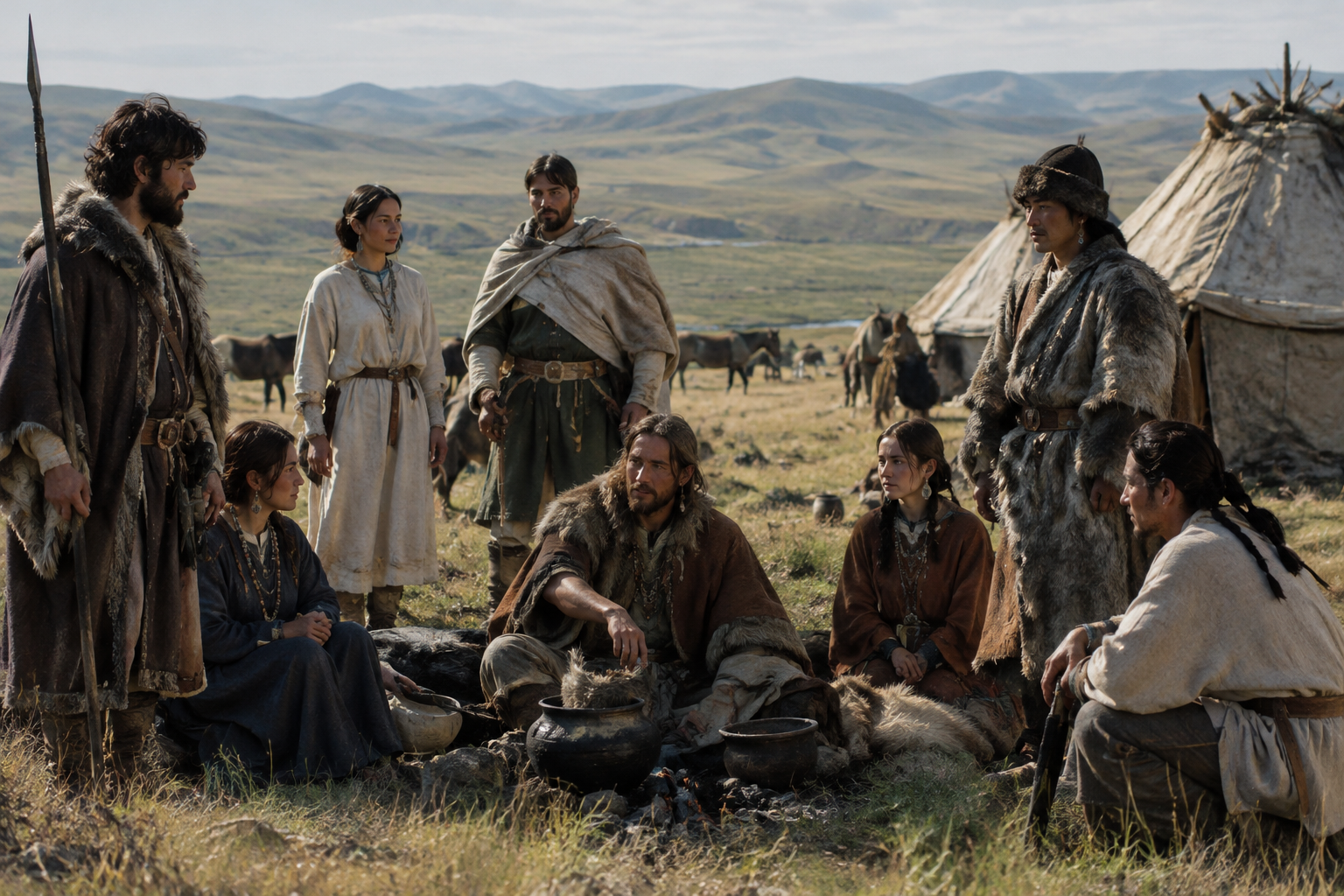
Some Y-chromosome lineages announce themselves in the ancient DNA record with a bang. Haplogroup R1b1a2a2 is one of them. It appears in some of the most consequential archaeological settings in Eurasian prehistory: the steppe world associated with Yamnaya burials, the South Caucasus in the Iron Age, and even far to the east in Mongolia. That alone makes it historically intriguing. We are not looking at a single kingdom or one famous dynasty, but at a paternal branch that helps illuminate long-distance movement across enormous stretches of Eurasia.
As always, a caution worth making at the start: Y-DNA traces one direct paternal line only - father to father to father. It does not represent a person's whole ancestry, culture, language, or identity. Still, because paternal lines can sometimes persist for long periods, haplogroups like R1b1a2a2 give us a remarkably useful tool for asking where particular male lineages appear, when they appear, and in what archaeological worlds they were living.
R1b is a major branch of the Y-chromosome tree with a long and complicated history across western Eurasia. The more specific label R1b1a2a2 points us into a narrower paternal corridor within that wider family. For this branch, the supplied ancient evidence places some of its clearest early appearances in Bronze Age steppe-associated contexts, especially among burials linked with Yamnaya settings in present-day Ukraine and Russia.
That matters because the Yamnaya horizon has become central to discussions of prehistoric mobility across the Pontic-Caspian and adjacent steppe. Archaeology, isotopes, and genetics together suggest communities that were highly mobile, stock-raising, and connected over very large distances. When a lineage appears repeatedly in such contexts, it tells us not that every Yamnaya man belonged to the same paternal line, but that this line was at home in that world.
Several of the samples here cluster strikingly in that early steppe zone: MAJ009 from Early Bronze Age Ukraine Mayaki Yamnaya dated to 2669 BC, and from the Volga-Ural region I0429 from Neolithic Russia Yamnaya Lopatino Sok River dated to 2917 BC, I0370 from Neolithic Pre-Ural Steppe Yamnaya Eastern Orenburg dated to 2700 BC, I0438 from Neolithic Russia Yamnaya Luzkhi I Samara River dated to 2635 BC, and I0444 from Neolithic Russia Yamnaya Kutuluk I Samara dated to 2881 BC. Whatever the quirks of period labels in the dataset, the broader picture is plain enough: this paternal line is turning up again and again in the steppe-associated archaeological record.
For readers interested in the wider archaeological background to this zone, the North Pontic record gives useful context for how these early populations moved and mixed.
Explore North Pontic migrations
One of the best things about ancient DNA is that it brings us back from theory to people. Sample MAJ009 was not a diagram in a population-genetics paper. He was a man buried in the Yamnaya world of Early Bronze Age Ukraine. Likewise I0429, I0370, I0438, and I0444 were individuals placed in burials across the steppe and forest-steppe margins east of the Volga. Their Y-chromosomes suggest that related paternal branches could stretch across a broad arc from the Black Sea zone toward the southern Urals.
That geographical spread is historically important. It hints that the paternal story behind R1b1a2a2 was not confined to one valley or one clan cemetery. It belonged to the large-scale social networks of mobile Bronze Age Eurasia. That does not prove a single migration event, and it certainly does not let us assign a tidy ethnic label. But it does support the idea that this lineage participated in the expansion and circulation of steppe populations over wide distances.
The easternmost sample in the list is especially arresting: YAG001, from Chemurchek Yagshiin Khuduu Early Bronze Age Mongolia, dated to 1000 BC. Even allowing for the need to preserve the supplied description exactly, this is the kind of find that reminds us how far paternal lineages can travel. It does not mean a simple march from the Volga to Mongolia by one family tree. What it does show is that lineages within this broader paternal sphere could appear far into Inner Asia, in regions shaped by their own local histories, exchanges, and mixtures.
If that eastward dimension catches your imagination, the broader steppe story in Mongolia is well worth following.
Discover DNA from the Mongolian steppe
The story does not stop in the Bronze Age. Two later samples bring R1b1a2a2 into the South Caucasus: geo029 and geo005, both from Early Iron Age Georgia Didnauri, dated to 1049 BC. These Didnauri individuals are especially valuable because they show this paternal branch in a very different historical landscape from the classic Yamnaya steppe graves.
Georgia in the Early Iron Age was no empty frontier. It sat in a region of uplands, passes, river valleys, and political interaction zones linking the Black Sea, the Caucasus, Anatolia, and the steppe. So when R1b1a2a2 appears there, it suggests either persistence, movement, or both across the centuries between Bronze Age steppe societies and Iron Age Caucasian communities. We should be careful not to flatten that into a single narrative. The South Caucasus has its own deep local continuity as well as repeated episodes of contact. But these samples do place this paternal lineage firmly inside that historical conversation.
Readers who want more on the long-term genetic record of this region should look at the broader South Caucasus picture.
Read South Caucasus genetic history
So what can we responsibly say about haplogroup R1b1a2a2 from this evidence? First, it has a strong presence in ancient contexts tied to the steppe world, especially Yamnaya-associated burials from Ukraine, Samara, the Sok River region, and eastern Orenburg. Second, it appears later in the South Caucasus at Didnauri in Georgia. Third, a related presence much farther east in Mongolia shows just how widely such paternal lines could be distributed across Eurasia.
What we cannot say is just as important. We cannot say that everyone with this haplogroup descends from Yamnaya in any simple or exclusive sense. We cannot say that an Iron Age Georgian male carrying the same broad branch was the direct descendant of one specific Bronze Age man from Samara. And we cannot turn a Y-chromosome label into a ready-made claim about language, tribe, or nationality.
In other words, the value of R1b1a2a2 lies not in fantasy genealogy but in historical placement. It helps us see how paternal lines can persist through changing archaeological cultures and across large regions. The men buried under kurgans on the steppe, the individuals at Didnauri in Georgia, and the later populations of Eurasia did not live in the same world. But ancient DNA shows that some paternal branches moved through all those worlds nonetheless.
That is also why broader archaeogenetic method matters. A haplogroup is most useful when read alongside burial practice, geography, chronology, and genome-wide ancestry rather than as a stand-alone badge of identity.
Learn how archaeogenetics works
For MyTrueAncestry users, haplogroup R1b1a2a2 is a reminder that a direct paternal line can open onto unexpectedly large historical landscapes. A modern result in this branch does not make someone a Yamnaya herdsman, an Iron Age Georgian noble, or a Bronze Age traveler to Inner Asia. But it may place one narrow paternal line in the same deep historical frame as populations who lived in those places.
That is the excitement of ancient DNA when handled properly. It does not hand out costumes from the past. It gives context. It lets you ask whether your paternal line belongs to one of those branches that once turned up in the burial grounds of the steppe, in the Caucasus, or at the edge of the Mongolian world. And once you start asking that question, prehistory becomes much less abstract.
Upload your DNA to MyTrueAncestry and explore whether your results show connections to ancient individuals like MAJ009, I0429, I0370, I0438, I0444, geo029, geo005, or YAG001. These matches can offer a fascinating perspective on your ancestry, even though they do not by themselves prove direct descent from any one ancient person or later historical family.






Comments