Haplogroup R1b1a2

– 5 min read


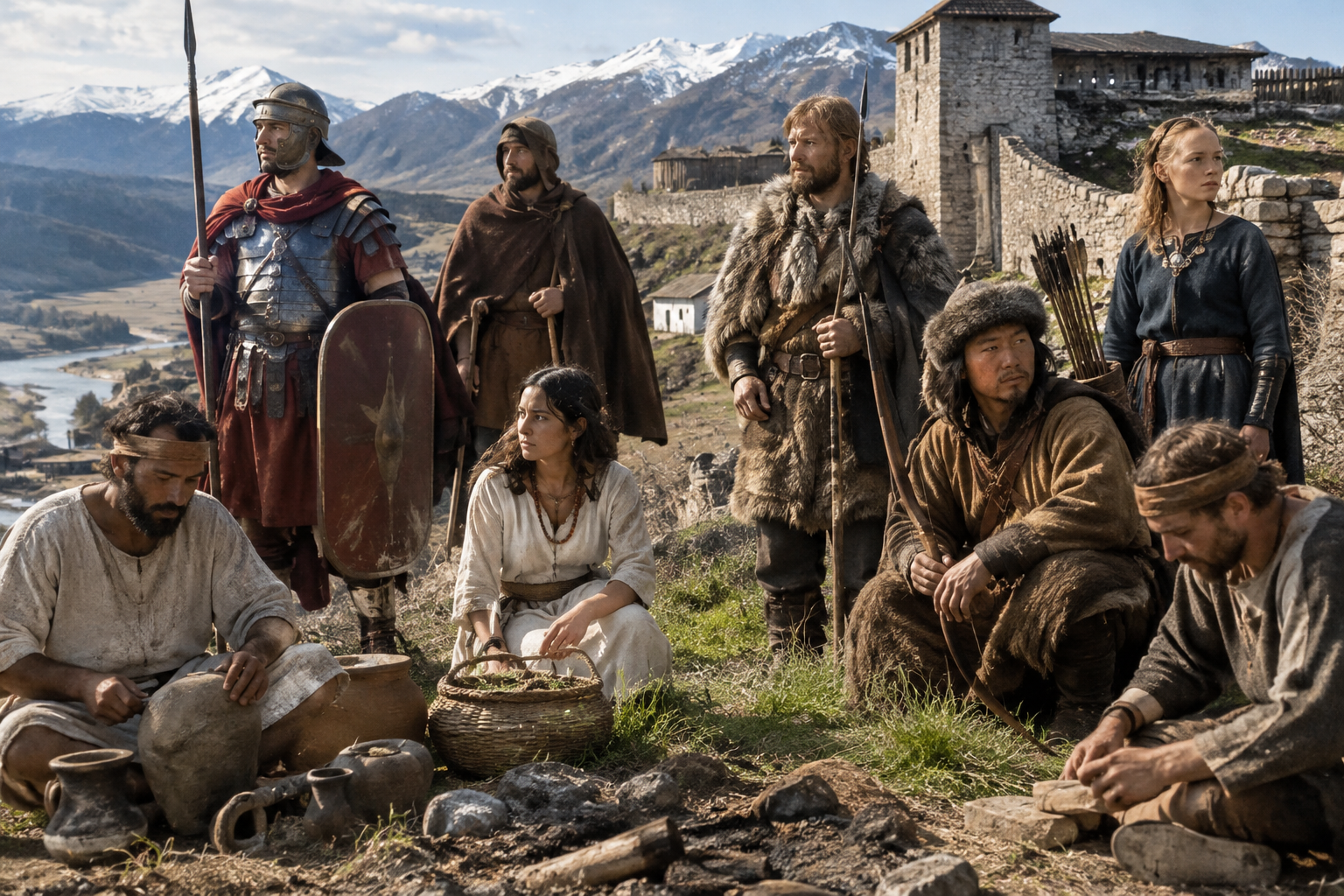
At Malles Burgusio Santo Stefano in South Tyrol, one man buried around AD 650, sample 2430, offers a neat way into the history of R1b1a2. He lived in an Alpine borderland where Roman traditions, local communities, and early medieval political change all met in close quarters. That matters because this haplogroup, as it appears in ancient DNA, is not a badge of one people or one kingdom. It turns up instead in very different settings, across a long timespan, reminding us that a Y-chromosome line traces one direct paternal thread, not a whole identity.
The samples linked here make that point unusually well. The same broad paternal branch appears in an Eneolithic steppe individual, in Bronze Age central Europe, in Iron Age Latvia, and in post-Roman Italy and Iberia. So rather than telling a single heroic origin story, R1b1a2 is better approached as archaeological evidence of continuity, movement, and re-use of older male lines in new societies.
South Tyrol in the seventh century was no remote backwater. It sat on routes through the Alps, where movement between northern Italy and regions farther north had been a fact of life since Roman times and long before. Sample 2430, dated here to about AD 650, belongs to that world of post-imperial transition rather than to any simple "tribal" map.
What makes this burial useful for the story of R1b1a2 is not aristocratic glamour but context. Early medieval Alpine cemeteries often show how communities persisted while political labels changed around them. A genetic study of ancient Italian populations, including early medieval contexts, has helped underline just how mixed and regionally varied those transitions could be, rather than neatly replacing one population with another through ancient DNA research on Italy.
In other words, finding R1b1a2 in South Tyrol does not prove that one dynasty marched in and took over. It shows that this paternal line was present in an Alpine community shaped by centuries of contact, local survival, and migration.
A second revealing case is sample I23175 from Arroyo Vaquero, Estepona, in Malaga, dated around AD 558. Southern Iberia in the sixth century was a place of real complexity: late Roman inheritance, Visigothic rule, older local populations, and Mediterranean links all overlapped. A Y-line such as R1b1a2 appearing here is perfectly at home in that historical mixture.
It is tempting, of course, to see any male lineage in post-Roman Spain and try to label it Roman, Gothic, or something similarly tidy. Archaeology is usually less obliging. The better reading is that broad western Eurasian paternal lines continued through enormous cultural changes, even while languages, rulers, and burial customs shifted.
This is one reason Iberian ancient DNA has been so valuable. It keeps showing that the peninsula's later history was built on deep local foundations as well as incoming influences. Sample I23175 fits that wider pattern: not an isolated curiosity, but one more sign that paternal continuity and cultural change often travelled together.
If we wind the clock back much further, sample UZH011 from Unterhautzenthal in Austria, dated around 1900 BC, places R1b1a2 in the Early Bronze Age heart of central Europe. This is important because it shifts the discussion away from medieval ethnonyms and into a much older archaeological landscape of farming communities, exchange networks, and changing burial traditions.
Austria and the wider Danube zone have proved crucial for understanding how paternal lines spread and persisted after the great prehistoric transformations of the third and early second millennia BC. By the time of UZH011, central Europe was already a place where earlier steppe-derived ancestry had been woven into settled regional populations. The Y-chromosome line is one clue among many to that longer demographic history.
There is also a grimmer detail in the broader Austrian Bronze Age record. Research on early Bronze Age graves at Drasenhofen has drawn attention to some of Austria's earliest known plague victims, showing that these communities were living through not just cultural change but biological shocks as well in work on early Bronze Age Austrian burials. That does not attach plague to UZH011 specifically, but it does place this world in sharper human focus.
The oldest sample in this set, PG2004, dated around 4200 BC and labeled simply as Eneolithic Steppes, matters because it pushes the paternal story of R1b1a2 back into the world north of the Black Sea and Caspian zones where mobile herding societies were taking shape. That does not mean every later carrier can be read as a direct historical "steppe man" in the popular imagination. But it does mean the lineage was already present in populations involved in some of the deepest prehistoric changes in Eurasia.
This is where ancient DNA has changed the conversation most dramatically. Steppe populations of the Eneolithic and Bronze Age were not footnotes to European prehistory; they were part of major demographic expansions whose effects can be seen far to the west and east. A sample like PG2004 gives R1b1a2 a very long archaeological tail, one that predates Celts, Romans, Germans, or medieval kingdoms by millennia.
And yet, one must be careful. A broad haplogroup assignment in an Eneolithic context does not license a direct straight-line story to every later region where the lineage appears. What it does provide is a deep chronological anchor: this paternal branch belonged to the human traffic of the prehistoric steppe long before it shows up in Alpine cemeteries or Iberian burials.
Two other samples in this set help stop us from making the story too narrow. Kivutkalns153, from the hill-fort of Kivutkalns in Latvia and dated around 670 BC, places this paternal branch in the eastern Baltic during the Iron Age. That is a very different world from Bronze Age Austria or early medieval South Tyrol: fortified settlement, river trade, and the social landscapes of the Baltic long before Christianization.
Then there is IAG001, from Yagshiin Khuduu in Khovd, Mongolia, dated around 1800 BC. One should resist the temptation to turn this into a simple tale of one lineage "riding east" across Eurasia. Still, its presence is a useful reminder that Bronze Age mobility on the steppe could distribute paternal lines across remarkable distances. Ancient DNA from the Mongolian steppe has repeatedly shown that this was not an isolated world but a crossroads of populations, economies, and ancestries.
The same caution applies to NS3c, labeled as a North Roman Warrior around AD 590. Even where the cultural label sounds vivid, the genetics do not hand us a ready-made ethnic identity. They show a paternal line within a historically mixed frontier world.
Taken together, these samples make R1b1a2 look less like the signature of one famous people and more like a durable paternal branch carried through very different societies. It is present in an Eneolithic steppe context, in Bronze Age central Europe, in the Iron Age Baltic, and in the post-Roman western Mediterranean. That is the real interest here: longevity, spread, and repeated reappearance in places where history was being remade.
For someone researching this haplogroup today, the responsible takeaway is not a promise of one tribe, one nation, or one noble pedigree. It is something better grounded and, frankly, more interesting: your direct paternal line belongs to a branch with deep roots in the archaeological record of Eurasia, and one that kept turning up as old worlds gave way to new ones.






Comments