Haplogroup R1b1a1b1a2a1

– 5 min read


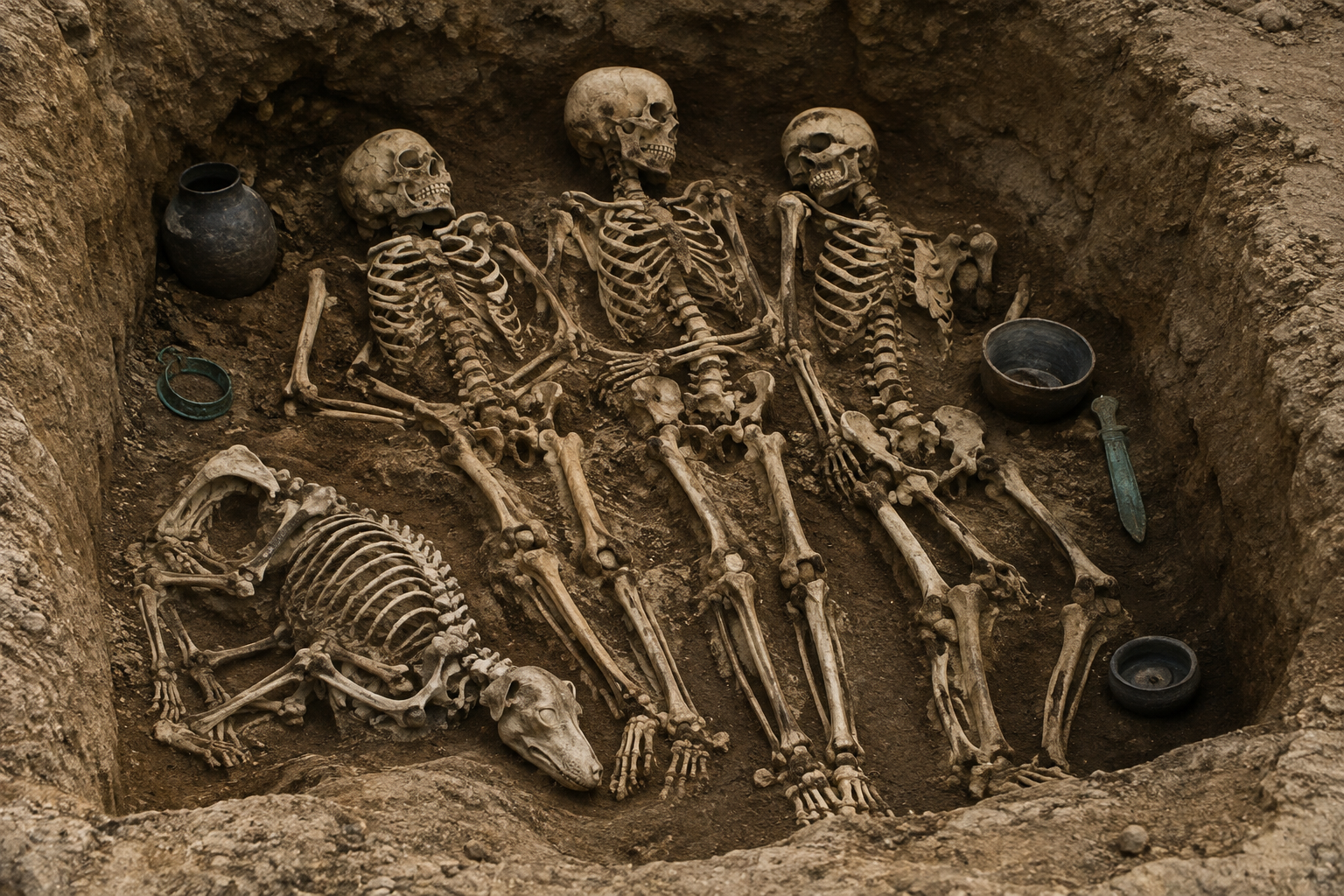
At Verona's Seminario Vescovile, archaeologists uncovered an Iron Age burial that is memorable not because it is grand, but because it is intimate. Around 300 BC, in territory associated with the Gallic Cenomani of northern Italy, a man was buried in a context that also included a dog. From that burial come the linked sample records 3227, 3227s, and 3227n, a small cluster that gives us a rare way into the paternal history of one Late Iron Age community and connects the Y-DNA line reported here, R1b1a1b1a2a1, to a very specific place and moment.
That specificity matters. Y-DNA traces one direct paternal line only, not a whole identity, tribe, or biography. But when a lineage turns up in an excavated Iron Age burial with a clear archaeological setting, it stops being an abstract string of letters and begins to belong to the human world of cemeteries, animals, rituals, and local history.
The Cenomani are known from classical sources as a Celtic-speaking people settled in the Po Valley, especially in the region around Brescia and Verona. By the 4th and 3rd centuries BC, this was a landscape of interaction: local Italic traditions, incoming La Tene cultural influences, and the political pressure of expanding Rome all met here. A burial from Verona, then, is not just "Celtic" in a vague sense. It belongs to a frontier zone where identities were shaped locally and continuously renegotiated.
The haplogroup label R1b1a1b1a2a1 sits within the broad R1b family, a major paternal lineage long associated in many ancient DNA studies with later prehistoric and Iron Age western Eurasia. Still, one must be careful: a broad family is not the same thing as a precise branch, and a precise branch is not a shortcut to language or ethnicity. In this case, what we can say securely is that a paternal line assigned to the article's branch is associated with an Iron Age burial in Verona dated to around 300 BC.
An ancient DNA study of these Verona remains, published in PLOS ONE, is especially useful because it places the genetic finding back into its archaeological setting rather than leaving it as a detached laboratory result.
The sample cluster itself is a reminder that ancient burials are often more complex than a single neat label suggests. The records 3227, 3227s, and 3227n are all tied to the same Verona Seminario Vescovile context, described as a Gallic Cenomani tribe dog co-burial and dated to around 300 BC. Without inventing distinctions that are not given, the safest reading is that these identifiers reflect multiple sampling designations from one burial context rather than three unrelated stories.
That may sound technical, but it matters historically. Ancient DNA results can sometimes seem more numerous than the archaeology really is, because one individual or grave can generate several laboratory identifiers. Here the real historical weight lies not in the count of records, but in the burial setting they share: an Iron Age man and a dog, buried together in the Veneto, at a time when northern Italy contained communities that were neither isolated nor culturally uniform.
The dog is significant even if we resist over-interpretation. Co-burials involving dogs appear in many ancient societies for different reasons: companionship, symbolism, status display, ritual practice, or funerary tradition. For this Verona burial, the supplied evidence supports the fact of the co-burial itself. It does not entitle us to invent a myth, a profession, or a personal bond. Yet even that restraint leaves us with something evocative: a paternal lineage preserved in a grave where human and animal were placed together with deliberate care.
For people researching haplogroup R1b1a1b1a2a1, the Verona burial is valuable because it places the branch in a recognizably Late Iron Age setting in northern Italy, among a population commonly described as Gallic Cenomani. That does not prove that every bearer of the branch today descends from Iron Age Cenomani, nor that the branch "belongs" to one ancient people. It does show that this paternal line was present in the social world of Celtic-speaking groups south of the Alps.
This is historically important because northern Italy in the centuries before Roman dominance was not a passive edge of the Mediterranean. It was a busy political and cultural corridor. Communities there dealt with Alpine routes, Etruscan neighbors, other Gallic groups in the Po basin, and increasingly with Roman expansion. A Y-line found here may reflect deeper Bronze and Iron Age processes in western and central Europe, but the burial anchors that lineage in one local society rather than in a sweeping generalization.
In other words, the value of sample 3227 is not that it lets us tell a giant story with false certainty. Its value is almost the opposite. It narrows the lens. It shows one paternal thread inside a cemetery, a city, and a historical landscape that we can actually name.
Modern readers often meet ancient Italy through Rome first and everything else second. But around 300 BC, Verona belonged to a patchwork world. The Cenomani occupied part of the eastern Po Valley; nearby lived Venetic communities, and farther west and south were other Celtic and Italic groups. Political loyalties shifted. Alliances could be practical rather than ethnic in any modern sense. Burial evidence is therefore precious, because it catches people where texts often flatten them.
The Verona man associated with haplogroup R1b1a1b1a2a1 stands in that pre-imperial world. He was not a literary type but an excavated individual. His burial reminds us that the spread of lineages happened through ordinary generations of fathers and sons living in local communities, not through the neat labels later historians prefer.
That is also why comparisons across Iron Age Europe need care. Similar Y-chromosome branches can turn up across regions that were culturally distinct, while nearby burials can differ in ancestry, mobility, or custom. The useful lesson is not that one haplogroup equals one people, but that paternal lines can help map the human texture of contact zones such as the Po Valley.
The dog co-burial deserves a moment of its own because it is the most distinctive archaeological detail attached to these samples. Dogs had many roles in ancient Europe: working animals, hunting companions, guardians, offerings, and creatures with symbolic weight in funerary practice. Their inclusion in graves could signal affection, ritual intention, or both. But the exact meaning always depends on context.
In this case, the context is enough to make the burial unusual and memorable, even when details remain spare. The presence of the dog tells us that this was not merely a body disposed of in the ground. It was a socially marked burial. The Y-DNA result, then, is attached not just to a date and a place, but to a deliberately structured funerary act inside an Iron Age community in northern Italy.
That combination of archaeology and genetics is where ancient DNA is at its best. The chromosome by itself cannot explain the burial. The burial by itself cannot reconstruct paternal descent. Together, they give us a sharper, more human picture.
The strongest insight from this evidence is modest but solid. Haplogroup R1b1a1b1a2a1 is represented here in an Iron Age burial from Verona associated with the Gallic Cenomani world, around 300 BC, in a grave notable for its human-and-dog co-burial context. For someone researching this paternal line today, that does not offer a ready-made tribal identity. It does, however, place the branch within the lived history of northern Italy before full Roman incorporation, in a region where Celtic-speaking groups were part of the historical landscape.
That is often the most valuable kind of ancient DNA finding: not a fantasy pedigree, but a real excavated ancestor-line somewhere on the map of the past.






Comments