Haplogroup R1b1a1b1a1a2g

– 5 min read


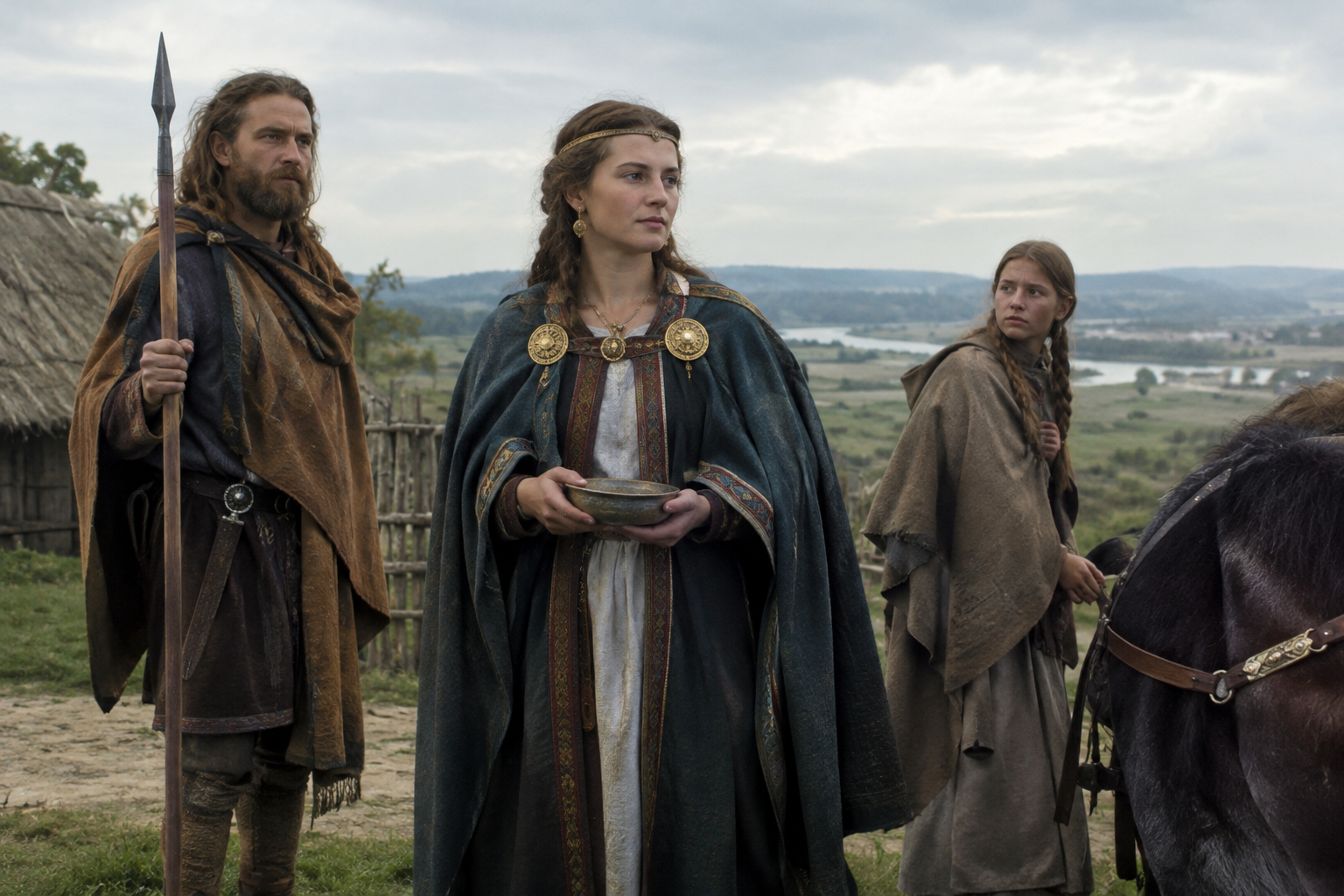
In early medieval Burgundy, at Vix in eastern France, one man dated to around AD 603 has become a very precise signpost in the history of a paternal line. He appears in the record as sample CGG023635, and he is the clearest ancient individual here associated with the Y-DNA haplogroup R1b1a1b1a1a2g.
That looks forbiddingly technical, but the historical point is simple enough. Y-DNA follows one direct paternal line - father to son to grandson - and so it captures only one narrow thread of a person's ancestry. Even so, a thread can matter. In a place like Burgundy, in the generations after Roman rule and during the formation of early medieval kingdoms, a single well-placed male lineage can help us think about continuity, movement, and the making of post-Roman societies.
Vix is a famous archaeological name because of its much earlier Iron Age past, but the individual relevant here belongs to a very different world: the early seventh century AD. By then Burgundy was no longer the land of Hallstatt princes and elite wagons. It sat within the political landscape of the post-Roman West, shaped by Gallo-Roman inheritance, Christian institutions, and the dynastic power of the Merovingian age.
That is what makes CGG023635 interesting. He is not a prehistoric founder or a legendary patriarch. He is instead a real man from a documented transition zone in European history, living at a moment when local communities in Gaul were being folded into new political and cultural arrangements. If his Y-line is indeed represented by R1b1a1b1a1a2g, then this branch was present in Burgundy by the early medieval period in a setting where Roman and so-called barbarian categories had long since begun to blur.
An ancient DNA study of this broad historical landscape has helped show just how mixed and regionally varied such communities could be, rather than fitting tidy textbook labels. Research on these centuries, including work published in Nature, is part of the reason individual burials like this now matter so much: they let us anchor paternal lines to real places and dates instead of treating them as abstract maps.
Germanic languages and genomes
The first thing to say about R1b1a1b1a1a2g is that it is a specific sub-branch, not a stand-in for all R1b. That distinction matters. The wider R1b family is enormous and widespread across western Eurasia, with deep prehistoric roots and many different later histories. A narrow branch like this one cannot simply inherit every grand claim ever made about R1b as a whole.
So the safe reading is modest but useful. This branch, or a lineage placed within it, appears in early medieval Burgundy through sample CGG023635. That tells us the line existed in western Europe by around AD 603 and was part of a population living in a region central to the remaking of post-Roman Gaul. It does not, by itself, prove whether this paternal line arrived with Iron Age populations, with Roman-era mobility, with late antique military movement, or through early medieval family continuity. For that, we would need more ancient occurrences across time.
Still, even one securely placed individual can be historically valuable. Ancient Y-DNA works best when it stops us from speaking too vaguely. Instead of saying that a branch was "somewhere in Europe at some point," we can say that one attested carrier was in Burgundy in the early seventh century.
If one were forced to choose a region where such a finding would be especially revealing, Burgundy would be a good candidate. This was a zone where older provincial Roman life, local Gallic traditions, Christian institutions, and incoming or newly dominant power structures all met. By the sixth and seventh centuries, identities in Gaul were not simple ethnic boxes. People could live within Merovingian political frameworks while carrying ancestry shaped by much older regional histories.
That is why a paternal lineage here should not be overtranslated into language or ethnicity. A Y-chromosome branch cannot tell us whether a man thought of himself as Burgundian, Frankish, Gallo-Roman, or something more local still. What it can do is place a paternal line inside that historical world. In other words, R1b1a1b1a1a2g was not merely a modern testing result waiting to be discovered; it was already part of the lived population of early medieval eastern France.
This fits a broader pattern seen across post-Roman Europe, where archaeology and genomics increasingly show blending rather than clean replacement. Communities often contained people whose ancestors had arrived through different episodes of migration and local persistence. The old Roman frontier world did not vanish overnight; it was repopulated, repurposed, and reimagined.
Readers sometimes expect ancient DNA to produce a parade of identical matches across many graves. Real evidence is often less tidy. Here, the record is sparse, but that does not make it meaningless. Quite the opposite: when a rare or narrow branch appears in an ancient individual with a date and a place, it gives genealogical research a fixed point.
Sample CGG023635 is important precisely because he is not floating in legend. He belongs to a datable early medieval setting in France. For someone exploring this haplogroup today, that means the branch has at least one confirmed or reported archaeological foothold in a region that sat at the crossroads of late antique and medieval western Europe.
It also sharpens how we think about paternal persistence. One ancient carrier does not found a people, but he does show that a direct male line could pass through the centuries amid major political change. Empires fell, kingdoms shifted, speech communities evolved, and burial customs changed; yet the paternal line continued, generation by generation, quietly enough that only genetics now spots it.
The temptation with an early medieval French sample is to make him symbolize an entire historical people. But Burgundy in around AD 603 was not ethnically neat, and neither are haplogroups. The better comparison is with other genomic studies of the period that show local populations could include varied ancestries while sharing a common burial landscape and political order.
That is one reason related work from western Europe has been so illuminating. Studies of Roman and early medieval populations in places such as Iberia and Britain have repeatedly shown that the centuries around the end of Roman rule were full of demographic complexity. Some regions preserve strong local continuity; others show more visible incoming ancestry; most show a bit of both.
Seen in that light, R1b1a1b1a1a2g at Vix is less a badge of one "tribe" than a marker of participation in that larger western European story. A paternal line present in Burgundy at the start of the seventh century may have older roots nearby, or it may reflect movement within the post-Roman world. At present, the evidence is best used as a carefully dated presence, not a sweeping migration slogan.
The most distinctive thing we can responsibly say about R1b1a1b1a1a2g from the present evidence is that this paternal branch is already visible in early medieval Burgundy through CGG023635 at Vix, around AD 603. That places the lineage in a historically rich setting: post-Roman Gaul, where older local populations and new political identities were being woven together. If this is your paternal haplogroup, the ancient clue is not a promise of royal descent or a single ethnic label; it is something better grounded than that - a real human point on the map, in a real cemetery, in a century when Europe was being remade.






Comments