Haplogroup R1b1a1b1a1a2e1c

– 6 min read


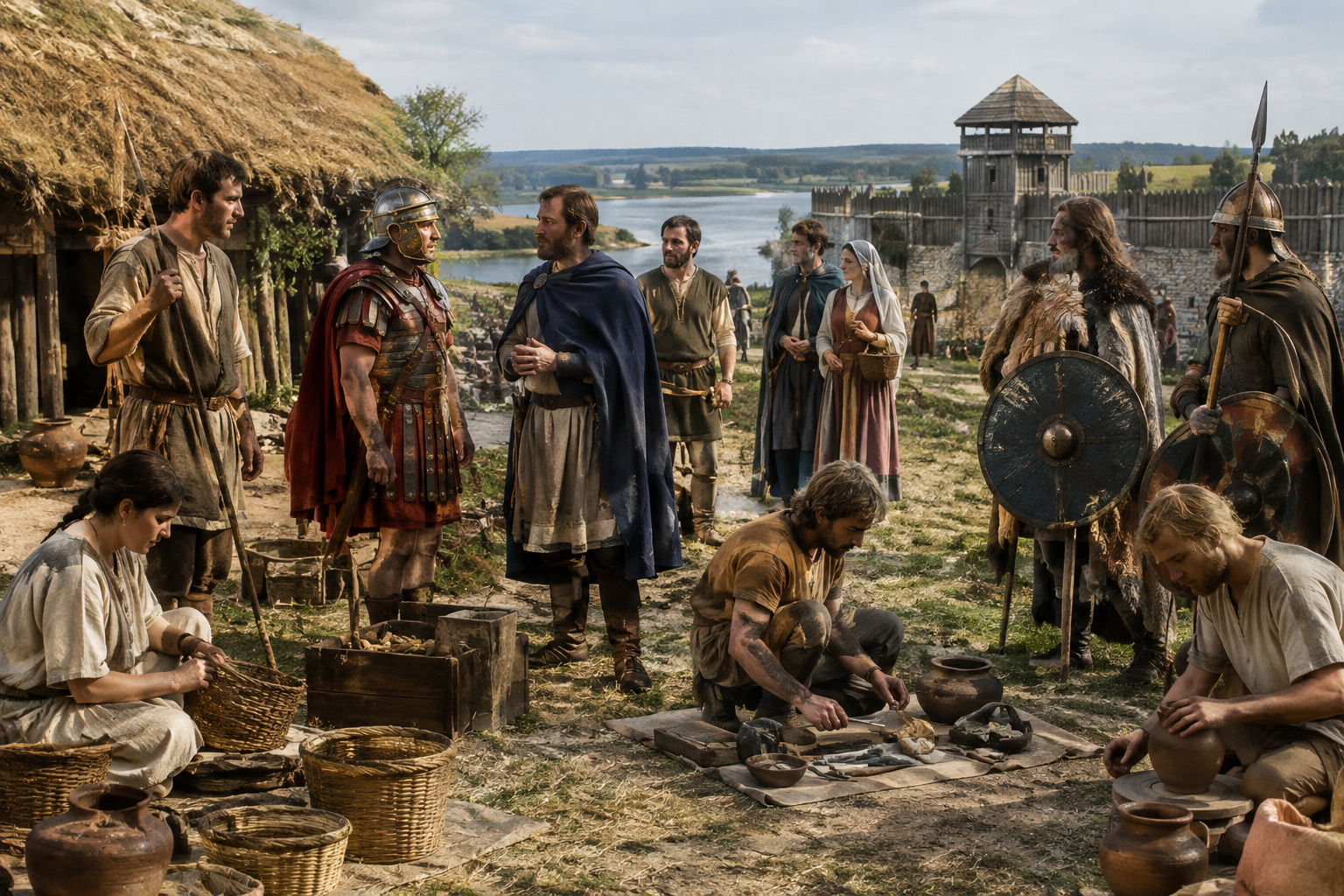
Some Y-chromosome lineages are easy to place in the public imagination. Others are more elusive, appearing not as the badge of one famous people, but as a recurring paternal thread across very different places and centuries. Haplogroup R1b1a1b1a1a2e1c belongs to that second category. It sits within the wider R1b family, one of the major Y-DNA groupings in western Eurasia, yet this very specific subclade should not be treated as if it simply carries the whole history of R1b on its back.
That is exactly what makes it interesting. A Y-DNA haplogroup traces one direct paternal line only: father to father to father. It does not describe all of a person's ancestry, culture, language, or identity. But when a lineage turns up in ancient burials from the Bronze Age Netherlands, Iron Age Bohemia, Roman Britain, the Lower Rhine frontier, Visigothic Spain, and Viking Age Sweden, it gives us a wonderfully awkward historical problem. Not "who were these people really?" in some grand essential sense, but how one paternal line could move through so many different worlds.
The long label R1b1a1b1a1a2e1c marks a narrow twig on a much larger Y-chromosome tree. Broadly speaking, R1b has deep importance in the paternal history of much of western Europe, but caution matters here: the history of a broad parent clade is not automatically the history of every tiny downstream branch. For a specific lineage like this one, the safest approach is to work from the evidence we actually have - above all, the ancient DNA finds.
What those finds suggest is a paternal line with a strong western and central European footprint across time, especially in regions tied to the North Sea, the Rhine frontier, and later the Roman and post-Roman worlds. That pattern fits well with what archaeology has been revealing for years: prehistoric Europe was not static, Roman frontiers were full of mobile men, and early medieval societies inherited populations already mixed by centuries of movement.
Explore How Ancient DNA Changed History
The earliest supplied sample is I26830, from Bronze Age Wervershoof-Zwaagdijk Netherlands, dated to 1450 BC. Even one burial cannot stand for an entire population, of course, but it places this paternal thread in the low countries surprisingly early. That matters, because the coastal North Sea zone would remain one of the most historically dynamic regions in Europe: a place of farmers, traders, warriors, river traffic, and later imperial frontiers.
By the Iron Age, the line appears farther inland in I17607, from Iron Age Louny Stradonice Czech Bohemia, dated to 675 BC. Stradonice is the sort of site that reminds us how interconnected Iron Age Europe could be. Bohemia was no backwater. It sat in the middle of exchange networks linking central Europe to the Danube, the Alpine world, and beyond. A lineage found in both the Bronze Age Netherlands and Iron Age Bohemia does not prove a single neat migration route, but it does point to a paternal presence across a broad swathe of temperate Europe long before the Roman Empire arrived to write things down.
So already, before Romans, Goths, or Vikings, we are looking at a lineage that belongs in the story of prehistoric western and central Europe. Not in the crude sense of "this was the people of X," but in the more interesting sense that one paternal branch could persist through major cultural changes.
Explore the Lower Rhine in Deep Prehistory
If the prehistoric evidence gives us the background, the Roman period gives us the drama. Several of the supplied ancient samples belong to the world of forts, auxiliaries, frontier settlements, and provincial mobility. Here the haplogroup's story becomes vividly historical.
Take CGG107761 from Batavi Germanic Tribe Netherlands Valkenburg Marktveld, dated to 175 AD, and CGG107763 from the same Batavian setting, dated to 254 AD. The Batavi are familiar from Roman history as a people of the Lower Rhine deeply entangled with imperial service. They are a perfect example of why paternal lineages do not map neatly onto modern national labels. Batavian men might serve Rome, rebel against it, marry locally, move along military roads, or settle far from their ancestral district.
The sample R10657, from a Chauci Auxilliary Klosterneuburg Fortress Lower Austria and dated to 126 AD, pushes this point still further. A Chauci auxiliary in Lower Austria is, in miniature, the Roman Empire itself: recruitment from the North Sea zone, redeployment to the Danube, and a life spent in a military landscape far from home. In other words, when we find a paternal lineage in both the low countries and a frontier fortress in Austria, we need not imagine mysterious prehistoric wandering. The Roman army was perfectly capable of moving lineages around the map in historically documented ways.
Another useful piece is FEN012, from Roman Era Fenstanton Cambridgeshire, dated to 100 AD. Roman Britain was not merely Britons under occupation. It was a province tied into continental networks of soldiers, merchants, craftsmen, and families. A paternal line turning up in Cambridgeshire and on the Rhine frontier is exactly the sort of thing Roman archaeology has trained us to expect.
And then there is RKF263 from Late Roman Hungary Rakoczifalva Szolnok, dated to 250 AD. The later Roman world, especially in the Danubian regions, was one of intense military pressure and population movement. A lineage found here joins the same pattern: western and central European paternal lines circulating through imperial structures, local communities, and frontier society.
Discover DNA on the Roman Rhine Frontier
The post-Roman evidence is just as suggestive. I20271, from Early Visigothic Spain Girona Sarria de Ter Pla de lHorta, dated to 475 AD, places this paternal line in a world of collapsing Roman authority and new political formations in Iberia. That does not mean the lineage was "Visigothic" in some pure ethnic sense. It means that by the late 5th century, this Y-DNA branch was present in the mixed societies that emerged from Roman and migration-period upheaval in northeastern Spain.
This matters because early medieval Iberia was a crossroads of local continuity and incoming groups. A haplogroup appearing there, after earlier appearances in the Roman north and center of Europe, fits a broad historical picture in which military elites, migrant war-bands, provincial communities, and older local populations all became entangled.
Much later, VK333 from Viking Age Oland Island Sweden, dated to 885 AD, shows that the same paternal branch - or at least this very specific haplogroup assignment in the supplied material - was still part of Europe's living population nearly two millennia after the Bronze Age Dutch sample. That is the real fascination of Y-DNA. Cultures change their languages, rulers, religions, and fashions. A paternal line can quietly continue through all of it.
Readers interested in the Iberian side of this story may also want to look at Roman Hispania's Lasting Genetic Legacy, which helps frame how Roman and later populations overlapped in Spain.
Read About Multi-Ethnic Gothic Communities
The supplied noble connection brings us to medieval Normandy and the House of Mandy, associated here with Fecamp Abbey. It is an inspired pairing, because Fecamp was never just a monastery. It was one of the great Benedictine houses of medieval France, a place where piety, ducal propaganda, pilgrimage, and architecture all met.
Its origins were said to reach back to the 7th century, but its real medieval prominence came when the dukes of Normandy rebuilt and richly endowed it in the 10th and 11th centuries. That made Fecamp a religious showpiece closely tied to Norman rulers. The cult of the Precious Blood brought prestige and pilgrims; the buildings themselves, reshaped across Romanesque and Gothic phases, embodied centuries of patronage, ambition, fire, war, reform, and survival.
Now, it would be irresponsible to claim that a noble family linked with Fecamp Abbey is genetically proven to descend from any of the ancient men above. We cannot say that. Nor should we assume that every man in a medieval house shared one single verified haplogroup. But geographically and historically, the connection is still valuable. Normandy sits on the edge of the same broader northwestern European world in which this lineage appears repeatedly: the North Sea sphere, the Roman frontier zone, and the later Scandinavian-Norman orbit.
In that sense, Fecamp Abbey is not genetic proof of anything. It is a memorial in stone to the later medieval societies built in regions where such paternal lines had circulated for centuries. The abbey's survival after Revolution, ruin, and reform gives us a useful historical lesson too: institutions endure unevenly, records are patchy, and genetics can sometimes illuminate stretches of the past that charters and chronicles leave obscure.
R1b1a1b1a1a2e1c is historically interesting not because it unlocks a single lost nation, but because it shows continuity through change. From I26830 in the Bronze Age Netherlands to VK333 in Viking Age Sweden, with Roman and post-Roman appearances in Britain, the Rhine frontier, Austria, Hungary, and Spain, the lineage sketches a broad northern and western European field of movement.
That does not prove direct descent between any ancient sample and any later family. It does not prove noble ancestry. It does not assign a fixed ethnicity. What it does offer is something subtler and, frankly, more illuminating: a way of seeing how one paternal line could pass through prehistoric communities, Roman military systems, migration-period societies, and medieval regions later remembered through houses, abbeys, and lordship.
If this lineage appears in your Y-DNA results, MyTrueAncestry may help you place that paternal branch beside real ancient individuals like FEN012, I20271, RKF263, CGG107761, CGG107763, R10657, I17607, I26830, and VK333. Such matches do not prove that you descend directly from those men, or that you belong to a particular noble house. But they can give your ancestry a deeper historical setting - one that stretches from Bronze Age shores to Roman frontiers and medieval Normandy.
Upload your DNA to MyTrueAncestry and see what ancient connections emerge from your own results.






Comments