Haplogroup R1b1a1b1a1a2c1b1

– 4 min read


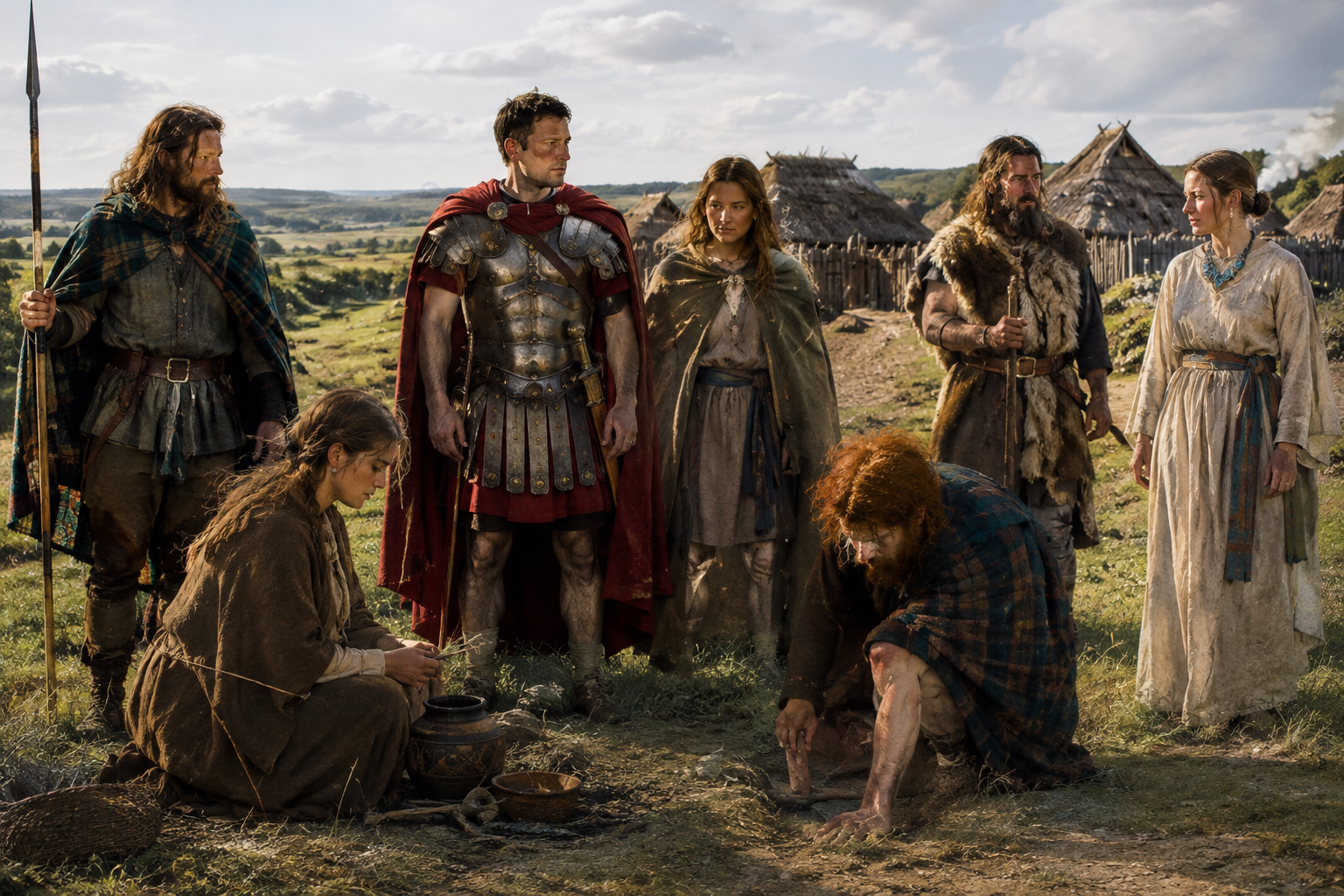
At Wetwang Slack in East Yorkshire, several Iron Age burials linked to the Parisi have now also become part of a genetic story. Among them are individuals I36875, I36809, and I36904, dated to around 225 BC. They matter because they place the Y-DNA haplogroup R1b1a1b1a1a2c1b1 in a very specific archaeological landscape: Iron Age eastern Yorkshire, in a community already famous for its burials, chariot traditions, and long-running debates about connections across the North Sea and the Channel.
That immediately gives this lineage a useful historical anchor. Rather than floating vaguely in "ancient Europe", this branch appears here in Britain across several moments, from the Bronze Age into the Iron Age and then into Roman-era Cambridgeshire. Y-DNA traces one direct paternal line only, not a person's whole ancestry, but when the same branch turns up repeatedly in related regions and successive periods, it begins to sketch a durable male-line presence rather than an isolated curiosity.
The strongest cluster in this dataset comes from Wetwang Slack. Three individuals, I36875, I36809, and I36904, all date to around 225 BC and are associated with the Iron Age Parisi of East Yorkshire. That is already significant. Wetwang Slack is not just any cemetery site; it belongs to one of the best-known burial landscapes in Iron Age Britain, and so a repeated paternal signal here deserves attention.
What makes this especially interesting is not that one man carried this lineage, but that several did. That does not automatically mean they were all close relatives, nor does it prove a ruling dynasty. But it does suggest that the branch was established in this regional population. In other words, R1b1a1b1a1a2c1b1 was not merely passing through eastern Yorkshire in the late Iron Age.
A wider ancient DNA study of Britain and nearby regions has helped sharpen the broader context for Iron Age population structure and continuity, including how local communities could preserve strong regional signatures while still participating in wider movements of people and culture. For that background, see this ancient DNA research.
The Yorkshire pattern does not stop at Wetwang Slack. Sample I14107, a Celtic Briton from Pocklington, also dated to around 225 BC, adds a second East Yorkshire setting for the same haplogroup. Pocklington has become one of the most discussed Iron Age landscapes in Britain in recent years, precisely because it offers unusually vivid archaeological evidence for local elites, burial customs, and regional identity.
Here the value of the haplogroup evidence is cumulative. One cemetery can always be unusual. Two nearby Iron Age contexts pointing in the same direction are harder to dismiss as chance. Taken together, Wetwang Slack and Pocklington suggest that this paternal branch belonged to the fabric of later prehistoric communities in eastern Yorkshire.
That does not tell us what language these men spoke in any simple genetic sense, nor does it collapse archaeology into biology. But it does fit a picture in which some paternal lines persisted locally across generations while material culture and political identities evolved around them.
Celtic Origins and Ancient DNA
The older samples in this set push the story back well before the Parisi. Sample I13714 from East Kent, dated to around 1417 BC, and sample I2448 from Yarnton in Oxfordshire, dated to around 1200 BC, show that the branch was present in Bronze Age southern England too. That matters because it widens the chronology considerably. We are no longer looking only at an Iron Age Yorkshire phenomenon, but at a paternal line with a footprint in Britain centuries earlier.
The Bronze Age in Britain was a time of major social and cultural change, but also of local continuities that archaeology sometimes obscures if we focus only on spectacular shifts in burial rite or artifact style. A lineage appearing in Kent, Oxfordshire, and later Yorkshire is not proof of one uninterrupted family tree connecting all these men. Still, it does suggest that the deeper ancestry of this branch in Britain may reach into the later Bronze Age, not just the Iron Age.
That is an important distinction for anyone researching this haplogroup today. The ancient evidence here points less toward one dramatic migration episode and more toward a branch that was already embedded in prehistoric Britain by the second millennium BC.
The latest sample in the group is DUX019 from Roman-era Duxford in Cambridgeshire, dated to around AD 112. That is a striking chronological jump. By the early second century AD, Britain was part of the Roman Empire, with roads, forts, towns, taxation, military movement, and new opportunities for mobility. Yet one paternal line seen in earlier British contexts still appears in this altered landscape.
Now, one must be careful here. A Roman-era burial in Britain does not by itself identify a person as "native", "Roman", or anything else quite so tidy. Roman Britain was full of local people living under imperial rule, migrants from elsewhere in the empire, soldiers, traders, and families of mixed backgrounds. But the appearance of this branch in Cambridgeshire shows that the haplogroup remained part of the population history of Britain into the Roman period.
Recent research on Roman and early medieval Britain has explored exactly this tension between continuity and change: new people arrived, but not every older lineage vanished or was replaced. For readers interested in that larger setting, see this study of genomic history in Roman and early medieval Britain.
Roman and Early Medieval Britain
With this particular dataset, the most defensible description of R1b1a1b1a1a2c1b1 is not that it belonged to one tribe, one kingdom, or one famous dynasty. It is that it appears in multiple ancient male individuals from Britain across a long arc of time: Bronze Age southern England, Iron Age East Yorkshire, and Roman-era Cambridgeshire.
That pattern is, in its way, more interesting than a glamorous but flimsy royal claim. It suggests endurance. The branch seems to belong to the long-settled paternal landscape of Britain, especially when the Yorkshire cluster is set beside the earlier southern finds. Archaeology often reminds us that communities change their politics, burial customs, and outward identities faster than they replace every family line.
For someone carrying R1b1a1b1a1a2c1b1 today, these ancient samples offer a solid and rather attractive picture: this paternal branch is documented in Britain from at least the later Bronze Age, appears repeatedly in Iron Age Yorkshire, and is still visible in Roman Britain. That does not make every modern bearer "Parisi" or "Romano-British". It does, however, place the lineage within a long and well-attested British archaeological story, one rooted not in legend but in excavated people from real places such as Wetwang Slack, Pocklington, Yarnton, East Kent, and Duxford.






Comments