Haplogroup R1b1a1b1a1a2c1a1m

– 5 min read


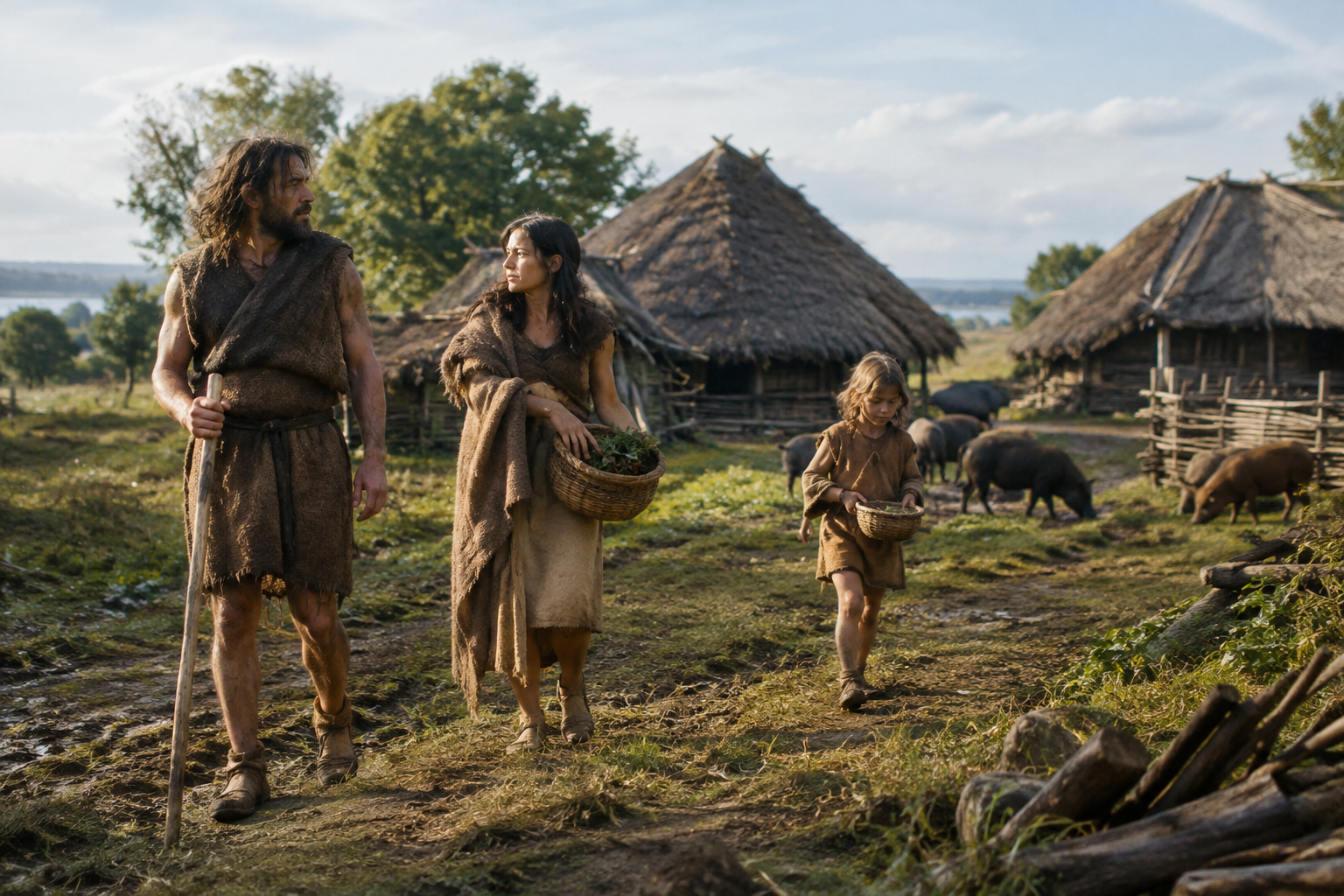
At around 2030 BC, in Bronze Age Oxfordshire, one man now known simply as I2445 left behind more than a skeleton. His remains have become one of those deceptively modest finds that matter greatly to genetic history, because they place the Y-DNA haplogroup R1b1a1b1a1a2c1a1m in southern Britain during the Early Bronze Age. That is not a king in a chronicle or a hero in a saga. It is something better for the archaeologist: a real person, from a real landscape, fixed to a real time.
The setting matters. Oxfordshire in the early 2nd millennium BC was part of a Britain already transformed by the Beaker phenomenon and by the arrival and spread of new paternal lineages linked to wider movements across northwestern Europe. Y-DNA follows one direct male line only, not a person's whole ancestry, but it can still be extraordinarily revealing when it turns up in securely dated ancient burials. In I2445, we have a glimpse of one such paternal thread inside the making of Bronze Age England.
I2445 belongs to a period when Britain was changing quickly. By about 2400-2000 BC, older Neolithic patterns had been disrupted by major demographic shifts, with ancestry connected to continental Europe becoming dominant in many regions. One of the clearest genetic signatures of that transformation was the strong presence of branches within the wider R1b paternal family.
A major ancient DNA study of prehistoric Britain, published in Nature, helped establish just how dramatic that shift was. The broad picture is now familiar: after the arrival of Beaker-associated groups, male lineages in Britain changed markedly. What makes I2445 useful is that he gives this large continental story a local English face. He was not an abstraction called "migration." He was a man living in Oxfordshire generations after that upheaval, carrying one of the paternal lines that had become part of Britain's Bronze Age population.
That is especially important for a very specific haplogroup label like R1b1a1b1a1a2c1a1m. Such a long-form designation points to a narrow twig on a much larger paternal tree. We should be careful here: the bigger history of R1b cannot automatically be copied onto every tiny sub-branch. But the presence of this lineage in Early Bronze Age England does show that one branch of that expansive paternal family had already become established in Britain by roughly 2030 BC.
There is a temptation with any ancient Y-DNA result to turn one individual into an entire people. That would be a mistake. I2445 does not stand for all Bronze Age Britons, all Oxfordshire communities, or all men carrying related R1b branches. He is a single excavated data point. But in archaeology, single data points matter when they are well dated and historically situated.
What I2445 tells us securely is that this paternal line was present in Bronze Age southern England. What it suggests, more cautiously, is continuity within the new male-line landscape that took shape in Britain after the Beaker horizon. By the time this man lived, those once-new lineages were no longer newcomers. They were simply part of the population.
That matters for modern testers because many people imagine deep ancestry as a sequence of famous tribes and named kingdoms. In reality, the crucial changes often happened much earlier, before written history, through repeated acts of settlement, marriage, inheritance, and local survival. A Y-chromosome branch can persist through all that without leaving a single named dynasty behind it.
The deeper historical interest of R1b1a1b1a1a2c1a1m lies in timing. Early Bronze Age England was not the moment of first human settlement, nor the first farming revolution, nor the age of Rome. It was a period when earlier migrations had already been absorbed into lived community life. Cemeteries, barrows, settlements, and field systems speak to societies that were no longer improvising their existence. They were established, local, and structured.
That is why a sample like I2445 is so useful. He sits after the great demographic break but before later historical overlays. In other words, he belongs to a phase when the paternal transformation of Britain had already happened, yet the island was still wholly prehistoric. For anyone carrying a related lineage today, that makes the connection particularly evocative: not to a later badge of identity like "Anglo-Saxon" or "Norman," but to the much older remaking of Britain in the 3rd and early 2nd millennia BC.
North Sea Migrations to Britain
Archaeology also reminds us that southern England was never isolated. Oxfordshire sat within a connected world of river routes, exchange networks, and regional traditions. Objects, ideas, and probably people moved across Britain and across the Channel. A paternal lineage found there in 2030 BC belongs to that larger web, even if we cannot reconstruct one neat migration path for one man or one family.
Oxfordshire is not merely a dot on a genetic distribution map. It is part of a rich archaeological zone in central-southern England, tied into the Thames corridor and into the monument-dense landscapes of later prehistory. Finds from this broad region help scholars compare local persistence with larger population change. The value of I2445 is therefore geographical as well as chronological: he anchors this branch in a part of Britain central to understanding how continental-derived ancestry became normal in everyday life.
That broader process has been explored from several angles in MyTrueAncestry's coverage of Britain, including work on population change, kinship, and adaptation across later periods. Those later studies do not prove anything specific about I2445 himself, but they help place Early Bronze Age male-line evidence into the longer story of how British populations kept changing without ever becoming genetically simple.
Bronze Age Tomb Reuse in Britain
There is also a useful contrast here with historical periods. In early medieval and medieval Britain, we often have texts, place-names, and sometimes family histories to set beside the DNA. For a man like I2445, we have none of that. Yet his evidence is in some ways cleaner. He is not wrapped in later legend. He belongs to that stern prehistoric world where we must build carefully from date, place, and genome.
People researching a haplogroup this specific often arrive with a surname puzzle in mind. That is understandable, but ancient DNA tends to lengthen the timescale dramatically. R1b1a1b1a1a2c1a1m, as represented here by I2445, points not first to medieval genealogy but to the population history of Bronze Age Britain. It is a reminder that the roots of many later family lines may lie in prehistoric population changes far older than heraldry or parish registers.
That does not mean every modern man with a nearby branch descends in any direct, documentable sense from this Oxfordshire individual. It does mean that the paternal world to which I2445 belonged forms part of the deep background from which many later British and northwestern European lineages emerged. If your own results sit close to this branch, the strongest historical image is not a castle or a coat of arms, but a man living in Bronze Age England after one of the great demographic turning points in the island's past.
Roman and Early Medieval Britain
The most distinctive thing we can say about R1b1a1b1a1a2c1a1m from the evidence here is simple and important: it was present in southern England by the Early Bronze Age, represented by the Oxfordshire individual I2445 around 2030 BC. That places this paternal branch inside the long aftermath of the Beaker-era transformation of Britain. For a modern tester, that is a substantial clue. Your direct male line may reach back, not merely to the historical peoples of Britain, but to the prehistoric generations who helped create Bronze Age England itself.
Comments